

Country Guides
Argentina

Start here
Overview
Explore sections
Guide Details
Household Goods
Documents
Documents required for importing used household goods, personal effects, and related shipments.
- Complete copies of passport including blank pages, certified by public notary and legalised by the Argentine Public Notaries Association
- Complete copies of Argentine ID (DNI), certified by public notary and legalised by Argentine Public Notaries Association
- Argentine ID (DNI) updated with current address in Argentina
- Certificate of Migratory Movements (must show entries and departures for the previous 24 months; obtainable at https://www.migraciones.gov.ar/transitos/ — TLS certificate issue as of June 2026, verify in browser)
- Clave Unica de Identificacion Laboral (CUIL) certificate / Argentine Tax ID
- Residence Certificate issued by the Argentine Consulate at origin, certified in Argentina by the Ministry of Foreign Affairs (MFA)
- Bill of lading (OBL) / air waybill (AWB) / CRT
- Typed packing list in Spanish (handwritten lists are not accepted; must be a detailed inventory)
- Letter authorising the moving company to perform import clearance on the shipper's behalf, with signature certified by public notary and legalised (the moving company can provide the form locally)
- Import permit for artwork, if applicable (declaration of all pieces in a special form with photographs, filed online at the Secretaria de Cultura prior to customs clearance)
- All of the above, plus:
- Copy of Visa or Residencia Precaria (temporary visa) if DNI is unavailable
- Insurance bond (Poliza de Caucion) issued by a local insurance company
- Diplomatic franchise from the Argentine Ministry of Foreign Affairs
- Full copy of passport
- Bill of lading (OBL) / AWB / CRT
- Typed packing list in Spanish
- Letter authorising the moving company (with certified/legalised signature)
- Import permit for artwork, if applicable
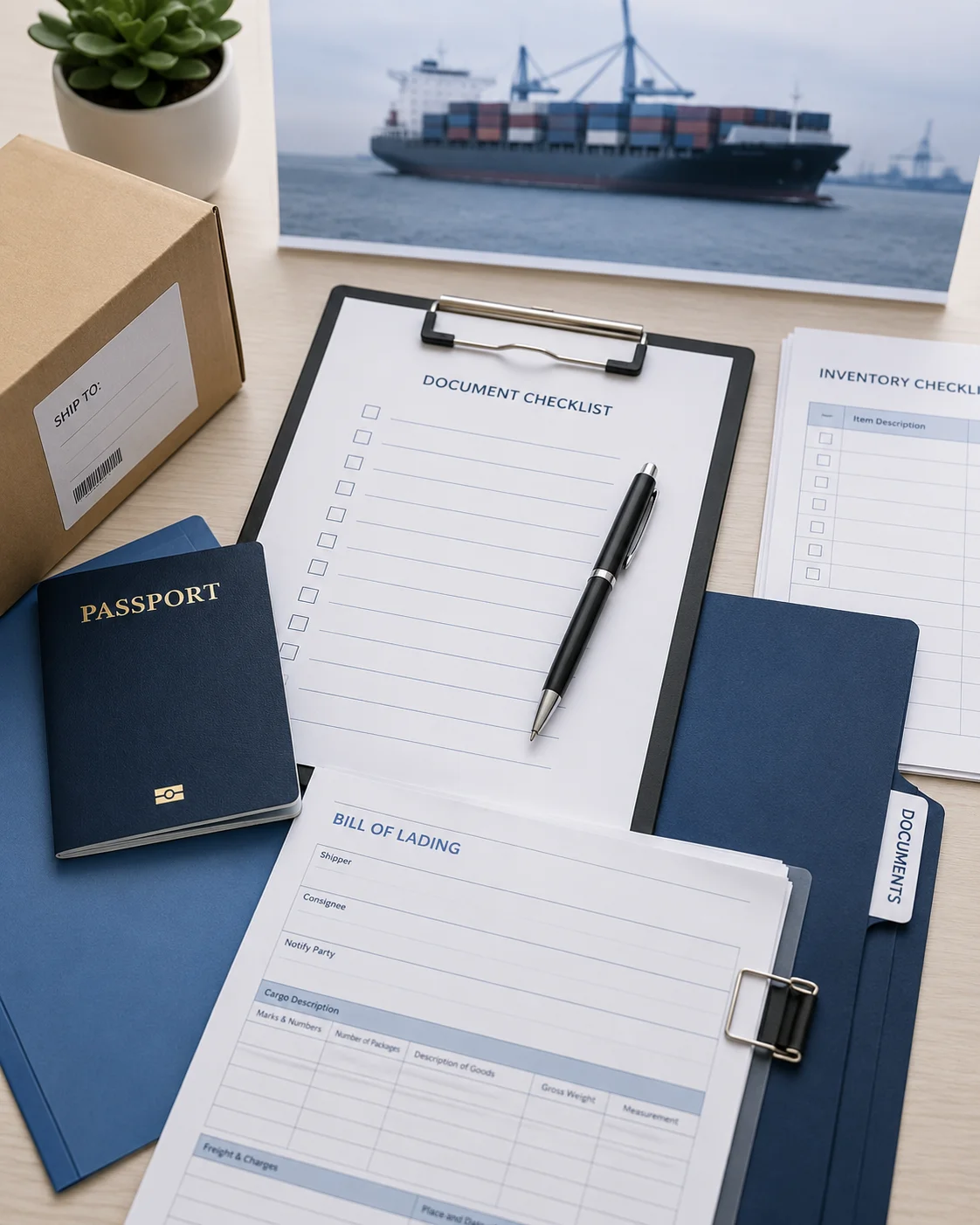
Specific Information
Passport declaration requirement: Owners must declare to customs officers upon entry that a shipment is expected. A stamp ("Manifiesta Esperar Equipaje No Acompanado") must be placed in the passport. Diplomats are excluded from this requirement.
Origin of move: The origin of the move must be the last place of residence of the owner. If the passport was issued within the last 12 months, the previous passport must also be presented. For multiple citizenships, all passports must be presented.
Shipment arrival deadline: Shipments must arrive within 6 months of the owner's stamped date of entry into Argentina.
Owner presence: The shipper should be in Argentina at the time of shipment arrival. Customs may require the owner to be present for physical inspection.
Document submission deadline: Documents must be received by the agent at least 7 days or 48 hours prior to the arrival of the shipment. Use the more conservative 7-day lead time.
Tourist visas: Shipments of foreigners holding a tourist visa cannot be imported.
Temporary visa holders — bond/guarantee system: Foreigners with a temporary resident visa must import under temporary admission. The items must be bonded (guaranteed) for the duration of the visa. The bond must be renewed before the expiration date. The goods are guaranteed by a local insurance company through a Poliza de Caucion (insurance bond). If the visa is not renewed by the guarantee's expiration, the goods must be re-exported. If a permanent residence visa is later obtained, the goods are "nationalised" and the guarantee is cancelled without paying taxes or duties. The bond system applies for all moves arriving by sea, land, or air.
Physical inspection: All shipments are subject to physical inspection (diplomats may be inspected only under special customs requirement). Since mid-2016, mandatory anti-narcotics dog team inspections apply to all import and export shipments. Clearance depends on the availability of these dog brigades.
Physical inspection handling charges (non-diplomatic):
- LCL: USD 600
- 20ft container: USD 800
- 40ft container: USD 1,000
- 40HC container: USD 1,200
Translation requirements: All documents not written in Spanish must be translated by an official translator and certified by the Colegio Argentino de Traductores. All documents must be certified and legalised by the Argentine Ministry of Foreign Affairs.
Artwork: Requires an import permit. A declaration of all pieces in a special form must be filed, with photographs submitted online to the Secretaria de Cultura prior to customs clearance.
Duties & Taxes
Duty-free conditions — lived abroad more than 1 year: If the owner has lived abroad for more than 12 months and has not re-entered Argentina for more than 60 cumulative days during the 12 months prior to re-entry, the shipment can be imported duty-free. One duty-free shipment is allowed every 3 years (for Argentine citizens and foreigners with a permanent visa).
Duty-free conditions — lived abroad more than 2 years: If the owner has lived abroad for more than 2 years, the shipment can be imported duty-free. Customs will not count how many days the owner accumulated in Argentina during the 12 months prior to re-entry. One duty-free shipment is allowed every 7 years (for Argentine citizens and foreigners with a permanent visa).
Prohibited & Restricted Items
Prohibited Items
- Items compromising public, animal, and agricultural health — Prohibited
- Organic products (soil, firewood, wood, animal parts, dried insects) — Prohibited
- Narcotics and illegal drugs — Strictly prohibited
- Pornographic material — Prohibited
- Dangerous, toxic, or flammable items — Prohibited
- Stolen or smuggled items — Prohibited
- Currency (actual or counterfeit) — Prohibited in shipments
- Food — Prohibited in household goods shipments
- Alcoholic beverages — Prohibited beyond the allowed limits (see Restricted Items)
- Spare parts or parts of any vehicle — Prohibited in household goods
- Items with internal combustion or outboard engines — Prohibited in household goods
- Hoverboards — Prohibited
- Items not considered part of a move by Argentine Customs — Prohibited
- Meat or meat products — Prohibited
- Milk and dairy products — Prohibited
- Fresh fruit and vegetables — Prohibited
- Trees, plants, and plant products — Prohibited
- New computers — Prohibited (per VisaHQ; confirm with agent)
- New colour TVs — Prohibited (per VisaHQ; confirm with agent)
- Counterfeit goods — Prohibited
Restricted / Dutiable Items
Duty-Free Traveller Allowances
From neighbouring countries (Brazil, Uruguay, Paraguay, Chile, Bolivia):
- 1 litre of alcoholic beverages
- 200 cigarettes and 25 cigars
- 2kg of food products
From all other countries:
- 2 litres of alcoholic beverages
- 400 cigarettes and 50 cigars
- 5kg of food
Restricted Items
- Alcoholic beverages within shipments: Up to 30 litres of wine plus up to 30 litres of any other alcohol may be included. Sealed bottles are subject to duty payment. For foreign diplomats, alcohol is allowed up to the annual limit imposed by the MFA and the Embassy's own limit.
- Archaeological or palaeontological patrimony (fossils, human remains, geological collections and sediment) — Once admitted, export is not permitted
- Works of art and monuments of recent antiquity `PERMIT REQUIRED` — Authorisation required; import permit and photographs must be filed with the Secretaria de Cultura
- Original paintings and works of art — Specialised form required; check with agent
- Wood and wood items — Must be treated specifically for pests (ISPM 15 or equivalent)
- Weapons `PERMIT REQUIRED` — Must be declared and authorised by the Registro Nacional de Armas (RENAR)
- Items considered commercial — Determined by quantity, quality, or type; subject to duties
- Hoverboards — Prohibited in shipments
Trade Regime Changes (Milei Administration)
As of April 2025, Argentina has fully eliminated its import licensing system (SEDI). The former SIRA regime was replaced by SEDI in December 2023, and SEDI was itself eliminated in February 2025 via ARCA General Resolution No. 5651/2025. The PAIS tax on foreign currency transactions was also eliminated in December 2024. These changes generally liberalise trade but primarily affect commercial imports; household goods import procedures remain largely unchanged.
Importing a Used Personal Vehicle
Required Documents
- Complete copies of passport (certified and legalised as above) For Returning Argentine Citizens
- Residence Certificate issued by the Argentine Consulate at origin For Returning Argentine Citizens
- Vehicle title/documentation, legalised at the Argentine Consulate in the country of origin For Returning Argentine Citizens
- Original purchase invoice, certified by the Argentine Consulate at origin, legalised For Returning Argentine Citizens
- Bill of lading (OBL) / AWB For Returning Argentine Citizens
- Letter authorising the moving company (certified and legalised) For Returning Argentine Citizens
- Argentine ID (DNI) updated with current address For Returning Argentine Citizens
- Migrations Certificate For Returning Argentine Citizens
- Complete copies of passport (certified and legalised) For Foreigners Holding a Temporary Visa
- Vehicle title/documentation For Foreigners Holding a Temporary Visa
- Temporary admission forms, completed and signed For Foreigners Holding a Temporary Visa
- Bill of lading (OBL) / AWB For Foreigners Holding a Temporary Visa
- Letter authorising the moving company For Foreigners Holding a Temporary Visa
- Diplomatic franchise For Foreign Diplomats
- Bill of lading (OBL) / AWB For Foreign Diplomats
- Letter authorising the moving company For Foreign Diplomats
Specific Information
All vehicle documents not in Spanish must be translated by an official translator and certified by the Colegio Argentino de Traductores.
Ownership duration: The vehicle title must be registered under the owner's name for at least 3 months prior to departure from the origin country (not applied for foreign diplomats).
Arrival deadline: Vehicles must arrive within 6 months of the owner's entry date.
New vehicles prohibited: New vehicles may not be imported as part of a household move. Only foreign diplomats may import new vehicles (with a diplomatic franchise).
Returning Argentine citizens: May import used vehicles only — one car and one motorcycle per adult family member. The importation will be dutiable except in very specific cases. Argentine citizens who have lived abroad for more than 2 years and can confirm this through a Residence Certificate may import one car duty-free if the customs appraisal is less than USD 15,000 CIF. If over USD 15,000 CIF, duties and taxes apply.
Duties and taxes on vehicles:
- Standard automobiles: 82-105% of CIF value
- Diesel vehicles: 100% CIF
- Motorcycles: 110% CIF
- Additional local taxes may apply depending on the vehicle's value
Foreigners with permanent resident status: Same rules as returning Argentine citizens for used vehicles.
Foreigners with temporary visa: May import used vehicles under temporary admission — no duties or taxes charged. Vehicles are allowed temporary admission only for the duration of the visa and can be renewed upon visa renewal. Vehicles must be removed from Argentina before the visa expires. Vehicles must retain original plates.
Driving: Driving is on the right-hand side of the road.
Pets
- International Veterinary Certificate (CVI) or official health certificate, issued within 10 days of arrival, endorsed by the Official Veterinary Service of the country of origin (e.g., USDA/APHIS endorsement for US-origin pets)
- One version of the CVI must be in Spanish or accompanied by a certified Spanish translation (bilingual USDA forms are acceptable)
- Rabies vaccination certificate (administered at least 21 days before travel; must not have expired)
- Vaccination records (distemper, hepatitis, leptospirosis, parvovirus recommended for dogs; panleukopenia, feline leukemia, rhinotracheitis recommended for cats — these are recommended, not required)
- Proof of internal and external parasite treatment within 15 days before the health certificate is issued
- ISO 15-digit microchip (recommended; not strictly required but strongly advised)
Import permit: Not required for personal pet dogs and cats. Special import permit required for dogs and cats arriving from Asia (except Japan) and Africa.
Minimum age: Puppies and kittens should not be vaccinated for rabies before 3 months of age. After vaccination, a 21-day waiting period applies. Effective minimum age approximately 4 months.
Rabies vaccination timing: Must be administered at least 21 days before travel and must not have expired. Primary vaccinations and boosters per the vaccine manufacturer's schedule.
Rabies titer test: Not required by SENASA for any country of origin.
Deworming: Internal and external parasite treatment must be administered within 15 days before the health certificate is issued. Products used should be approved by the official veterinary authority of the country of origin.
Health certificate validity: The CVI is valid for 60 calendar days from its issuance for entry into Argentina. The health certificate must be issued within 10 days of travel and stamped by the nearest Argentine Consulate if possible.
SENASA inspection at arrival: SENASA personnel perform a documentary review and a physical/identity verification at the point of entry. They check the CVI, microchip (if applicable), vaccination records, and parasite treatment. For pets entering as accompanied baggage, this inspection is generally free of charge. A fee applies for pets entering as cargo (approximately USD 50–100 depending on exchange rate).
Quarantine: No quarantine is required for dogs and cats from most countries if all paperwork is correct. Non-compliance (missing documents, incorrect timing, health concerns) may result in quarantine, return to origin, or in severe cases euthanasia, all at the owner's expense.
Entry method: Pets may enter as accompanied baggage (in-cabin or checked) or as air cargo. For cargo shipments, the owner must give prior notice or request for intervention to the border post at least 24 business hours in advance. IATA-compliant crates required. Main entry point is Ezeiza International Airport (Buenos Aires), which has a SENASA office.
Banned breeds: Argentina does not have a nationwide ban on specific dog breeds. However, Buenos Aires has breed-specific legislation targeting 17 breeds deemed potentially dangerous (including pit bull-type dogs, mastiffs, German shepherds, and the Dogo Argentino), requiring special permits, registration, badges, and liability insurance. Other provinces or municipalities may have their own restrictions.
Common mistakes: Not having the health certificate stamped by the Argentine Consulate. Not providing a Spanish translation of the CVI. Failing to administer parasite treatment within the 15-day window. Attempting to import pets from Asia (except Japan) or Africa without the special import permit.
Consignment Instructions
Recommended: Contact the destination agent to ensure all requirements have been met prior to import, especially for differences regarding air / sea / land shipments.
Inventory requirements: A typed packing list in Spanish is required. Handwritten lists are not accepted. Must be a detailed inventory.
Translation and legalisation: All documents not in Spanish must be translated by an official translator and certified by the Colegio Argentino de Traductores. All documents must be certified and legalised by the Argentine Ministry of Foreign Affairs.
Inspection: All shipments subject to physical inspection. Mandatory anti-narcotics dog team inspections since mid-2016. Clearance depends on dog brigade availability. Inspection handling charges of USD 600–1,200 apply for non-diplomatic shipments.
Owner presence: The shipper should be in Argentina at the time of shipment arrival. Customs may require the owner to be present for physical inspection.
Fines for late documentation: Fines apply if shipping documents are not presented for customs clearance within 15 days of shipment arrival.
Routing / port of entry: Buenos Aires is the primary port of entry (Puerto Nuevo / Dock Sud for sea freight; Ezeiza International Airport for air freight). Land crossings from neighbouring countries are also used.
Bill of lading requirements: The consignee's CUIT number (unique tax identification code) must appear on all bills of lading. If the party to be notified differs from the consignee, their CUIT must also be provided. If the individual is not a resident and has no tax ID, the passport number must be used. Cargo will be blocked if this information is missing.
ARCA (formerly AFIP): In 2024, the Argentine Revenue Service Agency (AFIP) was replaced by ARCA (Customs Collection and Control Agency) under Decree 953/2024. The customs bureau (DGA) operates under ARCA.
Currency: The Argentine peso (ARS) is the official currency. The economy has experienced significant inflation and currency controls. Cash is required for many services. Credit cards are accepted in urban areas.
Cultural & Other Information
- OpenFactBook (replaces CIA World Factbook): https://www.openfactbook.org/countries/argentina/
- Wikipedia: https://en.wikipedia.org/wiki/Argentina
- Argentine Customs (ARCA / DGA): https://arca.gob.ar/
- SENASA: https://www.argentina.gob.ar/senasa
- Argentine MFA (Cancillería) — Argentinos en el Mundo: https://www.argentina.gob.ar/argentinosenelmundo
- Migrations Certificate: https://www.migraciones.gov.ar/transitos/ *(TLS certificate issue as of June 2026 — verify in browser)*
- trade.gov — Argentina Customs Regulations: https://www.trade.gov/country-commercial-guides/argentina-customs-regulations
- trade.gov — Argentina Import Requirements: https://www.trade.gov/country-commercial-guides/argentina-import-requirements-and-documentation
- USDA APHIS — Pet Travel US to Argentina: https://www.aphis.usda.gov/pet-travel/us-to-another-country-export/pet-travel-us-argentina
Key country facts: Argentina is the second-largest country in South America, bordered by Chile, Bolivia, Paraguay, Brazil, Uruguay, and the Atlantic Ocean. The capital is Buenos Aires. The official language is Spanish; all customs documents must be in Spanish or officially translated. The currency is the Argentine peso (ARS). Argentina is a member of Mercosur. Driving is on the right-hand side. The customs authority was restructured in 2024 under the Milei administration, with AFIP replaced by ARCA.
Important notes for movers: Argentina's customs process is documentation-intensive and requires multiple layers of notarisation, legalisation, and official translation. The bond system for temporary visa holders is complex and requires a local insurance company. The mandatory anti-narcotics inspections since 2016 add time and cost to every clearance. The distinction between the 1-year/3-year and 2-year/7-year duty-free cycles is critical for customer advice. Physical inspection charges of USD 600–1,200 are unavoidable for non-diplomatic shipments.
Regulatory Updates
- February 2025: Argentina eliminated the SEDI import licensing system entirely (ARCA General Resolution No. 5651/2025), further liberalising trade.
- December 2024: PAIS tax on foreign currency transactions eliminated.
- 2024: AFIP replaced by ARCA (Agencia de Recaudacion y Control Aduanero) under Decree 953/2024. The customs bureau (DGA) now operates under ARCA.
- July 2025: Presidential Decree 513/2025 updated tariffs and the Common External Tariff (AEC) under Mercosur, effective July 30, 2025. Simplified regime for importing historic and collector vehicles.
- 2016–present: Mandatory anti-narcotics dog team inspections on all import/export moves in Buenos Aires.
Useful resources