

Country Guides
Australia

Start here
Overview
Process Step
1 stepRequired at the port of entry. ABF processes clearance. Use the Integrated Cargo System (ICS). A licensed customs broker is highly recommended.
Explore sections
Guide Details
Household Goods
Documents
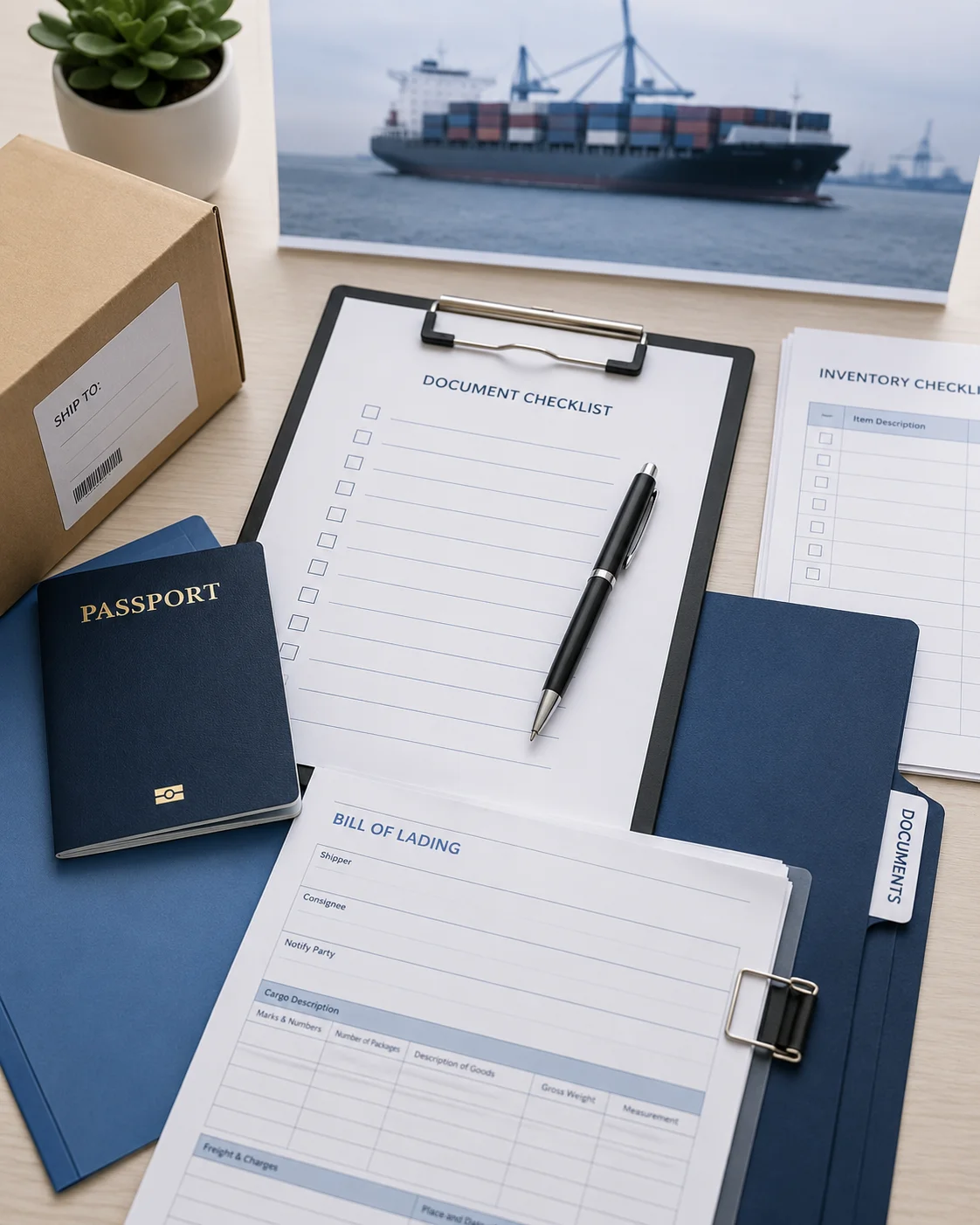
Documents required for importing used household goods, personal effects, and related shipments.
- Unaccompanied Personal Effects Statement (Customs Form B534), available from the ABF website
- Copy of passport (including Australian entry stamp; some ports require copies of all pages including blank pages)
- Full descriptive inventory in English
- Original bill of lading (OBL) / air waybill (AWB)
- LCL or FCL Packing Declaration (completed in English by the packer or supplier)
- Statutory declaration if someone other than the owner will be clearing the goods
- Evidence of identity (EOI) check at an ABF counter, or electronic submission via an international removals company
Specific Information
Who qualifies: Returning Australian citizens, permanent residents, holders of long-term work visas, and new immigrants. The goods must be personal property owned while overseas. There must be a clear connection between the person's travel to Australia and the goods importation (e.g., the UPE concession cannot be used to import goods months after arrival without justification).
Goods can arrive before or after the owner: Personal effects can arrive in Australia before or after the owner, but proof of intention to travel (airline ticket, work contract, university acceptance letter) must be provided if goods arrive first.
Form B534 requirements: Every section must be answered. The signature must match the passport. No whiteout or correction substances. Errors must be initialled. Penalties apply for false or misleading information.
Biosecurity (CRITICAL): Australia has some of the world's strictest biosecurity controls. The Department of Agriculture, Fisheries and Forestry (DAFF) assesses all personal effects imports. All shipments are subject to document assessment and potential physical inspection. Items of biosecurity concern include anything that has been in contact with soil, vegetation, livestock, or dust. Goods from countries with identifiable biosecurity risks may require higher levels of inspection.
Items requiring special attention for biosecurity:
- Shoes and boots (especially hiking/outdoor footwear) — must be clean and free of soil
- Camping and outdoor equipment — must be thoroughly cleaned
- Garden tools and equipment — must be free of soil and plant matter
- Bicycles — clean tyres and frames
- Golf clubs — clean heads
- Wooden items, crates, and furniture — may be inspected for pests
- Foodstuffs, herbs, spices, seeds — generally prohibited
- Straw, hay, and plant-based packing materials — prohibited
- Christmas decorations containing pinecones or plant matter — subject to confiscation
- Artificial trees with real timber trunks — subject to treatment or destruction
- Fruit boxes — do not use for packing
DAFF biosecurity actions: The department may require items to be cleaned, irradiated, fumigated, or destroyed (deep burial). All costs are borne by the importer.
Customs broker: Highly recommended. A customs broker will process goods through ABF and DAFF. The ABF uses the Integrated Cargo System (ICS) for all import declarations.
CFC refrigerants: Australia has an exemption for pre-charged equipment imported as personal effects by immigrants, temporary permit holders, or returning residents. The restriction applies only to equipment purchased overseas and imported for the first time by returning Australian residents. Equipment containing prohibited refrigerants may need to be evacuated and recharged with approved alternatives at the importer's expense.
Duties & Taxes
Duty-free conditions: Household goods and personal effects may be imported duty-free provided the items have been owned and used overseas for 12 months or more preceding the owner's departure for Australia. Items owned and used for less than 12 months are subject to duty. Rates vary by item type; purchase receipts or invoices are required to substantiate values.
Goods and Services Tax (GST): 10% GST applies to most imported goods. Personal effects that qualify for the duty-free concession (owned and used 12+ months) are generally also exempt from GST. Items not qualifying for the concession are subject to both duty and GST.
Alcohol and tobacco: Do not qualify for duty-free status within personal effects shipments. Subject to customs duty and excise. Limited amounts may be imported within traveller allowances.
Prohibited & Restricted Items
Prohibited Items
- Narcotics and illegal drugs — Strictly prohibited; severe penalties
- Firearms, weapons, and ammunition without permit — Prohibited
- Objectionable material — Prohibited
- Products infringing intellectual property rights — Prohibited
- Soil and sand — Strictly prohibited (biosecurity)
- Meat, poultry, and dairy products — Prohibited in household shipments (biosecurity)
- Live animals (other than approved pets through proper channels) — Prohibited
- Asbestos-containing materials — Prohibited
- Certain dog breeds (Pit Bull Terrier, Japanese Tosa, Dogo Argentino, Fila Brasileiro, Perro de Presa Canario) — Prohibited
- Bengal cats, Savannah cats, and all domestic/non-domestic feline hybrids — Prohibited (from March 2025/2026)
- Fruit boxes used as packing material — Prohibited (biosecurity)
Restricted / Dutiable Items
Duty-Free Traveller Allowances
- AUD 900 worth of general goods per adult (AUD 450 for under-18s)
- 2.25 litres of alcohol
- 25 cigarettes or 25 grams of tobacco
Biosecurity-Restricted Items (DAFF)
- Meat, poultry, eggs, dairy products — Prohibited in household shipments
- Seeds, herbs, spices — Prohibited or require permit
- Fresh fruit and vegetables — Prohibited
- Plants and plant material — Prohibited without phytosanitary certificate
- Timber items containing bark — Subject to treatment or destruction at importer's expense
- Straw and plant-based packing materials — Prohibited
- Soil — Strictly prohibited
- Wooden items — Subject to inspection; ISPM 15 requirements apply
- Animal products (skins, feathers, fur, ivory) — Subject to CITES and biosecurity controls
- Traditional medicines containing animal or plant products — May be prohibited
Customs-Restricted Items
- Alcohol and tobacco — Subject to duty and excise regardless of ownership duration; not eligible for the UPE duty-free concession
- Perfume concentrates — Subject to duty
- Antiques — Bona fide antiques (100+ years old) are duty-free but subject to 10% GST; LAPADA or BADA certificate of authenticity may be required; ABF may direct verification by an approved antiquity expert at the importer's expense
- Firearms `PERMIT REQUIRED` — Strict controls; police permit required in the state of residence
- Wildlife products `CITES` — Regulated by Fish and Wildlife; items made from wildlife species must be checked before shipping
- Medications — Prescription medications for personal use should be accompanied by a doctor's letter
Importing a Used Personal Vehicle
Required Documents
- Formal customs entry
- Copy of passport
- Vehicle registration papers
- Sales invoice / paid receipt
- Vehicle Import Approval (VIA) from the Department of Infrastructure — MUST be obtained before the vehicle arrives in Australia
- Original bill of lading (OBL)
- Form B534
- LCL or FCL Packing Declaration
Specific Information
CRITICAL: Motor vehicles are NOT considered personal or household effects. They require a separate formal customs entry and a Vehicle Import Approval (VIA).
Vehicle Import Approval is mandatory: All vehicles must have a VIA before arrival. Without an import approval, the ABF will not release the vehicle from customs control. Storage costs can be considerable and are the importer's responsibility. Applications are submitted through ROVER, the Department of Infrastructure's online portal.
Import pathways:
- Personal Import Scheme: For individuals migrating to Australia or returning Australian citizens. The vehicle must have been owned and used by the applicant for a continuous period of at least 12 months (3 months where ownership and use began in Australia). The vehicle must meet Australian Design Rules (ADRs) or be modified to comply. State/territory registration requirements apply.
- 25-Year Rule (Older Vehicles): Vehicles manufactured at least 25 years ago may be imported without meeting modern ADR requirements. They must retain original character. A state/territory engineer's inspection is typically required for registration.
- Specialist and Enthusiast Vehicle Scheme (SEVS): For vehicles not otherwise available in Australia that meet criteria such as high performance, low emissions, or unique features. The vehicle must be listed on the SEVS Register. A Registered Automotive Workshop (RAW) must modify and certify the vehicle to meet ADRs. RAW compliance costs approximately AUD 2,000+. The vehicle must be entered on the Register of Approved Vehicles (RAV) before state registration.
Duties and taxes on vehicles:
- Customs duty: typically 5% (reduced to 0% under some free trade agreements, e.g., Japan-Australia EPA)
- GST: 10%
- Luxury Car Tax (LCT): 33% on vehicles whose LCT value exceeds the LCT threshold (approximately AUD 76,950 for fuel-efficient vehicles, AUD 69,152 for others in 2025-26 — confirm current thresholds)
- Stamp duty varies by state/territory
VIA processing time: 3-6 weeks for standard applications; up to 60 business days for complex cases. Do not ship the vehicle until the VIA is issued.
Left-hand drive vehicles: May be imported under certain pathways (particularly SEVS) but face additional compliance requirements as Australia drives on the left (right-hand drive is standard).
Driving: Driving is on the LEFT-hand side of the road. Right-hand drive vehicles are standard.
Pets
- Import permit issued through BICON (Biosecurity Import Conditions system) Per DAFF (agriculture.gov.au) — the authoritative source for all pet imports:
- Rabies Neutralising Antibody Titre Test (RNATT) — result must be ≥ 0.5 IU/mL Per DAFF (agriculture.gov.au) — the authoritative source for all pet imports:
- RNATT Declaration endorsed by the official government veterinarian Per DAFF (agriculture.gov.au) — the authoritative source for all pet imports:
- Identity verification (two-part process with two separate USDA-accredited vets for US-origin pets) Per DAFF (agriculture.gov.au) — the authoritative source for all pet imports:
- ISO 15-digit microchip (ISO 11784/11785) — must be implanted BEFORE rabies vaccination Per DAFF (agriculture.gov.au) — the authoritative source for all pet imports:
- Current rabies vaccination (must remain valid from RNATT through export) Per DAFF (agriculture.gov.au) — the authoritative source for all pet imports:
- Country-specific veterinary health certificate endorsed by the government veterinary authority Per DAFF (agriculture.gov.au) — the authoritative source for all pet imports:
- For dogs: additional tests for Brucella canis (intact dogs), Leptospirosis vaccination, Leishmaniasis test, Canine Influenza Virus (CIV), and parasite treatments per the step-by-step guide Per DAFF (agriculture.gov.au) — the authoritative source for all pet imports:
- For cats: parasite treatments per the step-by-step guide Per DAFF (agriculture.gov.au) — the authoritative source for all pet imports:
Australia has among the world's strictest pet import requirements. As one of the few rabies-free countries globally, Australia enforces extensive pre-import testing, mandatory quarantine, and a months-long preparation timeline. Start planning 7+ months before travel.
Country groupings: Australia classifies countries into groups:
- Group 1: Countries from which cats and dogs may not be imported (most of Africa, Asia, and South America)
- Group 2: Countries with reduced requirements (e.g., New Zealand, Norfolk Island, Cocos Islands)
- Group 3: Approved countries where rabies is absent or well-controlled (includes US, Canada, UK, EU, Japan, and others)
- The US mainland is Group 3. Hawaii and Guam follow different pathways — check with DAFF.
- If your country is not on the approved list, direct import is not possible. The pet must spend a required period in an approved country before travelling to Australia.
The 180-day rule: After the RNATT blood sample arrives at a DAFF-approved laboratory and results are satisfactory (≥ 0.5 IU/mL), a mandatory 180-day waiting period begins. No exceptions. This is the single most critical timeline element.
Identity verification (determines quarantine length): If identity verification is completed BEFORE the RNATT blood draw, the pet qualifies for minimum 10-day quarantine. Without identity verification, the default quarantine is 30 days. The identity check is a two-part process (two separate vets, two separate appointments) for US-origin pets.
Mandatory quarantine: ALL cats and dogs entering Australia must complete quarantine at the Mickleham Post Entry Quarantine Facility near Melbourne, Victoria. There are no exceptions. Minimum 10 days (with identity verification) or 30 days (without). Quarantine booking can only be made after the import permit is issued. Quarantine costs start at approximately AUD 2,000 for 10 days (2025 rates). No visits are permitted during quarantine. All accounts must be paid in full before the pet is released.
Import permit: Applied for through BICON after the RNATT endorsement is obtained. Processing takes 10-20 business days. Do not book flights until the permit is confirmed. The permit specifies the required entry port.
Banned breeds (federal): American Pit Bull Terrier, Japanese Tosa, Dogo Argentino, Fila Brasileiro, and Perro de Presa Canario. Dogs derived from crosses with non-domestic species are also prohibited.
Banned cat breeds: As of 1 March 2025 (enforced March 2026), Bengal cats are no longer permitted for import. The previous exemption for 5th-generation (F5) Bengals was revoked. Savannah cats, Chausie cats, and all domestic/non-domestic feline hybrids remain banned. A limited transition period applied for permits granted before 28 February 2025.
Only dogs and cats can realistically be imported as pets. Birds are highly restricted (few species, extensive quarantine). Rabbits and ferrets are only permitted from New Zealand or for non-pet purposes. Reptiles, amphibians, and other mammals are generally not importable by private individuals.
Typical US-to-Australia timeline:
- 7 months before: Confirm microchip, schedule Part 1 and Part 2 identity checks
- 6-7 months before: RNATT blood draw after Part 2; send to DAFF-approved lab; 180-day wait begins
- During 180-day wait: Complete all dog-specific tests, vaccinations, and treatments; apply for import permit via BICON
- Once permit issued: Book Mickleham quarantine
- Final days before export: Final vet exam, health certificate, USDA endorsement (within 5 days of export)
Common mistakes: Microchipping after vaccination (invalidates the vaccination). Blood draw before identity check (results in 30-day quarantine instead of 10). Misunderstanding when the 180-day clock starts (it starts when the lab receives the sample, not when blood is drawn). Not having the RNATT within 12 months of export.
Consignment Instructions
Recommended: Contact the destination agent to ensure all requirements have been met prior to import, especially for differences regarding air / sea shipments.
Inventory requirements: A full descriptive inventory in English is mandatory. The packing list must be detailed.
B534 form: Must be completed accurately and signed by the owner. The signature must match the passport. Any corrections must be initialled (no whiteout). Every section must be answered.
Customs clearance: Required at the port of entry. ABF processes clearance. Use the Integrated Cargo System (ICS). A licensed customs broker is highly recommended.
Biosecurity inspection: DAFF assesses all documentation (B534 and packing list) to determine biosecurity risk. All shipments may be inspected. Items must be clean and free of soil, vegetation, dust, and animal matter. Biosecurity charges apply for inspections. If the responsible party is not an approved AIMS Account Client, upfront payment is required.
Cleaning recommendations before packing: All items that have been in contact with household dust, soil, livestock, or vegetation should be cleaned and dried before packing. Shoes and boots, garden equipment, sporting goods, bicycles, and outdoor furniture should be thoroughly cleaned and packed accessibly for inspection.
Ports of entry: Sydney, Melbourne, Brisbane, Perth, Adelaide, Darwin, and other ports. Customs clearance occurs at the port of entry.
Storage: If using a broker, goods are typically stored at a bond store or depot until cleared.
High Volume Specialist Operators (HVSOs): Some moving companies specialise in personal effects and offer total movement and clearance services.
Currency: Australian dollar (AUD). Credit cards widely accepted.
Cultural & Other Information
- OpenFactBook (replaces CIA World Factbook): https://www.openfactbook.org/countries/australia/
- Wikipedia: https://en.wikipedia.org/wiki/Australia
- Australian Border Force (ABF): https://www.abf.gov.au/
- DAFF — Moving/Immigrating Biosecurity: https://www.agriculture.gov.au/biosecurity-trade/travelling/moving-immigrating
- DAFF — Cats and Dogs: https://www.agriculture.gov.au/biosecurity-trade/cats-dogs
- DAFF — BICON: https://bicon.agriculture.gov.au/
- Department of Infrastructure — Vehicle Import: https://www.infrastructure.gov.au/infrastructure-transport-vehicles/vehicles/importing-road-vehicle-australia
- ABF — B534 Form and UPE Information: https://www.abf.gov.au/entering-and-leaving-australia/moving-to-australia/upe
- ABF Contact: 131 881 (within Australia)
- DAFF Pet Import Contact: 1800 900 090 or imports@aff.gov.au
Key country facts: Australia is the world's sixth-largest country by area, comprising the Australian mainland, the island of Tasmania, and numerous smaller islands. The capital is Canberra. The official language is English. The currency is the Australian dollar (AUD). Australia is a federal parliamentary constitutional monarchy. GST is 10%. Customs duty on most consumer goods is 5%, though many goods enter duty-free under free trade agreements. Australia has FTAs with the US, Japan, South Korea, China, ASEAN, and others. Driving is on the LEFT-hand side of the road (right-hand drive vehicles).
Important notes for movers: Australia's three defining characteristics for international moves are biosecurity, biosecurity, and biosecurity. The DAFF inspection regime is comprehensive and expensive when items fail. Advise customers to clean everything that has touched the outdoors — shoes, sports gear, garden tools, bicycles, camping equipment. Do not include any food, seeds, herbs, or plant material. Do not use fruit boxes for packing. Wooden crates and pallets must comply with ISPM 15. Vehicles are a completely separate process from household goods and require a VIA before shipping. Pets require 7+ months of advance planning, mandatory quarantine, and a rabies titer test with a 180-day waiting period.
Regulatory Updates
- March 2025 / March 2026: Bengal cats banned from import (exemption for F5 Bengals revoked). Transition period ends February 2026.
- February 2026: Guide content reviewed and confirmed current.
- Ongoing: Road Vehicle Standards (RVS) legislation governs vehicle imports, replacing the former Motor Vehicle Standards Act 1989. The SEVS Register and RAV are the key databases for vehicle eligibility.
- 2025: Mickleham Post Entry Quarantine Facility (opened 2024, replacing the former Eastern Creek facility) is the sole quarantine facility for all pet imports.
Useful resources