

Country Guides
Belgium

Start here
Overview
Explore sections
Guide Details
Household Goods
Documents
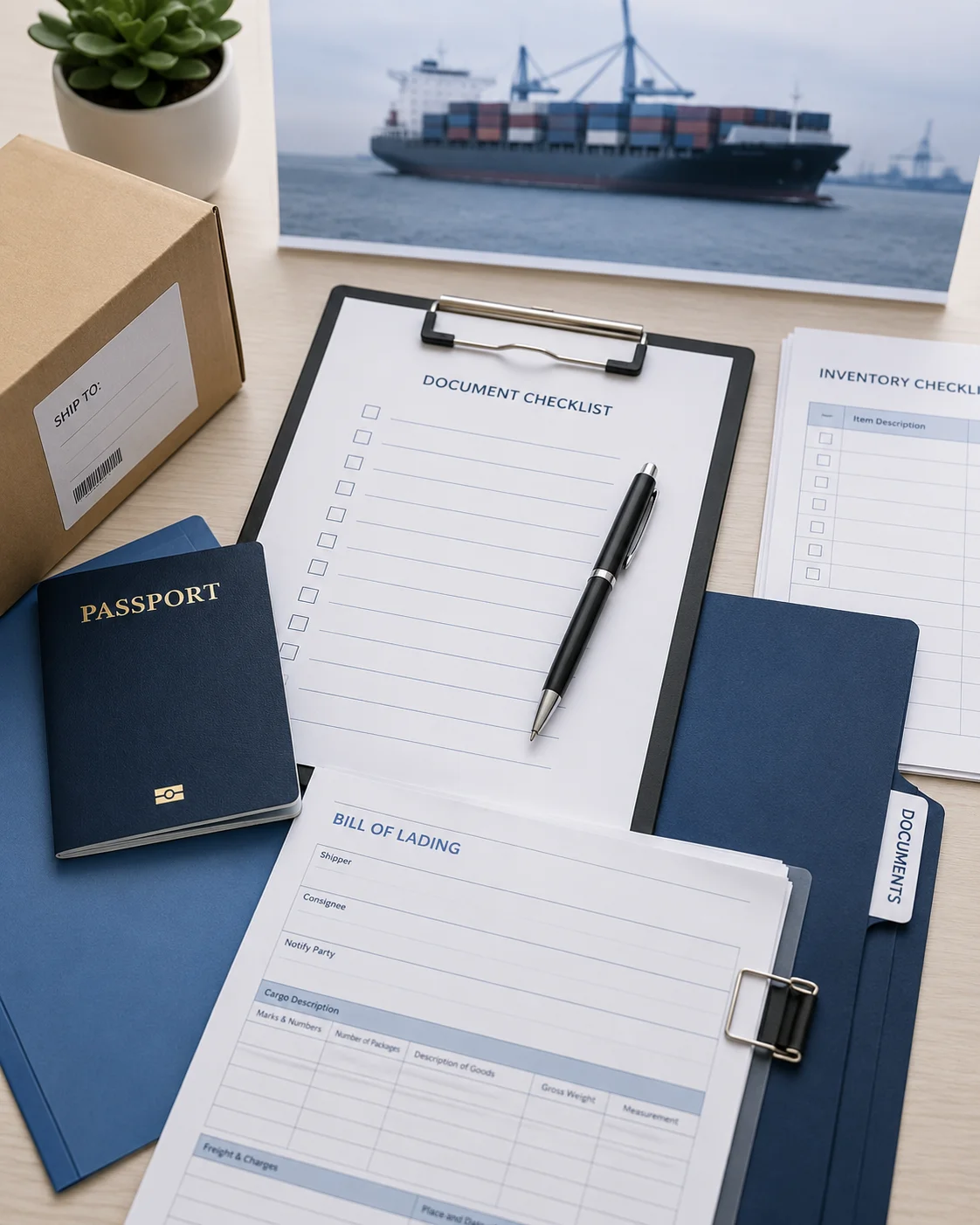
Documents required for importing used household goods, personal effects, and related shipments.
- Passport (copy including signature page)
- Original and 5 copies of a signed, dated, valued inventory, including an "introductory statement" and a "concluding statement" listing household goods and personal vehicles (if applicable), number of shipments, and all electrical items with serial numbers
- Bill of lading (OBL) / air waybill (AWB)
- Certificate of Residence (original) from the local Belgian town hall (aankomstattest / attestation d'arrivee)
- Documentation proving residence abroad for at least 12 consecutive months (certificate from Belgian consulate at origin, or employer at origin, or employer's branch office in Belgium)
- For company moves: signed and stamped declaration from the employer confirming the transfer is required and that the employee resided outside the EU
- Change of Residence Certificate (for Belgian nationals returning)
- Customs Form 136F and diplomatic statement (for diplomats)
- Bank guarantee (if all documents are not available; refunded within 6 months upon presentation of required paperwork)
Specific Information
Intra-EU moves: If moving from within the EU, no customs declaration is required. Free movement of goods applies within the EU single market.
Pre-arrival import possible: Relief can be granted before the person establishes residence in Belgium. In that case, the person must commit to establishing residence within 6 months. A security deposit is required.
Partial shipments: Used household goods may be imported in several separate shipments, but the declaration of duty-free entry must be completed for all shipments at the time of the first importation.
12-month transfer restriction: After import, goods may not be lent, pledged, rented out, or transferred (whether or not for consideration) without notifying Customs in advance for 12 months. Violation results in revocation of the relief and payment of import duties.
Warranty/guarantee for non-residents: Foreigners without a Certificate of Residence in Belgium must pay a warranty of 10% customs duties + 21% VAT + EUR 500 to cover possible fines. This is refunded upon proof of residency.
Belgian nationals returning within 2 years: Must produce the customs documents issued at the time of export of their household goods and/or vehicle. Without these, a warrant/guarantee must be paid.
Customs competence: The local head of customs at the import office grants exemption for most goods. For motor vehicles, trailers, motorcycles (over 50cc), motor caravans, pleasure boats, and tourist aircraft, the director of the regional Customs and Excise Centre (for the area of the new residence) is responsible.
Shipper arrival timing: The shipper should arrive in Belgium at least 1-2 weeks before the shipment to obtain the Certificate of Residence from the town hall.
Duties & Taxes
From non-EU countries — Duty-free conditions: Per the FPS Finance (official government source), personal property may be imported free of import duties and VAT if all of the following conditions are met: the person is transferring normal place of residence to the EU (Belgium); they have resided outside the EU for at least 12 consecutive months; the goods have been owned and used for a minimum of 6 months at the former residence before the departure date; the goods are for the person's use and will continue to be used; and the goods are imported within 12 months from the date of establishing residence in Belgium.
Items not eligible for duty exemption: Alcoholic products (except "fond de cave" of less than 30 bottles with a declaration), tobacco products, commercial means of transport, articles for use in a trade or profession (other than portable instruments of applied/liberal arts). New items (less than 6 months old), presents, and souvenirs are subject to duties.
VAT: Standard Belgian VAT is 21%. Exempt for qualifying transfer of residence goods.
Prohibited & Restricted Items
Prohibited Items
- Narcotics and illegal drugs — Strictly prohibited
- Meat, milk, and dairy products from non-EU countries — Prohibited (limited exceptions from Andorra, Faroe Islands, Greenland, Iceland, and small amounts of specific products from other countries)
- Protected species and products `CITES` — Ivory, tortoiseshell, coral, reptile skin, Amazonian forest wood, etc.
- Counterfeit goods — Prohibited
- Weapons without permit — Prohibited
Restricted / Dutiable Items
Duty-Free Traveller Allowances (from non-EU countries)
Alcohol (persons 17+):
- By air/sea: 1L spirits over 22% OR 2L under 22%, plus 4L still wine, plus 16L beer
- By land: 0.5L spirits over 22% OR 1L under 22%, plus 2L still wine, plus 8L beer (frontier zone/land travellers)
Tobacco (persons 17+):
- By air/sea: 200 cigarettes OR 100 cigarillos OR 50 cigars OR 250g tobacco
- By land: 40 cigarettes OR 20 cigarillos OR 10 cigars OR 50g tobacco
Other goods:
- EUR 430 by air/sea, EUR 300 by land, EUR 150 for under-15s
Restricted Items
- Alcohol within household shipments — "Fond de cave" declaration required for fewer than 30 bottles; larger quantities subject to duties
- Plants and vegetable products `PERMIT REQUIRED` — Phytosanitary certificate from the Ministry of Agriculture of the origin country required
- Ivory and animal products `CITES` — Complete list must be obtained from the Belgian consulate before packing
- Electronic/electrical equipment from non-EU countries — May require modifications for Belgian/EU standards
- New items (less than 6 months old) — Subject to duties
- Presents and souvenirs — Subject to duties
- Firearms `PERMIT REQUIRED` — Strict EU weapons regulations
Importing a Used Personal Vehicle
Required Documents
- All household goods documents listed above
- Vehicle listed on the inventory with manufacturer, body and engine number, colour, and model
- Vehicle registration from origin country (registered for over 12 months)
- Proof of use for at least 6 months
Specific Information
Duty-free eligibility: Vehicles may be imported duty-free if the vehicle has been registered for over 12 months and used by the shipper for at least 6 months. This applies to automobiles, motorcycles, trailers, motor homes, and pleasure boats.
Separate customs competence: Vehicle exemption is handled by the director of the regional Customs and Excise Centre, not the local customs office.
Trailers and motor homes: Permitted duty-free if they show visible signs of use.
Non-exempt vehicles: Subject to EU customs duties (typically 6.5% for passenger vehicles from non-preferential countries) plus 21% VAT.
Certificate of Conformity (COC): Required for vehicle registration in Belgium. Vehicles must meet EU technical standards. Non-EU specification vehicles may require modification.
Belgian vehicle registration: After customs clearance, the vehicle must be registered with the DIV (Directorate for Vehicle Registration). Technical inspection (controle technique / technische keuring) is required.
Driving: Driving is on the RIGHT-hand side of the road.
Pets
- EU Pet Passport From EU Member States
- ISO-compliant microchip (or tattoo applied before 3 July 2011) From EU Member States
- Valid rabies vaccination From EU Member States
- EU Health Certificate (non-commercial) From Non-EU Countries
- ISO-compliant microchip (ISO 11784/11785) From Non-EU Countries
- Valid rabies vaccination (at least 21 days before travel; after microchip implantation) From Non-EU Countries
- Rabies antibody titration test (RNATT) if travelling from an unlisted (non-Part 1/Part 2) country — blood sample taken at least 30 days after vaccination and at least 3 months before travel From Non-EU Countries
- Written declaration that the movement is non-commercial From Non-EU Countries
EU standard regulations apply: Belgium follows EU Regulation 576/2013 for pet travel. The standard EU pet import rules apply.
Maximum 5 pets (dogs, cats, ferrets) per person for non-commercial movement. May be exceeded for competition/exhibition animals over 6 months with written proof.
Minimum age: Belgium does NOT allow entry of unvaccinated young pets (under 12 weeks) or pets not yet immune to rabies (under 16 weeks) from non-EU countries.
Quarantine: Not required if all documentation requirements are met.
No import permit required for dogs, cats, and ferrets entering with their owner.
Customs control: Pets from non-EU countries are subject to customs/veterinary control at the point of entry. Use the red channel at airports.
Duty-free: Pets may be imported free of duties as part of a transfer of residence.
Approved entry points: Major Belgian airports (Brussels, Liege, Charleroi) and border crossings.
Meat and dairy from non-EU countries: Prohibited in personal luggage/shipments (with limited exceptions from specific countries). This affects any pet food included in shipments.
Consignment Instructions
Recommended: Contact the destination agent to ensure all requirements have been met prior to import, especially for differences regarding air / sea shipments.
Inventory requirements: Original plus 5 copies, signed, dated, and valued. Must include introductory and concluding statements. Electrical items must include serial numbers.
Certificate of Residence: Must be obtained from the local Belgian town hall upon arrival. The shipper should arrive 1-2 weeks before the shipment. This document is critical for customs clearance.
Signature legalisation: Customs may require proof of the shipper's signature authenticity. It is advisable to have the signature legalised in the country of origin by a local notary. The certificate should be dated at least 30 days but not more than 1 year before entry into Belgium.
Port of entry: Antwerp (one of Europe's largest ports, primary for sea freight). Brussels Airport (Zaventem) for air freight. Liege Airport for cargo. Belgium is also accessible overland from all EU neighbours.
EU member state: Belgium is a founding EU member state, NATO headquarters, and the seat of EU institutions. Goods from other EU countries move freely. Only imports from non-EU countries require customs clearance.
Languages: Belgium has three official languages: Dutch (Flemish), French, and German. Customs documents may need to be in the relevant regional language depending on the customs office location.
Currency: Euro (EUR). Belgium is part of the Eurozone.
Cultural & Other Information
- OpenFactBook (replaces CIA World Factbook): https://www.openfactbook.org/countries/belgium/
- Wikipedia: https://en.wikipedia.org/wiki/Belgium
- FPS Finance — Moving to Belgium: https://fin.belgium.be/en/private-individuals/international/coming-belgium/moving-belgium
- FPS Finance — Moving from Non-EU: https://finance.belgium.be/en/moving-non-eu-country-belgium
- FPS Finance — Travelling with Goods: https://fin.belgium.be/en/private-individuals/international/travel-luggage/traveling-outside-eu/goods
- Belgian Customs: https://finance.belgium.be/en/customs_excises
Key country facts: Belgium is a federal state in Western Europe, bordered by France, Luxembourg, Germany, the Netherlands, and the North Sea. The capital is Brussels (also the de facto capital of the EU). Official languages are Dutch, French, and German. The currency is the euro (EUR). Belgium is a founding member of the EU and NATO. VAT is 21%. Import duties follow the EU Common External Tariff. Driving is on the right-hand side. Antwerp is one of the world's largest ports.
Important notes for movers: Belgium's customs procedures for transfer of residence are standard EU procedures — well-documented and predictable. The key practical steps are: obtain the Certificate of Residence from the town hall upon arrival (shipper must arrive before the shipment); prepare the detailed inventory with the specific format required (introductory/concluding statements, 6 copies); and ensure all items are genuinely used and owned for 6+ months. The 10% + 21% + EUR 500 guarantee for persons without a residence certificate at the time of clearance is a significant cash flow consideration. The Antwerp port is efficient but Belgium's central location means many shipments also arrive via Rotterdam (Netherlands) or Hamburg (Germany) and are transported overland.
Regulatory Updates
- Ongoing: EU customs regulations apply. Belgium follows the Union Customs Code (UCC) and all EU-wide tariff updates.
- 2024-2025: EU digital customs initiatives continue; Belgium uses the PLDA/NCTS electronic customs systems.
- VAT: Stable at 21% for standard rate.
Useful resources