

Country Guides
Brazil

Start here
Overview
Explore sections
Guide Details
Household Goods
Documents
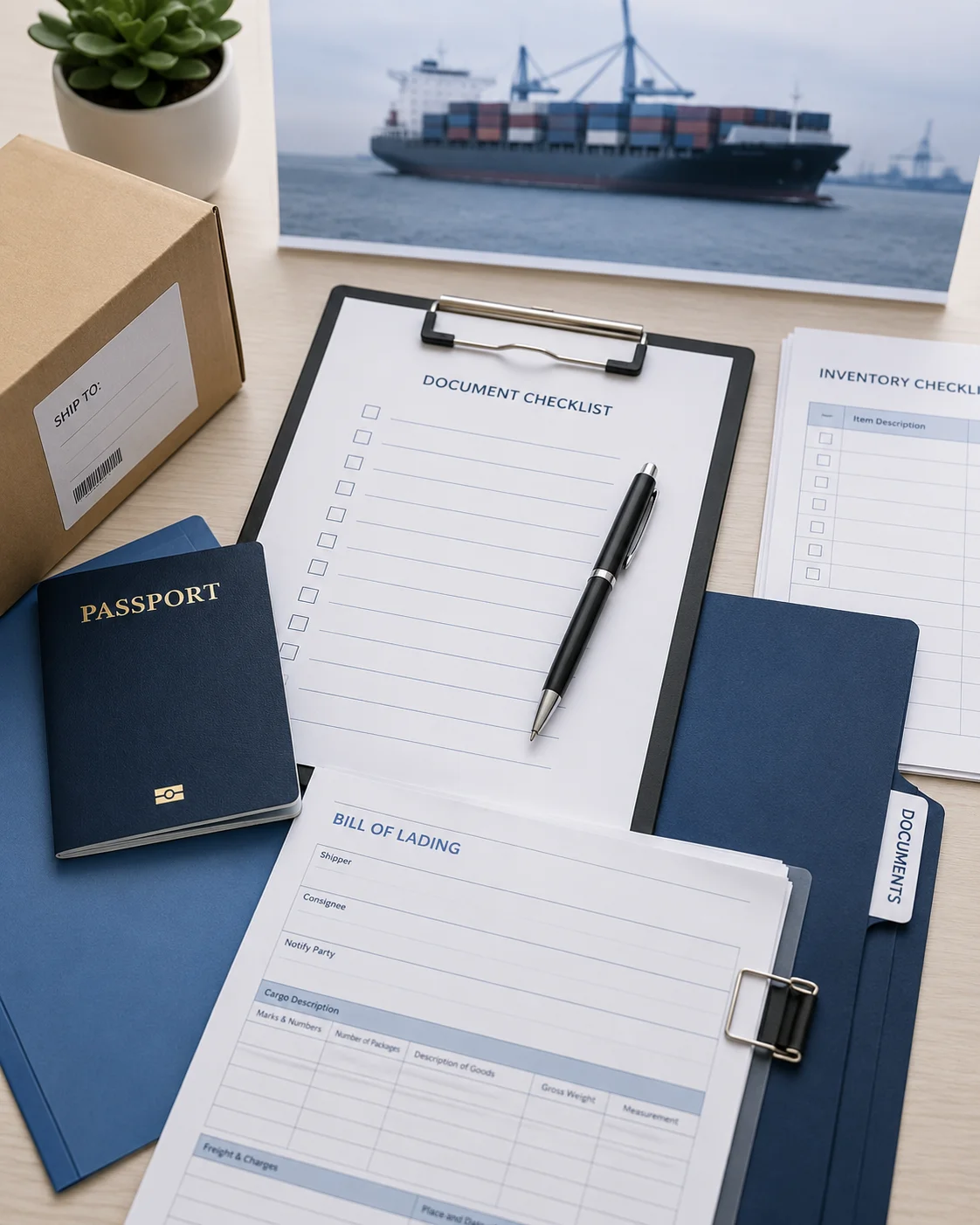
Documents required for importing used household goods, personal effects, and related shipments.
- Original bill of lading (OBL) / air waybill (AWB) — weight must be in kilograms, volume in cubic metres (not pounds/feet); CPF number must appear on the OBL
- Notarised copies of passport including all blank pages (2 copies)
- Temporary work visa (must be valid for more than 180 days) or permanent visa
- Notarised copies of Brazilian CPF (Cadastro de Pessoas Fisicas / tax ID) (2 copies)
- Detailed inventory of new items in Portuguese
- Packing list
- Statement of Responsibility from employer attesting they assume payment of all duties and taxes on household goods not re-exported after expiration of the work contract
- Proof of residence in Brazil (utility bill or rental contract)
- Fumigation certificate (for any wood crates/boxes, liftvans, or containers, per ISPM 15)
- Original OBL / AWB (with CPF number)
- Notarised copies of passport including all blank pages (2 copies)
- Notarised copies of CPF (2 copies)
- Proof of residence abroad for minimum 1 year (letter from Brazilian Consulate or letter of employment on company letterhead confirming work abroad for more than 12 months)
- Detailed inventory of new items in Portuguese
- Packing list
- Same documentation plus diplomatic credentials
- Must be in Brazil prior to shipment arrival to apply for required Brazilian documents
Specific Information
CPF number mandatory: A Brazilian CPF (tax ID) is mandatory for all shipments without exception. The CPF number must appear on the bill of lading. The address registered in the CPF must match the final destination of the shipment.
Visa must be stamped by Federal Police: Goods can only be imported after the visa is authorised by Brazilian authorities and the residence permit/visa is stamped in the passport by the Brazilian Federal Police.
Do not ship until "green light": The shipment should only be sent when all documents are complete and received by the destination agent, including the CPF number. Confirm receipt with the agent and wait for their explicit approval to ship.
Electrical/electronic items: Must be declared showing brand name, model, and serial number on the inventory and packing list.
Arrival deadline: Household goods must arrive within 180 days of the owner's arrival in Brazil. However, within 90 days is strongly preferred.
Owner presence: The client must be in Brazil at the time of customs clearance. The arrival airline ticket must be retained for presentation to customs.
Temporary admission (work visa holders): Goods are cleared under a bond and imported under temporary admission. All items must be re-exported when the client leaves Brazil.
Bond guarantee: When the suspended taxes for household goods exceed USD 45,000, the Receita Federal requires a security guarantee equivalent to the suspended taxes (including IPI, PIS, and COFINS). The guarantee is refunded when goods are re-exported before the work visa expires. Payment options: cash deposit at Caixa Economica Federal, customs insurance policy, or bank guarantee letter.
45-day rule for returning Brazilians: If a returning Brazilian citizen spent more than 45 cumulative days in Brazil in the year before their actual return with the move, they lose the tax exemption. This is a critical rule that catches many people.
Demurrage and port storage: All imports without exception, including diplomats, pay demurrage and port/airport storage charges. These are assessed on the CIF value within a period of 2 weeks of arrival.
Diplomats: Must be in Brazil before the shipment arrives. May import household appliances if owned for 6 months and appropriate to the rest of the shipment.
ISPM 15: Fumigation certificate required for all wood crates, boxes, liftvans, and containers.
Duties & Taxes
Duty-free conditions: Both new and used household goods and personal effects may be imported duty-free if for personal use. New items must be specifically declared as new and identified on the packing list. Undeclared new items discovered during customs inspection are subject to import duties and a fine.
Prohibited & Restricted Items
Prohibited Items
- Narcotics and illegal drugs — Strictly prohibited; severe penalties
- Counterfeit goods and currency — Prohibited
- Pornographic material involving minors — Prohibited
- Weapons without authorisation — Prohibited
- Hazardous materials — Prohibited
- Items that violate intellectual property rights — Prohibited
- Cigarettes and beverages produced in Brazil for export — Prohibited for re-import
Restricted / Dutiable Items
Duty-Free Traveller Allowances (per Receita Federal)
- USD 1,000 by air/sea (goods for personal/household use)
- USD 500 by land/river/lake
- Additional USD 1,000 at duty-free shops at the first landing airport in Brazil
Restricted Items
- Alcohol — Subject to quantity limits; not specified in the household goods duty-free concession
- Firearms and ammunition `PERMIT REQUIRED` — Strict controls; police/military authorisation required
- Medications — Personal use quantities permitted with prescription
- Exotic animals `PERMIT REQUIRED` — IBAMA authorisation required (Brazilian Institute of Environment and Renewable Natural Resources)
- Plants and plant products `PERMIT REQUIRED` — Phytosanitary certificate required
- Telecommunications equipment — May require ANATEL certification
Importing a Used Personal Vehicle
Required Documents
- All household goods documentation listed above
- Vehicle title and registration from origin country
- Purchase invoice
- Technical specifications
Specific Information
Vehicle import is extremely restricted in Brazil. Import of personal vehicles by private individuals is subject to very high duties and complex regulations. Vehicles are generally not part of the standard household goods duty-free import.
Duties on vehicles: Import duties, IPI (industrial products tax), PIS/COFINS, and ICMS (state tax) can total 80-100%+ of the vehicle's CIF value. This makes importing a personal vehicle economically impractical in most cases.
Diplomatic exemption: Diplomats may import vehicles duty-free.
Driving: Driving is on the RIGHT-hand side of the road.
Pets
- **MAPA Import Permit via SISCOMEX** — Multiple 2026 sources (pet transport specialists) now confirm an import permit applied for through the SISCOMEX system is required for dogs and cats, contradicting the official MAPA PDF below (which still states no permit is necessary). This appears to be a regulatory change since the PDF's last update. Processing takes approximately 3-4 weeks and must be completed before the health certificate is finalised. Apply for the permit as soon as the move date is confirmed; do not wait for vaccinations to be completed first. Per the official MAPA document (gov.br):
- International Veterinary Certificate (CVI) / Pet Passport issued or endorsed by an Official Veterinarian from the country's Veterinary Authority (certificates signed only by a private veterinarian are NOT accepted; for US pets, the USDA/APHIS-endorsed health certificate is required) Per the official MAPA document (gov.br):
- Rabies vaccination certificate (for animals 90 days or older; approved by the Veterinary Authority) Per the official MAPA document (gov.br):
- Proof of broad-spectrum treatment against internal and external parasites administered within 15 days prior to the CVI issuance date (with active ingredients identified) Per the official MAPA document (gov.br):
- Clinical examination within 10 days prior to the CVI issuance date confirming no clinical signs of infectious or parasitic disease and fitness for transport Per the official MAPA document (gov.br):
No import permit required for dogs and cats. Per the official MAPA document: "An Import Permit is not necessary for dogs and cats." All other pet species require an import permit from MAPA. Note: One 2026 pet transport company states that a MAPA import permit via SISCOMEX IS now required. This may reflect a recent policy change. Confirm with the destination agent before shipping.
No microchip required by Brazil. Per MAPA: "A pet microchip is not required to enter Brazil." However, an ISO 11784/11785 microchip is strongly recommended as it is required by most airlines and facilitates identification.
Rabies vaccination timing: Animals 90 days or older must have a rabies vaccination. If it is the first vaccination, travel must occur at least 21 days after the shot. Animals from OIE-designated rabies-free countries do not need to present proof of rabies vaccination (this must be noted on the CVI).
Animals under 3 months: May enter Brazil without rabies vaccination only if the Veterinary Authority certifies the animal was less than 90 days old at CVI issuance and has not been on any property with reported urban rabies cases in the last 90 days.
Parasite treatment: Broad-spectrum treatment against internal and external parasites must be administered within 15 days before the CVI issuance date. Products must be authorised by the Veterinary Authority and the active ingredients must be identified on the CVI.
CVI validity: 60 days from the date of issuance, as long as the rabies vaccination is still valid.
EU Pet Passport: The European Pet Passport is NOT valid for entry into Brazil.
Leishmaniosis: Brazil may not accept animals previously diagnosed with leishmaniosis.
VIGIAGRO inspection: Upon arrival, pets are inspected by VIGIAGRO officials. Ensure arrival is during business hours on a weekday when inspectors are on duty.
No quarantine: Brazil does not impose quarantine on dogs and cats meeting all requirements.
Banned breeds: Brazil does not have a federal banned breed list. Some municipalities may have restrictions.
Common mistakes: Submitting a health certificate signed only by a private vet (must be endorsed by the official government veterinary authority). Not having the parasite treatment within the 15-day window. Arriving outside VIGIAGRO business hours.
Consignment Instructions
Recommended: Contact the destination agent to ensure all requirements have been met prior to import, especially for differences regarding air / sea shipments.
Do not ship without agent approval. This is the single most important rule for Brazil. Wait for the destination agent's explicit "green light" confirming all documents (including the CPF number on the OBL) are in order before shipping. Premature shipping causes severe delays and costs.
CPF on the OBL: Non-negotiable. The CPF number must appear on the bill of lading for all importers without exception.
Weight and measurement: OBL must show weight in kilograms and volume in cubic metres. Pounds and cubic feet are not accepted.
Bond clearance: All work visa shipments are cleared under a bond (temporary admission). The bond must be managed and renewed throughout the visa period.
Port charges: Demurrage and storage charges begin quickly (within 2 weeks) and apply to all shipments including diplomatic.
Routing / port of entry: Santos (Sao Paulo state — Brazil's largest port), Rio de Janeiro, Paranagua, and other major ports for sea freight. Guarulhos International Airport (Sao Paulo), Galeao International Airport (Rio de Janeiro), and Brasilia International Airport for air freight.
ISPM 15: Fumigation certificate required for all wood packaging materials.
Currency: Brazilian real (BRL). Foreign exchange is regulated. The Receita Federal handles all customs matters.
Cultural & Other Information
- OpenFactBook (replaces CIA World Factbook): https://www.openfactbook.org/countries/brazil/
- Wikipedia: https://en.wikipedia.org/wiki/Brazil
- Receita Federal: https://www.gov.br/receitafederal/
- MAPA — Pet Import: https://www.gov.br/agricultura/pt-br/assuntos/sanidade-animal-e-vegetal/saude-animal/transito-animal/arquivos-transito-internacional/PetImportHowtobringyourdogorcattoBrazilEnglish.pdf
- USDA APHIS — Pet Travel US to Brazil: https://www.aphis.usda.gov/pet-travel/us-to-another-country-export/pet-travel-us-brazil
- trade.gov — Brazil Customs Regulations: https://www.trade.gov/country-commercial-guides/brazil-customs-regulations
Key country facts: Brazil is the largest country in South America and the fifth-largest in the world. The capital is Brasilia. The official language is Portuguese; all customs documents must be in Portuguese. The currency is the Brazilian real (BRL). Brazil is a member of Mercosur and the G20. VAT (ICMS) rates vary by state (7-25%). Federal taxes include IPI, PIS, COFINS, and import duty. Driving is on the right-hand side.
Important notes for movers: Brazil's customs process is notoriously bureaucratic and documentation-intensive. The three non-negotiable rules are: get the CPF number, put it on the OBL, and do not ship until the agent gives the green light. The temporary admission bond system for work visa holders means goods are not permanently imported and must be re-exported when the visa expires. The USD 45,000 bond guarantee threshold adds a significant financial requirement for larger shipments. The 45-day rule for returning Brazilians (cumulative days in Brazil in the year before return) is a trap that catches many people. Demurrage charges begin within 2 weeks for all shipments including diplomatic — delays are expensive.
Regulatory Updates
- 2026 (CONFIRMED): MAPA now requires an import permit for dogs and cats applied for via the SISCOMEX system, contradicting the official MAPA PDF (linked in Section 3 and Quick Links) which still states no permit is required for these species. This is confirmed across multiple independent pet relocation specialists as of May 2026. Processing takes 3-4 weeks and must be completed before the health certificate is issued. Advise clients to apply for the permit immediately upon confirming the move date.
- Ongoing: Receita Federal continues to digitise customs processes. The CPF requirement and bond system remain unchanged.
- Mercosur: Brazil is a founding member. Preferential tariff treatment applies to goods from Mercosur member states (Argentina, Uruguay, Paraguay, and associate members).
Useful resources