

Country Guides
Canada

Start here
Overview
Explore sections
Guide Details
Household Goods
Documents
Documents required for importing used household goods, personal effects, and related shipments.
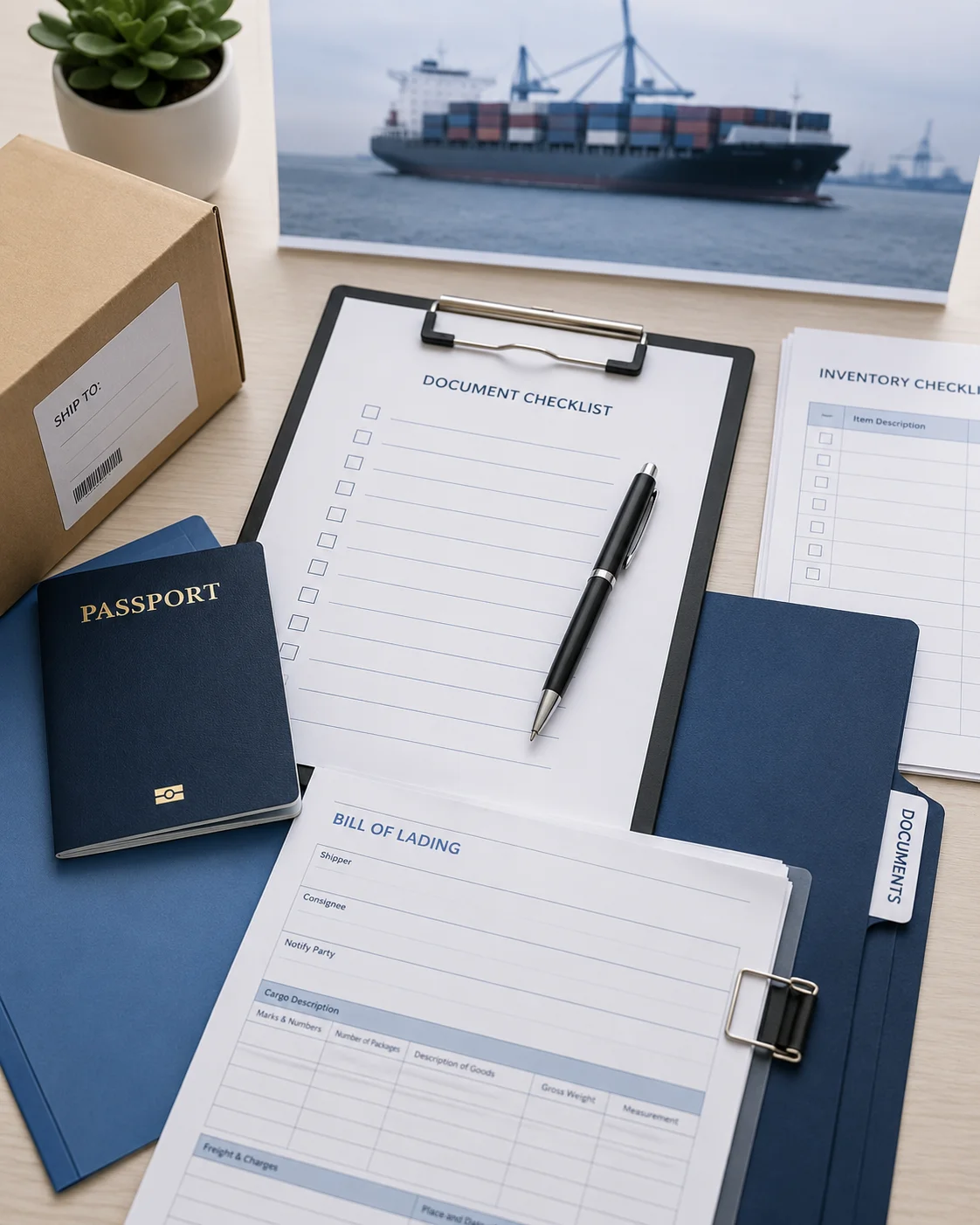
- Passport / travel documents / Confirmation of Permanent Residence (COPR) if applicable
- Form BSF186 (Personal Effects Accounting Document) — completed before or upon arrival; 2 copies recommended
- Form BSF186A (list of goods being imported, both accompanying and goods to follow) — 2 copies
- Detailed inventory with descriptions, serial numbers (where applicable), and values in Canadian dollars
- For vehicles: separate vehicle section on BSF186 (make, model, serial/VIN number)
Specific Information
Who qualifies for duty-free import:
- Settlers (Tariff Item 9807.00.00): Persons entering Canada with the intention of establishing, for the first time, a permanent residence for a period exceeding 12 months.
- Former residents (Tariff Item 9805.00.00): Canadian Forces members, Canadian government employees, former residents returning to Canada after residing in another country for at least 1 year, or residents returning after an absence from Canada of at least 1 year. Former residents returning after less than 1 year do not qualify under this tariff item.
- Seasonal residents (Tariff Item 9829.00.00): Household furniture and furnishings for a seasonal residence (excluding construction materials and permanently attached fixtures).
- Beneficiaries: Persons receiving an inheritance from someone who was a resident of another country.
CRITICAL: Declare everything on first arrival. Even if arriving with no goods, the complete list of all goods (accompanying and to follow) must be presented to the CBSA officer at the first point of entry. The officer stamps the BSF186 form and assigns a file number. Only items on this stamped list qualify for duty-free treatment when they arrive later. Items not on the original list may be subject to duties and taxes.
No time limit on goods to follow. Once the BSF186A is stamped at the port of entry, there is no time limit for importing the declared goods to follow. However, goods should arrive within a reasonable period.
Owner must arrive before the goods. The settler or former resident must arrive in Canada before or at the same time as the goods. Goods cannot arrive before the owner.
12-month resale restriction: If goods imported duty-free are sold or given away within 12 months of importation, the owner must notify CBSA and pay all duties originally exempted.
GST/HST: Goods qualifying under the settlers' effects or former residents' tariff items are exempt from GST/HST.
Duties & Taxes
Duty-free conditions — Settlers: All household and personal effects must have been actually owned, possessed, and used abroad by the settler prior to their arrival in Canada. Wedding gifts and bridal trousseau acquired within 3 months before or after arrival are exempt from the use requirement. Alcoholic beverages (subject to provincial minimum age) and limited tobacco (50 cigars, 200 cigarettes, 200 tobacco sticks, 200g manufactured tobacco) are also exempt from the use requirement.
Duty-free conditions — Former residents: Goods must have been owned, possessed, and used abroad. For former residents returning after 1+ year, goods exceeding CAD 10,000 in value receive a CAD 10,000 reduction in value for duty purposes, with the remainder classified normally.
New items: Brand new items still in original packaging may not qualify for duty-free treatment. Items should be opened and used prior to shipping.
Prohibited & Restricted Items
Prohibited Items
- Narcotics and controlled substances (beyond personal prescribed medications) — Prohibited
- Obscene material — Prohibited
- Hate propaganda — Prohibited
- Child pornography — Strictly prohibited
- Certain firearms (prohibited weapons as defined by the Criminal Code) — Prohibited
- Counterfeit goods and currency — Prohibited
- Certain food, plant, and animal products — Prohibited by CFIA depending on origin
- Used or second-hand mattresses — Prohibited
- Radar detectors in certain provinces (Quebec, Ontario, Manitoba, etc.) — May be seized
Restricted / Dutiable Items
Duty-Free Traveller Allowances (after 48+ hours absence)
Alcohol (provincial minimum age required):
- 1.5 litres of wine, or 1.14 litres of spirits, or 8.5 litres of beer/ale (or equivalent)
- Additional quantities subject to provincial/territorial duties and taxes
Tobacco (18+):
- 200 cigarettes, 50 cigars, 200 tobacco sticks, and 200g manufactured tobacco
- Minimum duty applies even within the personal exemption (unless products bear "DUTY PAID CANADA" excise stamp)
Other goods:
- CAD 800 after 48+ hours absence (duty- and tax-free)
Restricted Items
- Firearms `PERMIT REQUIRED` — Strict controls; Firearms Import/Export Authorization required; all firearms must be declared; restricted/prohibited firearms require additional licensing
- Food, plants, and animal products — Subject to CFIA inspection; many items prohibited (fresh fruits, vegetables, meat, dairy from certain countries)
- Currency: CAD 10,000+ must be declared (or equivalent in foreign currency)
- Medications — Personal supply (typically 90 days) with prescription; controlled substances require documentation
- Cultural property — Export of Canadian cultural property restricted; import of stolen/illegally exported cultural property prohibited
- Alcohol within shipments (settlers): Exempt from the use requirement but subject to provincial minimum age. Quantities beyond the personal exemption may be subject to provincial excise/markup
Importing a Used Personal Vehicle
Required Documents
- BSF186 form (vehicle section completed with make, model, VIN/serial number)
- Vehicle title / registration from origin country
- Bill of sale / purchase invoice
- Recall clearance letter from the vehicle manufacturer (confirming the vehicle meets all outstanding safety recalls)
- Form 1 from the Registrar of Imported Vehicles (RIV)
Specific Information
Registrar of Imported Vehicles (RIV): All vehicles imported into Canada must be processed through the RIV programme administered by Transport Canada. The vehicle must meet Canadian Motor Vehicle Safety Standards (CMVSS). US-spec vehicles from the US are generally admissible but may require modifications.
15-year exemption: Vehicles 15 years old or older are exempt from CMVSS requirements and do not need to go through the RIV programme.
US-origin vehicles: Most US-spec vehicles can be imported with minimal modification. However, daytime running lights, speedometer in km/h, and bilingual (English/French) warning labels may be required.
Non-US/non-Canadian vehicles: Vehicles not originally manufactured for the North American market may require extensive and expensive modifications to meet CMVSS. In many cases, it is more practical to sell the vehicle abroad and purchase one in Canada.
Recall clearance: A letter from the manufacturer confirming that all outstanding recalls have been addressed is required.
Duty on non-exempt vehicles: Vehicles that do not qualify under settlers' effects or former residents' tariff items are subject to 6.1% customs duty (from most countries; 0% from the US under CUSMA) plus GST/HST.
Provincial requirements: After federal customs clearance, the vehicle must be registered in the province of residence. Provincial safety inspections, emissions testing, and registration requirements vary.
Driving: Driving is on the RIGHT-hand side of the road.
Pets
- Valid rabies vaccination certificate (for dogs 3 months or older; must be administered at least 28 days before entry and not expired) Dogs
- The certificate must include: the animal's age/date of birth; breed and colour; owner's name and address; date of vaccination; trade name and serial number of the licensed vaccine; and the name and signature of the veterinarian Dogs
- Dogs under 3 months of age from the US: do not require rabies vaccination but must appear healthy Dogs
- Dogs from countries other than the US: may require an import permit from CFIA depending on country of origin and disease status Dogs
- No rabies vaccination certificate required for domestic cats entering from the US Cats
- Cats from countries other than the US: may require a health certificate; check with CFIA Cats
- Cats must appear healthy upon inspection Cats
Per the Canadian Food Inspection Agency (CFIA):
CFIA inspection: All pets are subject to inspection by CFIA officers at the port of entry. The animal must appear healthy. If the animal appears ill, further veterinary examination may be required at the owner's expense.
Dogs from the US: Straightforward. Valid rabies vaccination certificate for dogs 3+ months. No import permit required for personal pet dogs from the US.
Dogs from other countries: Requirements vary significantly by country. An import permit from CFIA may be required. Additional tests (e.g., rabies titer test, specific disease tests) may be needed depending on the country's disease status. Contact CFIA well in advance.
Microchip: Not federally required by Canada for entry, but strongly recommended for identification. Many airlines require microchips.
Banned breeds: No federal breed-specific legislation in Canada. Some provinces and municipalities have breed-specific bylaws (e.g., Ontario's Pit Bull ban under the Dog Owners' Liability Act, though enforcement has been debated). Check the destination province/municipality.
Quarantine: Not typically required for pets from the US meeting vaccination requirements. Quarantine may be imposed at CFIA discretion if the animal appears ill or documentation is deficient.
CITES: Exotic pets may require CITES permits. Contact CFIA and Environment and Climate Change Canada.
Common mistakes: Not having the rabies certificate with all required details (vaccine trade name and serial number are often missing). Arriving with a dog under 3 months from a non-US country without checking CFIA requirements. Not checking provincial breed-specific legislation.
Consignment Instructions
Recommended: Contact the destination agent to ensure all requirements have been met prior to import, especially for differences regarding air / sea / land shipments.
BSF186 and BSF186A: Must be completed and presented at the first port of entry. Even if no goods are being carried, the complete inventory of goods to follow must be declared. Keep the stamped copy — it is the receipt for claiming duty-free import of goods to follow.
Owner arrives first: The owner must arrive in Canada before or with the shipment. Goods cannot precede the owner.
Customs broker recommended: For unaccompanied shipments arriving by sea or air, a licensed customs broker is recommended to handle clearance through CBSA.
Routing / port of entry: Major sea ports include Vancouver, Montreal, Halifax, and Toronto (via Hamilton). Major airports include Toronto Pearson (YYZ), Vancouver (YVR), Montreal Trudeau (YUL), Calgary (YYC), and others. Land border crossings with the US are numerous. The first point of entry in Canada is where the BSF186 must be presented, even if it's a connecting flight stop.
Bilingual requirements: Canada is officially bilingual (English and French). Documentation in either language is accepted by CBSA. Quebec has additional French-language requirements for provincial services.
Provincial differences: Each province has its own tax rates (PST, HST, or QST), vehicle registration requirements, pet bylaws, alcohol importation rules, and professional licensing. The federal customs clearance is uniform, but provincial requirements vary.
Currency: Canadian dollar (CAD).
Cultural & Other Information
- OpenFactBook (replaces CIA World Factbook): https://www.openfactbook.org/countries/canada/
- Wikipedia: https://en.wikipedia.org/wiki/Canada
- CBSA — Moving or Returning to Canada: https://www.cbsa-asfc.gc.ca/travel-voyage/mrc-drc-eng.html
- CBSA — BSF186 Form: https://www.cbsa-asfc.gc.ca/publications/forms-formulaires/bsf186-eng.html
- CFIA — Importing Pets: https://inspection.canada.ca/importing-food-plants-animals/pets/eng/1326600389775/1326600500578
- Transport Canada — RIV: https://www.tc.gc.ca/en/services/road/importing-vehicle.html
Key country facts: Canada is the second-largest country in the world by area, spanning six time zones from the Atlantic to the Pacific and north to the Arctic. The capital is Ottawa. Official languages are English and French. The currency is the Canadian dollar (CAD). Canada is a federal parliamentary constitutional monarchy. GST is 5%; combined with provincial sales taxes, total tax ranges from 5% (Alberta) to 15% (Atlantic provinces). Canada is a member of CUSMA (formerly NAFTA), the G7, and the Commonwealth. Driving is on the right-hand side.
Important notes for movers: Canada's settlers' effects system is well-documented and generous — used goods that were owned, possessed, and used before arrival enter duty-free with no value cap. The critical rule is that everything must be declared on the BSF186/BSF186A at the first port of entry. Items not on the stamped list will not qualify for duty-free treatment later. The owner must arrive before the goods. New, unused items may not qualify. Vehicle import through the RIV programme is a separate federal process, followed by provincial registration. Pet import from the US is straightforward for dogs with rabies vaccination; from other countries, requirements vary significantly and CFIA should be contacted well in advance.
Regulatory Updates
- 2024-2025: CBSA continues to modernise electronic customs processes. The CARM (CBSA Assessment and Revenue Management) system has been progressively implemented.
- CUSMA: The Canada-United States-Mexico Agreement (replacing NAFTA) governs preferential tariff treatment for North American goods.
- Ongoing: Provincial alcohol importation rules continue to vary. Some provinces have liberalised interprovincial alcohol transport rules.
Useful resources