

Country Guides
Ethiopia

Start here
Overview
Explore sections
Guide Details
Household Goods
Documents
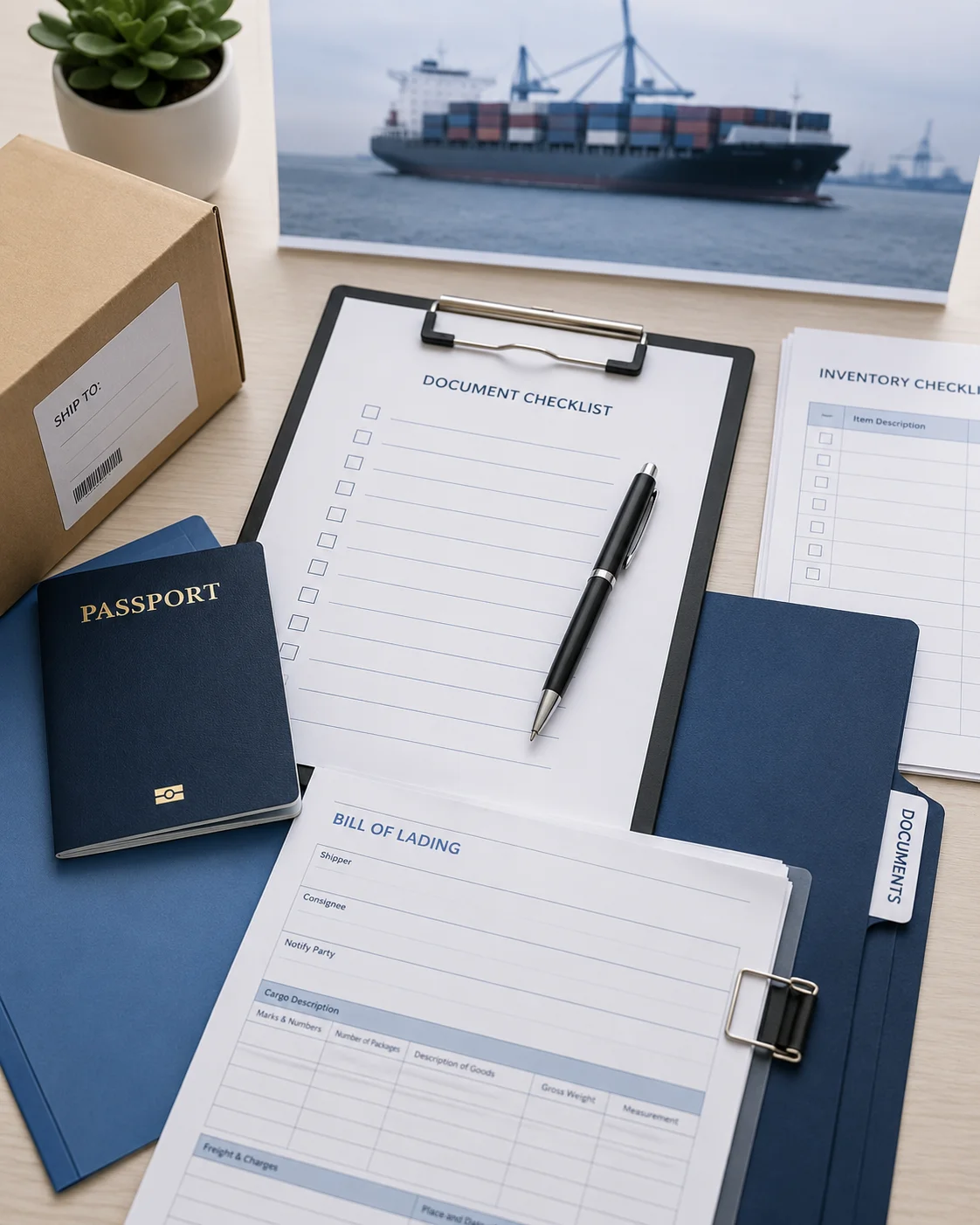
Documents required for importing used household goods, personal effects, and related shipments.
Requirements differ significantly by importer status.
- Original passport (original required, not a copy)
- Working permit (takes 3-6 weeks to obtain)
- Original packing list
- Original bill of lading (OBL) / air waybill (AWB)
- Valued inventory list in USD or EUR (for customs purposes only)
- Letter of support from employer
- Original passport
- Duty-free privilege document from the Ministry of Foreign Affairs (MoFA)
- Copy of diplomatic ID issued by MoFA
- Letter of guarantee issued and sealed by the diplomatic organization
- Import permit from MoFA
- Work permit from MoFA (issued to the shipper by the employer or diplomatic organization)
- Original two bills of lading / AWB
- Original packing list
- Valued inventory list in USD or EUR
- Client's passport
- Letter from the Ethiopian Embassy or Consulate where the client has been working (mandatory), authenticated by MoFA at arrival before submitting to customs
- Original packing list
- Original two bills of lading / AWB
- Valued inventory list in USD or EUR
- Certificate of origin
- Bank permit with import license
- Proof of insurance from a local company
- Purchase invoices
- Freight receipt from origin steamship line
Specific Information
Non-diplomatic shipments are subject to duty. Ethiopia does not provide blanket duty-free entry for household goods. Non-diplomatic shipments are subject to customs duty evaluation, and the shipper will pay duties on some or all personal belongings as assessed by customs.
Diplomatic and semi-diplomatic shipments are tax-exempt. Containers are exempt from inspection. The duty-free privilege document is the general franchise that diplomats receive from MoFA upon resuming work and after processing their diplomatic ID.
Diplomat inventory strategy: It is advisable for diplomats to present only a general inventory with goods listed by value, without specifying quantities. As diplomatic containers are not inspected, a general inventory avoids triggering duties on duplicate electrical items. If, however, the diplomat declares having more than one item of the same type, customs duty will apply per the evaluation grid.
Shipper must be present with original passport. The shipper must be physically in Ethiopia with their original passport and work permit (or diplomatic exemption) at the time of customs clearance. This is non-negotiable.
Express/telex release not accepted. Only the original bill of lading is accepted.
15-day document lead time. Documents should be express-mailed at least 15 days before shipment arrival at the port in Djibouti, so the employer can obtain the privilege document/import permit.
Do not ship before receiving clearance from the destination agent. The consignment must not be sent before receiving the green light to proceed from the destination agent. Premature shipping can cause customs clearance problems and incur demurrage charges for the shipper's account.
All original documents must arrive before the shipment. The destination agent must receive all original documents before the consignment arrives.
One electrical appliance per type: Only one unit of each type of electrical appliance is permitted (one TV, one CD player, one DVD player, etc.). Additional units are subject to duty.
Consolidation rules: Only consolidate 2 shipments of the same nature (both diplomatic or both non-diplomatic). If different-status shipments are consolidated, there will be clearance delays and violation of diplomatic immunity.
Container deposits:
- Ethiopian Shipping Line (ESL) containers: ETB 15,500 for a 20' container, ETB 31,000 for a 40' container
- Non-ESL containers: a guarantee letter from the consignee's employer to ERCA, or a cash deposit equivalent to duty and tax of each container
- Some shipping lines (Messina, PIL) require additional cash deposits to their agent in Addis Ababa
- The destination agent will not make deposits on behalf of the consignee
CIF value assessment: Customs considers the CIF value of a 20' container at USD 950 and a 40' container at USD 1,800.
Bill of lading requirements: Port of discharge should be Djibouti port. The body must state "Shipment in transit to Ethiopia." AWB must not state "As Agreed." The packing list must contain values in USD/EUR with no PBO descriptions.
Currency: Ethiopian birr (ETB). Foreign exchange controls are strict.
Duties & Taxes
Duty-free exceptions for non-diplomats:
- Exception 1: If a company's investment in Ethiopia exceeds 5 million ETB, they can import personal belongings worth USD 10,000 on a duty-and-tax-free basis. This does not include vehicles.
- Exception 2: Individuals coming to Ethiopia for the first time (confirmed by a government office) who intend to reside long-term are allowed to import belongings worth USD 5,000. This does not include vehicles.
Prohibited & Restricted Items
Prohibited Items
- Narcotics and illegal drugs of any kind — strictly prohibited
- Pornographic materials — prohibited
- Subversive materials (books, magazines, photographs, etc.) — prohibited
- Firearms, ammunition, and weapons — prohibited
- Explosives — prohibited
- Right-hand drive vehicles — prohibited
- Vehicles with tinted windows — prohibited
Restricted / Dutiable Items
Traveler Allowances
Per VisaHQ:
- 200 cigarettes, or 50 cigars, or 250g tobacco
- 2 litres of alcoholic beverages
- Perfume in reasonable quantities for personal use
Restricted Items
- Electrical appliances — only one of each type permitted; duplicates subject to duty
- Decoders and satellite dishes — authorization required from the Telecommunication Office prior to container arrival at Addis terminal, upon presentation of documents relative to the imported goods
- Radio transmitters and walkie-talkies — permit from the Telecommunications Department required `PERMIT REQUIRED`
Importing a Used Personal Vehicle
Required Documents
- VIN document (engine number, chassis number, type, model, year of manufacture) **For non-diplomats:**
- Commercial invoice (if available) **For non-diplomats:**
- Car booklet / commercial invoice **For non-diplomats:**
- Import permit issued by MoFA or other government office **For non-diplomats:**
- Authorization from the Road Transport Authority (RTA) and Communication Ministry **For non-diplomats:**
- Three original bills of lading **For non-diplomats:**
- Letter of support from employer **For non-diplomats:**
- Same as non-diplomats, but import permit and RTA authorization are issued via the diplomatic mission **For diplomats:**
Specific Information
Vehicles are subject to taxes. Vehicle import duties in Ethiopia are substantial. Only diplomats and semi-diplomats receive duty-free treatment.
Left-hand drive only. Only left-hand drive vehicles can be imported. Right-hand drive vehicles are prohibited.
Tinted windows prohibited. Vehicles with tinted windows cannot be imported.
Current Ethiopian residents cannot import vehicles. This is a firm prohibition.
RTA authorization required (non-diplomats). The shipper needs a vehicle import authorization from the Road Transport Authority, which is separate from the MoFA import permit.
Ethiopian Embassy letter (returning nationals). A letter from the Ethiopian Embassy at the country of origin is a prerequisite, and it must be legalized by MoFA.
Three original bills of lading required for vehicle imports.
Driving: Driving is on the RIGHT-hand side of the road.
Pets
Required documents include:
- Copy of passport
- Health certificate / carnet / booklet / birth certificate
- Letter / certificate of the Ministry of Agriculture from the origin country or state
For diplomatic pets:
- The embassy in Ethiopia formally notifies MoFA that a staff member will arrive with a pet, enclosing copies of all identity and health documents
- MoFA notifies the Ministry of Agriculture and Rural Development
- The Ministry of Agriculture requests any additional documents from the embassy
- The Ministry of Agriculture informs the Customs Authority and provides the owner with entry documents
For non-diplomatic pets:
- The request can be placed directly with the Ministry of Agriculture and Rural Development (no MoFA involvement needed)
1.5 to 2 month lead time for pet documentation. It is advisable to start the process of obtaining appropriate documents 1.5 to 2 months before the pet's arrival in Ethiopia. This is one of the longest pet documentation lead times in the project.
Shipper must be present at pet arrival. The shipper must be physically present when the pet arrives.
Multi-ministry process: The pet import process involves MoFA (for diplomats), the Ministry of Agriculture and Rural Development, and the Customs Authority. Each ministry must process its part sequentially.
Rabies vaccination required. Per PetTravel.com (February 2026), dogs and cats must be vaccinated against rabies. A titer test is recommended, especially for pets from high-rabies countries.
CDC high-risk rabies country: Ethiopia IS on the U.S. CDC's list of high-risk countries for dog rabies. This affects anyone returning to the U.S. with a dog. U.S.-vaccinated dogs must have a Certification of U.S.-Issued Rabies Vaccination form completed before departing the U.S. Source: CDC High-Risk Countries List (cdc.gov/importation/dogs/high-risk-countries.html).
Common mistakes: Not starting the pet documentation process 2 months in advance. Not having the shipper present at pet arrival. Assuming the process is the same for diplomats and non-diplomats (the channels are different). Not having the Ministry of Agriculture's authorization before the pet arrives.
Consignment Instructions
Contact the destination agent to ensure all requirements have been met prior to import, especially for differences regarding air/sea shipments.
Do NOT ship before receiving the green light from the destination agent. This is the single most important instruction for Ethiopia. Premature shipping causes customs problems and demurrage charges that the shipper must pay.
Port of entry is Djibouti. Ethiopia is landlocked. The recommended port of entry for sea shipments is Djibouti. The bill of lading must show Djibouti as the port of discharge and state "Shipment in transit to Ethiopia" in the body. Goods are then transported overland to Addis Ababa.
Original documents must arrive before the shipment. Express-mail all originals at least 15 days before the shipment arrives in Djibouti.
Shipper must be in Ethiopia. With original passport and work permit/diplomatic exemption. No exceptions.
Container deposits are mandatory. ESL containers require ETB 15,500 (20') or ETB 31,000 (40'). Non-ESL containers require employer guarantee letters or cash deposits. The destination agent will not make deposits on behalf of the consignee.
No PBO descriptions on the packing list. All items must be individually described with values in USD or EUR.
Do not consolidate diplomatic and non-diplomatic shipments. This violates diplomatic immunity and causes clearance delays.
Pet import: start 2 months early. The multi-ministry authorization process takes 1.5-2 months.
Work permits take 3-6 weeks. Factor this into the relocation timeline.
Cultural & Other Information
- OpenFactBook — Ethiopia (replaces CIA World Factbook) — verified 200
- Wikipedia — Ethiopia — verified 403 to bots, works in browser
- PetTravel.com — Ethiopia Pet Import Requirements — verified 200
- Trade.gov — Ethiopia Import Tariffs — verified 200
- VisaHQ — Ethiopia Customs — verified 200
Language: Amharic is the official working language. English is used in business and government.
Currency: Ethiopian birr (ETB). Foreign exchange controls are strict. The birr is not freely convertible. As of late June 2026, approximately 1 USD = 159-161 ETB (2026 range: 154-161; 2026 average approximately 156.5 ETB per USD). The guide's prior figure of 130 ETB/USD reflected the rate in early-to-mid 2025, before further depreciation. This rate should always be confirmed at time of quoting.
Calendar: Ethiopia uses the Ethiopian calendar (Ge'ez calendar), which is approximately 7-8 years behind the Gregorian calendar and has 13 months. Business and government deadlines may reference the Ethiopian calendar.
Landlocked logistics: Ethiopia has no seaport. All sea freight transits through Djibouti (primary) or, less commonly, through Berbera (Somaliland) or Mombasa (Kenya). The Djibouti-Addis Ababa corridor is the standard route, using either the railway or road transport.
African Union headquarters: Addis Ababa hosts the African Union headquarters and numerous international organizations, making diplomatic relocations a significant portion of the moving market.
Useful resources