

Country Guides
India

Explore sections
Guide Details
Household Goods
Documents
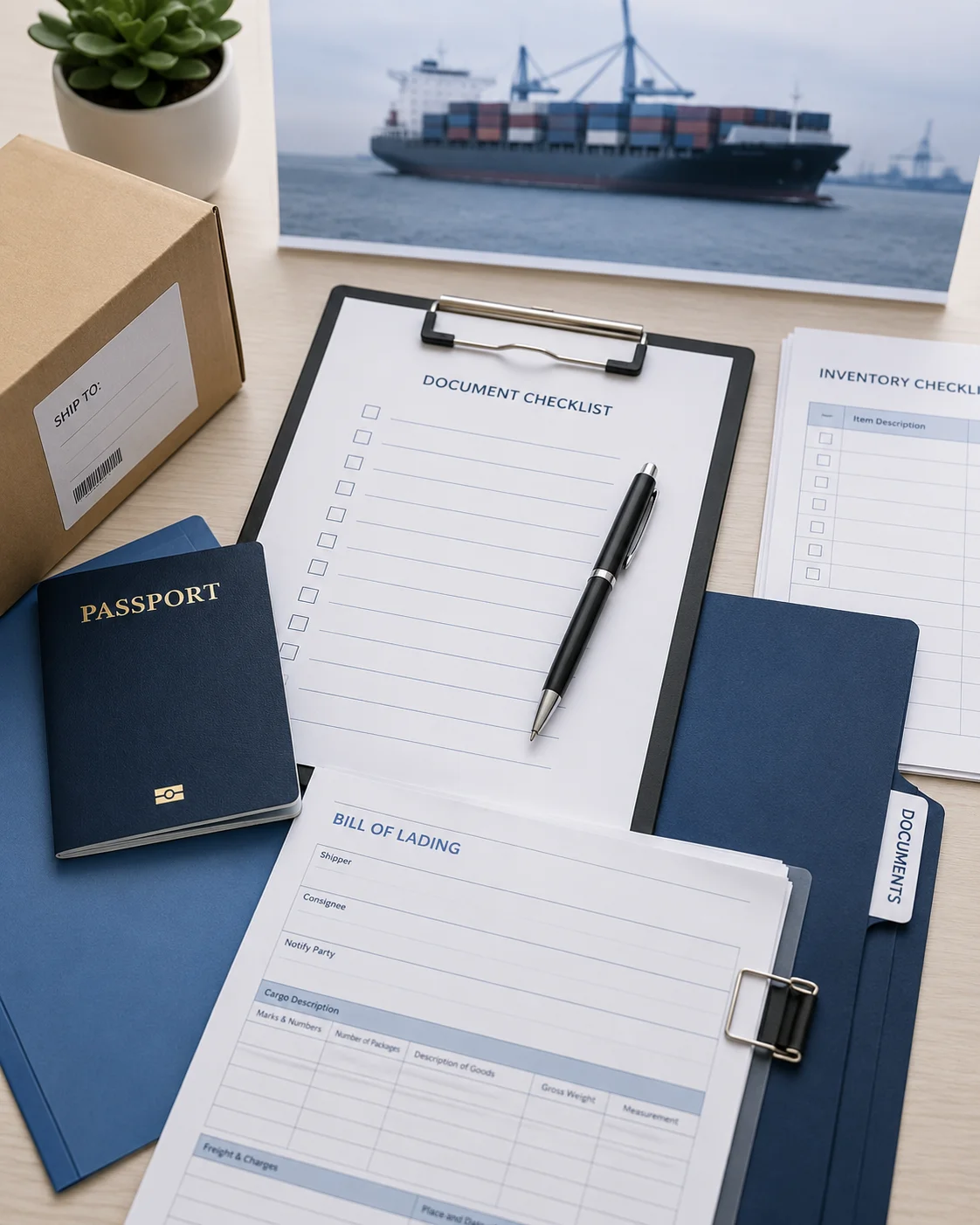
Documents required for importing used household goods, personal effects, and related shipments.
- Original passport (for diplomats, a certified copy is accepted)
- Valued list of articles with dates of purchase
- Baggage customs declaration signed by the owner
- Detailed packing list
- Separate list of electronic items
- Authority letter (format varies for diplomats vs. non-diplomats; refer to destination agent)
- Original bill of lading (OBL), sea waybill, or copy of air waybill (AWB)
- Valid visa (minimum 1-year validity) / PIO card / Overseas Citizen of India (OCI) card (for foreign nationals)
- Original residence permit (for foreigners)
- Employment letter, transfer letter, or assignment letter
- Duty-free exemption certificate issued by the diplomatic organization in India
- Packing list stamped by the consulate or embassy
Specific Information
Owner must be present: The owner of the goods must be present for customs clearance (except for diplomatic shipments).
Customs examination: All shipments are subject to customs examination unless they are diplomatic shipments.
Container handling: All non-diplomatic containers are offloaded at the port/terminal of entry and reloaded into vans for delivery. Direct container delivery is generally not available.
Residency requirements for Indian nationals: Must have lived abroad for at least 2 consecutive years preceding transfer to India and intend to reside in India for at least 1 year. The owner must not have visited India for more than 180 days in the preceding 2 years.
Foreign nationals: Must possess a visa valid for at least 1 year.
Shipment timing (air): Air shipments must be dispatched from the origin airport within 15 days after the owner's arrival in India.
Shipment timing (sea): Sea shipments must be dispatched from the origin seaport within 1 month after the owner's arrival in India.
Early arrival: Shipments may arrive at an Indian airport or seaport up to 2 months before the owner's arrival; however, demurrage and detention charges will apply.
Electronic items: Must be loaded at the front (opening side) of the container or lift-van. A separate list of electronic items must be provided.
Important note: Customs regulations are the same throughout India; however, regulations may be interpreted differently among various customs offices. The destination agent's familiarity with local customs practices is essential.
ISPM 15: Wood packaging materials should comply with ISPM 15 standards.
Prohibited & Restricted Items
Prohibited Items
- Beef and beef products
- Narcotics, non-branded drugs, and psychotropic substances
- Obscene literature, photographs, or films
- Politically subversive literature
- Illegal drugs
- Firearms and ammunition (without license) PERMIT REQUIRED
- Knives and deadly weapons
- Birds and bird products (eggs, feathers) due to Avian Influenza restrictions
- Pigs and pig meat products (per VisaHQ)
- Endangered plants and species CITES
- Plants and plant products (without permission)
- Culturally important or valuable antiques (export restriction)
- Counterfeit goods
- Pornographic material
Restricted / Dutiable Items
Personal duty-free allowances (per VisaHQ):
- 200 cigarettes, or 50 cigars, or 250 grams of other tobacco products
- Up to 2 litres of wine or alcoholic beverages
- 59 ml of perfume
- 250 ml toiletries
Currency: Unlimited foreign currency may be imported but amounts equivalent to USD 10,000 or more must be declared. Indian currency import by non-residents is restricted. Foreign travelers cannot take out more foreign currency than they brought in; amounts under USD 10,000 generally do not need to be declared.
Dutiable items within household goods:
- New items are subject to duties (invoice must be supplied)
- Plasma, LCD, and LED televisions (any technology): dutiable at approximately 38.5% whether new or used
- Certain electronics attract approximately 16.5% duty: old-technology televisions, video home theatres, dishwashers, domestic refrigerators above 300 litres, deep freezers, and video cameras
- Duplicate items or items in excess of INR 150,000 (INR 500,000 in Delhi and Mumbai) are subject to duties of approximately 36% to 61%
Foodstuffs: Import rules for food vary between cities throughout India. Foreign nationals may be allowed to import foodstuffs up to INR 1,000,000 per year. Confirm with the destination agent before including food in the shipment.
Firearms, ammunition, and weapons: Restricted item that must be included with the household goods shipment. A license must be obtained before import. PERMIT REQUIRED
Gold and precious metals: Subject to strict import controls and duties.
Radio transmitters: Prohibited without permission.
Importing a Used Personal Vehicle
Required Documents
- Original passport
- Original manufacturer's invoice
- Import license (unless entering on Transfer of Residence)
- Insurance policy
- Certificate of title or registration
- Original bill of lading (OBL)
- Duty exemption certificate (diplomats only)
Specific Information
Strongly discouraged: The import of motor vehicles to India is a detailed, conditional, and complicated procedure and is generally not recommended. Duties are extremely high.
Duty rates: Customs duties on imported vehicles are generally higher than 200% of the customs-assessed value. This makes private vehicle import prohibitively expensive for most individuals.
Transfer of Residence: Individuals may import one used vehicle only if coming to India on a Transfer of Residence (ToR). The vehicle must have been in the owner's possession and ownership for a minimum of 1 year before import.
Right-hand drive only: Only right-hand drive vehicles may be imported (India drives on the left). Diplomats are exempt from this requirement.
Emission standards: Only vehicles meeting at least Euro III pollution norms may be imported. A manufacturer's certificate is required.
Port restrictions: Not all ports or terminals in India are authorized to import cars. Used vehicles can only be imported through the customs port at Mumbai. Confirm with the destination agent before shipping.
Diplomatic vehicles: May be imported duty-free with a duty exemption certificate from the Indian Ministry of External Affairs, subject to Ministry approval.
Pets
- Advance NOC (No Objection Certificate) from the Animal Quarantine and Certification Services (AQCS) in India
- Veterinary health certificate (issued within 10 days of entry, endorsed by the government veterinary authority in the origin country)
- Vaccination record (rabies + species-specific vaccinations)
- Microchip documentation
- DGFT license (required in certain circumstances; see below)
Limit on pets: Only one cat, one dog, or one parrot may be imported per passenger coming to India on Transfer of Residence. PetTravel indicates up to two dogs or cats per person; a DGFT license is required for more than two.
NOC (No Objection Certificate): Required for all dogs and cats entering India. Application is submitted to AQCS. Advance notification must be provided. The NOC is issued at the port of entry.
DGFT license requirements: Indian citizens returning for tourism purposes need a DGFT (Director General of Foreign Trade) license to import pets unless they and their pet have been abroad for more than 2 years (with no more than 180 days of visits to India during that period). Foreign nationals of Indian origin must have an OCI or PIO card. Foreign nationals not of Indian origin must be relocating to India for a minimum of 1 year to import a pet without a DGFT license.
Unaccompanied pets: Cannot be imported unless associated with an owner transferring residency to India. The owner must enter India within 30 days of the pet's arrival. If traveling unaccompanied, pets must enter between 7 and 14 days after the owner.
Microchip: Required. AVID microchip or non-encrypted 15-digit ISO 11784/11785 compliant microchip accepted.
Rabies vaccination: Required for all dogs and cats. Must be administered more than 30 days before entry and no more than 12 months before entry. The 30-day waiting period does not apply if the pet has a current vaccination administered after microchip implantation.
Rabies titer test: Not required from any country.
Other vaccinations (dogs): Canine distemper, canine leishmaniasis, canine leptospirosis, canine parvovirus, and canine hepatitis.
Other vaccinations (cats): Feline viral rhinotracheitis, feline panleukopenia, and feline calicivirus.
Parasite treatments: Strongly recommended but not required. Internal parasites (especially Echinococcus multilocularis) and external parasites should be treated.
Health certificate: Must be issued by a licensed veterinarian within 10 days of entry and endorsed by the government veterinary authority responsible for animal exports.
Quarantine: No quarantine if all requirements are met. Non-compliant pets may be quarantined, returned, or euthanized at the importer's expense.
Puppies and kittens: May be imported after 3 months of age. Must be vaccinated for rabies no sooner than 3 months of age with a 30-day wait before entry. Unvaccinated pets are not permitted.
Banned breeds: India has an extensive banned breeds list. The following breeds and their crosses are prohibited from import: Pit Bull Terrier, Tosa Inu, American Staffordshire Terrier, Fila Brasileiro, Dogo Argentino, American Bulldog, Boerboel, Kangal, Central Asian Shepherd Dog (Ovcharka), Caucasian Shepherd Dog (Ovcharka), South Russian Shepherd Dog (Ovcharka), Tornjak, Sarplaninac, Japanese Tosa, Akita, Mastiffs (Boerbulls), Rottweiler, Terriers (specific types), Rhodesian Ridgeback, Wolf dogs, Presa Canario, Akbash Dog, Moscow Guard Dog, Cane Corso, and any dog commonly known as a Bandog.
Birds: Currently not permitted for import due to Avian Influenza restrictions.
Entry by air: Pets can enter as checked baggage (accompanied) at New Delhi, Mumbai, Bangalore, Chennai, Hyderabad, Cochin, or Kolkata. Air cargo (unaccompanied) is accepted only at New Delhi and Mumbai. Pets should arrive between 5:00 AM and noon, Monday through Friday. The owner's original passport is required at clearance and will be held until the pet clears customs.
Timing of arrival: All dogs and cats must arrive within 30 days of the owner's first immigration stamp on their passport. The owner's passport must show a proper work, spouse, or dependent visa.
CDC high-rabies-risk country: India is on the U.S. CDC list of high-risk countries for dog rabies. Dogs entering the United States from India are subject to enhanced CDC import requirements, including a CDC Dog Import Permit, valid rabies vaccination, and microchip. Owners planning to return a dog to the U.S. should prepare for these requirements before departure.
CITES: Animals covered by CITES must be quarantined for 30 days in the country of origin and 30 days in India.
Special Categories
Common Mistakes
- Attempting to import a banned breed (extensive list; confirm before shipping)
- Not obtaining the NOC from AQCS before arrival
- Arriving outside the 5:00 AM to noon window on weekdays
- Not having the owner present with original passport for customs clearance
- Exceeding the 30-day window after the owner's arrival
- Indian citizens not obtaining a DGFT license when required
- Attempting to import birds (currently prohibited)
Discrepancies
- Number of pets allowed: The IAM guide (2018) states "only one cat, dog or parrot may be imported by the passenger." PetTravel (2026) states "up to two dogs or cats can enter India per person" with a DGFT license required for more than two. The one-pet limit in the IAM guide may reflect an older regulation or a specific condition. PetTravel's more detailed and recent information is likely more current; confirm with the destination agent.
- Electronics duty rates: The IAM guide (2018) lists specific duty rates (16.5%, 38.5%, 36-61%). These rates may have been revised under India's GST framework. Current rates should be confirmed with the destination agent, as India frequently adjusts import duty rates in its annual Union Budget.
- Terrier breed ban: PetTravel lists "Terriers" as a banned breed but notes "specific types not specified." The PetTravel comments section confirms that Boston Terriers are NOT on the banned list; the restriction applies to specific terrier breeds listed (American Staffordshire Terrier, Pit Bull Terrier). Owners of any terrier breed should confirm eligibility with AQCS before shipping.
Unverified Items
- The specific duty rates for electronics and duplicate items (from the 2018 IAM guide) could not be independently verified against a current CBIC source. India revises duty rates annually in the Union Budget. Current rates should be confirmed with the destination agent.
- The INR value thresholds for duplicate items (INR 150,000 general / INR 500,000 in Delhi and Mumbai) from the 2018 IAM guide may have been revised. Confirm with the destination agent.
- The Euro III emission standard requirement for vehicle imports (from the 2018 IAM guide) may have been updated to a higher standard (India implemented BS-VI, equivalent to Euro VI, for new domestic vehicles in April 2020). The current requirement for imported used vehicles should be confirmed.
- The foodstuff allowance of INR 1,000,000 per year for foreign nationals (from the 2018 IAM guide) could not be independently verified.
Consignment Instructions
Recommended: Contact the destination agent to ensure all requirements have been met prior to import, especially for differences regarding air and sea shipments.
Customs interpretation varies by location: This is one of the most critical operational points for India. While regulations are nationally uniform, individual customs offices may interpret them differently. The destination agent's relationship with the local customs authority is essential.
Owner must be present: The owner must personally attend customs clearance with their original passport (except for diplomatic shipments). This is non-negotiable and unique among most countries.
Dispatch timing: Air shipments must be dispatched within 15 days of the owner's arrival. Sea shipments must be dispatched within 1 month of arrival. Missing these deadlines can result in the shipment being refused duty-free treatment.
Electronic items placement: Electronic items should be loaded at the front of the container for easy inspection access. A separate inventory of electronics is mandatory.
Ports of entry: Major seaports include Mumbai (Nhava Sheva/JNPT), Chennai, Kolkata, and Cochin. Air cargo clears through major international airports. Vehicle imports are restricted to the Mumbai customs port.
Unpredictable costs: Demurrage, detention, and handling charges in India can be substantial, especially at congested ports. Port congestion is common at Mumbai and other major terminals.
Food items: The permissibility of food imports varies by city. Always confirm with the specific destination agent before including food in the shipment.
Cultural & Other Information
- OpenFactBook (replaces CIA World Factbook): https://www.openfactbook.org/countries/india/ (verified 200)
- Wikipedia -- India: https://en.wikipedia.org/wiki/India (verified 403 to bots; works in browser)
- CBIC (Central Board of Indirect Taxes and Customs): https://www.cbic.gov.in/ (verified 200)
- Ministry of External Affairs: https://www.mea.gov.in/ (verified 403 -- CloudFront WAF block; browser-accessible)
- Ministry of Road Transport and Highways: http://morth.gov.in/ (verified 200)
- AQCS (Animal Quarantine and Certification Services): https://aqcsindia.gov.in/ (now confirmed Active 200 -- resolved from May 2026 503 outage)
- Department of Animal Husbandry and Dairying: https://dahd.gov.in/ (verified 200; redirects to Hindi version)
- Trade.gov -- India Import Requirements and Documentation: https://www.trade.gov/country-commercial-guides/india-import-requirements-and-documentation (verified 200)
- Trade.gov -- India Import Tariffs: https://www.trade.gov/country-commercial-guides/india-import-tariffs (verified 200)
- PetTravel.com -- India: https://www.pettravel.com/information/pet-passports/india-pet-import-requirements/ (verified 200)
- VisaHQ -- India Customs: https://www.visahq.com/india/customs/ (verified 200)
- CDC High-Risk Countries for Dog Rabies: https://www.cdc.gov/importation/dogs/high-risk-countries.html (verified 200)
Note: The AQCS website (aqcsindia.gov.in) is now confirmed active as of June 2026, with the title "Animal Quarantine and Certification Service" -- the May 2026 503 has been resolved. The Ministry of External Affairs (mea.gov.in) returns a CloudFront WAF error (403) to automated requests but is browser-accessible.
Useful resources
Quick Links & Resources
(now confirmed Active 200 -- resolved from May 2026 503 outage)