

Country Guides
Lithuania

Start here
Overview
Explore sections
Guide Details
Household Goods
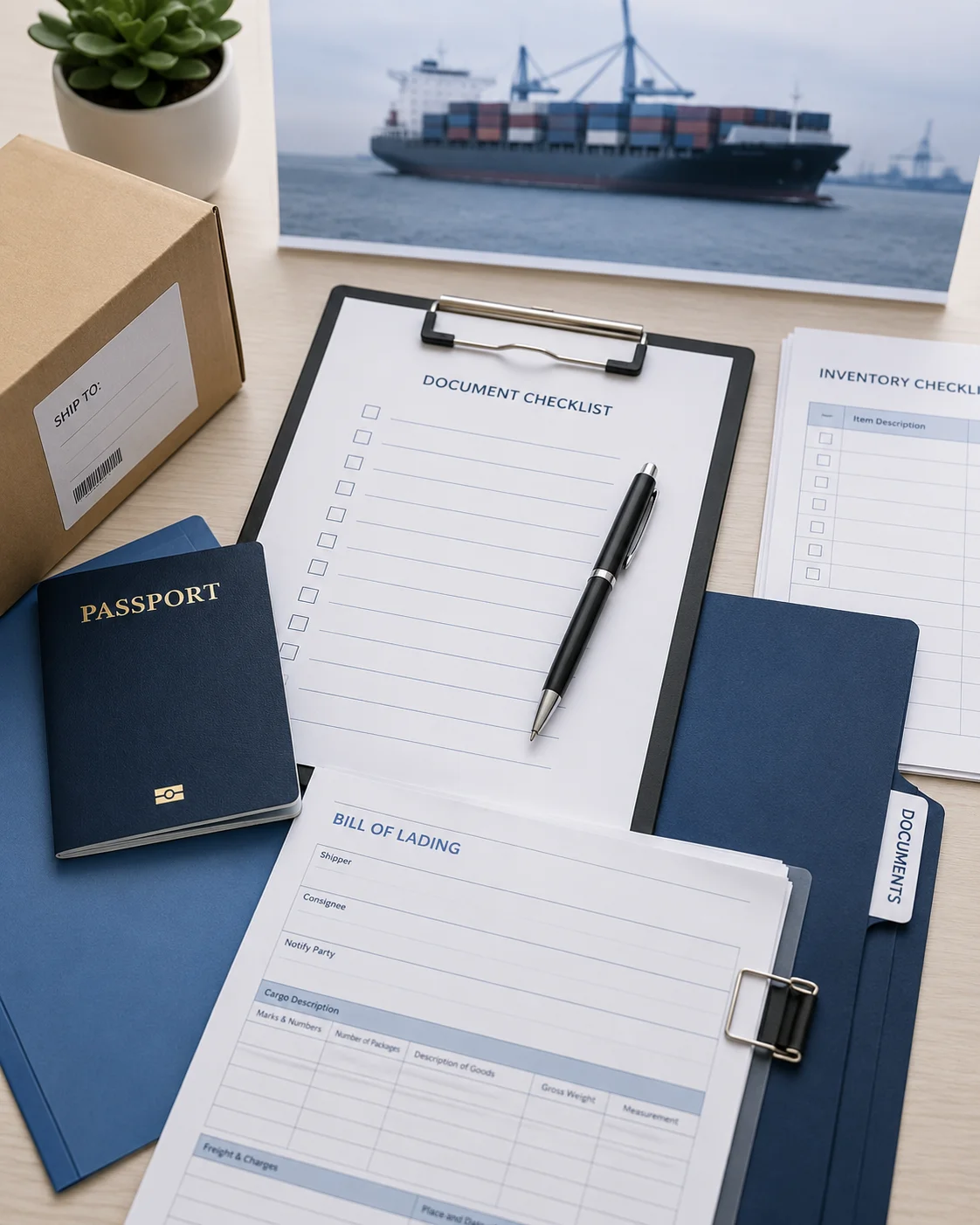
Documents
Documents required for importing used household goods, personal effects, and related shipments.
- Valid Lithuanian passport or ID card
- Original bill of lading (OBL) or airway bill (AWB), or CMR consignment note for road shipments
- Detailed packing list in English or Lithuanian
- *Must itemize all contents by carton/crate number*
- Pro-forma invoice or valued inventory
- Proof of prior residence abroad (e.g. deregistration certificate, employment contract, utility bills)
- *Must demonstrate residence outside the EU for at least 12 consecutive months*
- Proof of new residence in Lithuania (e.g. declared place of residence registration, employment contract, lease agreement)
- Customs declaration form
- Valid passport with Lithuanian residence permit or EU/EEA national ID card
- Original bill of lading (OBL) or airway bill (AWB), or CMR consignment note for road shipments
- Detailed packing list in English or Lithuanian
- Pro-forma invoice or valued inventory
- Proof of prior residence outside the EU for at least 12 consecutive months
- Lithuanian residence permit or EU registration certificate
- *EU/EEA citizens: EU registration certificate from the Migration Department. Non-EU citizens: valid national visa (D-type) or residence permit.*
- Proof of employment or other legitimate purpose for establishing residence (employment contract, university enrolment, etc.)
- Customs declaration form
- Diplomatic passport or official identification
- Note verbale from the sending country's embassy or the Lithuanian Ministry of Foreign Affairs
- Packing list
- Bill of lading / airway bill / CMR
- Customs declaration form
- *Diplomatic shipments are exempt from duties and taxes under the Vienna Convention. Clearance is coordinated through the Protocol Department of the Ministry of Foreign Affairs.*
Specific Information
Temporary import: Household goods and personal effects may be temporarily imported duty- and tax-free for a period of up to 24 months. This is commonly used for foreign workers on fixed-term contracts. The temporary import period may be extended upon application to Lithuanian Customs. At the end of the period, goods must be re-exported or formally imported with applicable duties and taxes.
New goods within shipments: New, unused items (still in original packaging or with tags) are not eligible for duty-free relief and may be assessed duty and 21% VAT based on their value. Alcohol and tobacco products within household shipments are also not covered by the transfer-of-residence exemption and are subject to excise duties.
ISPM 15 (wood packaging): All solid wood packaging material (pallets, crates, dunnage) used in shipments entering Lithuania from outside the EU must comply with ISPM 15 standards, meaning the wood must be heat-treated or fumigated and bear the IPPC stamp. Non-compliant wood packaging may result in the shipment being refused entry, treated at the importer's expense, or destroyed.
Pre-arrival import with guarantee: In certain circumstances, goods may be cleared before the importer has formally established residence, provided a bank guarantee is lodged covering the full duty and VAT liability. The guarantee is released once proof of residence is submitted within the stipulated timeframe. Confirm availability and conditions with the destination agent.
Bank guarantee / deposit: Lithuanian Customs may require a bank guarantee or cash deposit for temporary imports to secure the potential duty and VAT liability. The guarantee is released upon re-export of the goods or upon conversion to permanent import with payment of duties.
EORI number: An EORI (Economic Operators Registration and Identification) number is required for customs declarations in Lithuania. The destination agent typically handles this, but commercial shippers or individuals importing frequently should register with Lithuanian Customs.
Resale restriction: Goods imported duty-free under the transfer-of-residence relief may not be lent, pledged, hired out, or sold for a period of 12 months from the date of import. If goods are disposed of within this period, the applicable customs duties and VAT become payable.
Duties & Taxes
Duty-free conditions (transfer of residence): Under EU Council Regulation 1186/2009, personal property may be imported duty-free when transferring normal place of residence to Lithuania, provided the importer has resided outside the EU customs territory for at least 12 consecutive months, the goods have been in the importer's possession and use for at least 6 months, and the goods are intended for personal use at the new residence. Goods must be imported within 12 months of the date residence is established in Lithuania.
VAT: Lithuania's standard VAT rate is 21%. Goods qualifying under the transfer-of-residence relief are exempt from both customs duty and VAT. Goods that do not qualify (e.g. new items, commercial quantities, items owned less than 6 months) are subject to the applicable customs duty rate plus 21% VAT.
Prohibited & Restricted Items
Prohibited Items
- Narcotic drugs and psychotropic substances
- Firearms, ammunition, and explosives [Permit Required]
- *Import possible with a valid European Firearms Pass (within EU) or a Lithuanian police-issued import permit (from non-EU). Contact the Lithuanian Police Department for procedures.*
- Meat, milk, and dairy products from non-EU countries
- *Limited exceptions: up to 10 kg from Andorra, Faroe Islands, Greenland, and Iceland. Up to 2 kg of powdered baby milk, baby food, and special medical food from other non-EU countries, provided it is sealed, branded, and does not require refrigeration. Up to 20 kg of eviscerated fish.*
- Products derived from protected species (ivory, tortoise shell, coral, reptile skins, certain tropical hardwoods, etc.) [CITES]
- *Import requires a valid CITES permit. Fur coats, leather goods, and other products made from protected species require special authorization from the Lithuanian Environmental Protection Agency.*
- Counterfeit goods and goods infringing intellectual property rights
- Certain plant and plant products without a phytosanitary certificate [Permit Required]
- *Live plants, seeds, soil, and certain cut flowers from non-EU countries require a phytosanitary certificate issued by the exporting country's plant protection authority.*
- Pornographic material involving minors
- Goods originating from countries subject to EU trade sanctions or embargoes
- *As of 2026, comprehensive EU sanctions packages restrict or prohibit imports of certain goods from Russia, Belarus, and other sanctioned jurisdictions. Verify current sanctions with Lithuanian Customs before shipping.*
- Radar detectors and certain radio-frequency jamming equipment
Restricted / Dutiable Items
Intra-EU Imports (from another EU Member State)
There are no customs limits on goods transported between EU member states for personal use. However, Lithuanian customs officials may question travellers carrying quantities above the following indicative thresholds, which are considered evidence of commercial intent:
Tobacco: 800 cigarettes, 400 cigarillos (max 3g each), 200 cigars, 1 kg smoking tobacco.
Alcohol: 10 litres of spirits over 22% ABV, 20 litres of spirits/fortified wine under 22% ABV, 90 litres of wine (max 60 litres sparkling), 110 litres of beer.
Quantities exceeding these thresholds may be seized if customs officials determine they are of a commercial nature.
Non-EU Imports by Air or Sea
Travellers aged 17 or over arriving from outside the EU by air or sea may import the following quantities free of duty and tax:
Tobacco: 200 cigarettes, or 100 cigarillos, or 50 cigars, or 250 g smoking tobacco. These are alternative allowances (each constitutes 100% of the total allowance) and may be combined proportionally.
Alcohol: 1 litre of spirits over 22% ABV or un-denatured ethyl alcohol over 80% ABV; or 2 litres of spirits/fortified wine under 22% ABV. Plus: 4 litres of still wine. Plus: 16 litres of beer. The first two categories may be combined proportionally (total alcohol volume not exceeding 100%).
Other goods: Personal items of a non-commercial nature up to a value of EUR 430 per person. For travellers under 15 years of age, the threshold is EUR 150.
Medication: For personal use only, in quantities consistent with personal needs.
Non-EU Imports by Land
Lithuania shares land borders with Belarus and the Kaliningrad exclave of Russia (both non-EU). Significantly lower duty-free allowances apply to overland arrivals from non-EU countries:
Tobacco: 40 cigarettes, or 20 cigarillos, or 10 cigars, or 50 g smoking tobacco.
Alcohol: 1 litre of spirits over 22% ABV or 1 litre under 22% ABV; plus 0.5 litres of wine; plus 2 litres of beer. (Frontier-zone residents and workers may face further reduced allowances.)
Other goods: Personal items of a non-commercial nature up to a value of EUR 300 per person. For travellers under 15 years of age, the threshold is EUR 150.
Currency
No restrictions on transporting cash between EU member states, though amounts of EUR 10,000 or more may be subject to inquiry. When entering Lithuania from a non-EU country, cash amounts equivalent to EUR 10,000 or more (in any currency, including traveller's cheques and other monetary instruments) must be declared to customs.
Importing a Used Personal Vehicle
Required Documents
- Original vehicle registration certificate (title) from the country of origin
- Proof of ownership for at least 6 months prior to the transfer of residence
- *Purchase contract, insurance records, or registration history*
- Valid passport and Lithuanian residence permit or EU registration certificate
- Proof of deregistration from the country of origin (if applicable)
- Customs declaration
- Certificate of Conformity (COC) or individual vehicle approval documentation
- *Required for EU type-approval / homologation*
- Valid technical inspection certificate (roadworthiness test) from the country of origin
- *Must be current at the time of import; Lithuanian technical inspection (TA) will be required for registration*
- Proof of valid motor insurance (at minimum, third-party liability valid in the EU)
Specific Information
Duty-free conditions: A motor vehicle may be imported duty-free under the transfer-of-residence provisions (EU Regulation 1186/2009) if the owner has possessed and used the vehicle for at least 6 months, has resided outside the EU for at least 12 months, and is transferring their normal residence to Lithuania. The vehicle must be for personal use only.
Ownership duration: The vehicle must have been registered in the importer's name and used by them for a minimum of 6 months prior to the date of transfer of residence. Vehicles owned for less than 6 months do not qualify for relief and will be subject to customs duty (typically 6.5% for passenger vehicles from non-EU countries) plus 21% VAT.
Registration tax: Lithuania does not levy a separate vehicle registration tax. However, an annual vehicle tax applies based on CO2 emissions for vehicles first registered from 2025 onwards. A road user charge (vignette) is required for use of national roads.
Technical inspection (TA): All vehicles must pass a Lithuanian technical inspection (technine apziura, TA) before they can be registered. Inspections are carried out at authorized inspection centres. Vehicles imported from outside the EU may require modifications to meet EU/Lithuanian technical standards (e.g. headlight alignment, emissions compliance). The inspection must be completed within 30 days of import.
Registration with Regitra: Vehicles must be registered with Regitra (AB Regitra), the state vehicle registration authority. Registration should be completed promptly after passing TA. Temporary transit plates may be issued for the purpose of driving the vehicle to the inspection centre.
Homologation: Vehicles originally manufactured for non-EU markets (e.g. US-spec vehicles) require individual vehicle approval to confirm compliance with EU type-approval requirements. This process involves inspection for emissions standards, safety equipment (e.g. EU-compliant lighting, side markers), and other technical requirements. Homologation can be time-consuming and costly; it is recommended to confirm feasibility with the destination agent before shipping.
Resale restriction: Vehicles imported duty-free under transfer-of-residence relief may not be sold, lent, hired out, or otherwise disposed of for 12 months from the date of import. Disposal within this period triggers payment of the full customs duty and VAT that would have been due at import.
Intra-EU transfers: Vehicles transferred from another EU member state do not require customs clearance. However, they must still be registered with Regitra and pass a Lithuanian TA. VAT is generally not payable on intra-EU transfers of used personal vehicles (as VAT was paid in the originating member state), but confirm with the destination agent.
Pets
- Valid European Pet Passport issued by an authorized veterinarian in the country of departure **From Another EU / EEA Member State**
- *Must contain up-to-date rabies vaccination record and microchip details* **From Another EU / EEA Member State**
- ISO-compliant microchip (ISO 11784/11785, 15-digit) **From Another EU / EEA Member State**
- *Microchip must have been implanted before the rabies vaccination was administered* **From Another EU / EEA Member State**
- Valid rabies vaccination **From Another EU / EEA Member State**
- *Primary vaccination must have been given at least 21 days before travel; booster vaccinations must be administered before the previous vaccination expires to remain valid* **From Another EU / EEA Member State**
- ISO-compliant microchip (ISO 11784/11785, 15-digit) **From a Non-EU Country**
- *If a non-ISO microchip is used, the owner must provide their own compatible reader* **From a Non-EU Country**
- Valid rabies vaccination administered after the microchip was implanted **From a Non-EU Country**
- *Minimum age for vaccination: 12 weeks. At least 21 days must elapse after primary vaccination before travel.* **From a Non-EU Country**
- EU Animal Health Certificate issued by an official (government) veterinarian in the country of departure **From a Non-EU Country**
- *Must be issued no more than 10 days before the pet arrives in the EU. Valid for onward travel within the EU for 4 months from the date of issue or until the rabies vaccination expires, whichever is sooner.* **From a Non-EU Country**
- Rabies antibody titration test (RNATT) result of at least 0.5 IU/ml **From a Non-EU Country**
- *Required when travelling from countries not listed in Annex II of EU Regulation 577/2013 (i.e. most non-EU countries outside of Norway, Switzerland, etc.). The blood sample must be taken at least 30 days after vaccination and at least 3 months before travel. The test must be performed by an EU-approved laboratory. Once a valid titre result is obtained, it remains valid for life provided rabies boosters are kept current.* **From a Non-EU Country**
- Written declaration that the movement is non-commercial (max 5 pets per person, no change of ownership) **From a Non-EU Country**
Regulatory note: Lithuania is one of a small number of EU member states that permits entry of young pets (under 12 weeks old, or 12-16 weeks old and vaccinated but not yet immune) that have not completed their rabies vaccination protocol, subject to specific conditions. See details below.
Identification: An ISO 11784/11785 compliant microchip is the only accepted form of identification. Tattoos are accepted only if they were applied before 3 July 2011 and remain clearly legible.
Minimum age: Pets must be at least 15 weeks old to enter Lithuania from a non-EU country under standard rules (12 weeks minimum age for vaccination + 21-day waiting period). However, Lithuania permits entry of young, unvaccinated pets (under 12 weeks) or young vaccinated-but-not-yet-immune pets (12-16 weeks) from other EU countries, provided they carry a declaration that they have had no contact with wild animals susceptible to rabies since birth, or are accompanied by their vaccinated mother.
Quarantine: Lithuania does not impose quarantine on pets that arrive with all required documentation in order. Non-compliant animals may be placed in isolation at the owner's expense until requirements are met, returned to the country of origin, or in extreme cases, euthanised.
Echinococcus treatment: Lithuania does not require tapeworm (Echinococcus multilocularis) treatment for dogs. This requirement applies only to Finland, Ireland, Malta, Norway, and Northern Ireland.
Designated points of entry: When arriving from a non-EU country, pets must enter through a designated travellers' point of entry where veterinary border checks are carried out. At the point of entry, officials will check the pet's documents and verify the microchip.
Species covered: EU pet travel rules (Regulation 576/2013) cover dogs, cats, and ferrets. Other pet species (birds, rabbits, reptiles, etc.) are subject to separate national and EU regulations; confirm requirements with the destination agent.
Common mistakes that cause delays: Microchip implanted after (rather than before) the rabies vaccination, rendering the vaccination invalid. Rabies booster given after the previous vaccination expired, resetting the 21-day waiting period. Antibody titre test blood sample taken fewer than 30 days after vaccination. EU Animal Health Certificate issued more than 10 days before arrival in the EU. Travelling with more than 5 pets without competition/show documentation.
Consignment Instructions
Recommended: Contact the destination agent to ensure all requirements have been met prior to import, especially for differences regarding air / sea / road shipments.
Inventory requirements: A detailed, itemized packing list is required for all shipments. The list should describe each item (not just "box of household goods"), assign values to items where applicable, and note the condition (used/new). The packing list should be prepared in English or Lithuanian.
Shipment timing: Goods should arrive within 12 months of the importer establishing residence in Lithuania to qualify for duty-free relief. Goods may arrive before the owner under certain conditions, but a bank guarantee may be required pending proof of residence. Shipments arriving more than 12 months after establishment of residence are not eligible for transfer-of-residence relief.
Split shipments: The transfer-of-residence relief allows goods to be imported in multiple shipments within the 12-month window. Each shipment must be declared to customs with reference to the initial relief application.
Customs inspection: Lithuanian Customs reserves the right to physically inspect any shipment. Inspections are more common for shipments arriving from outside the EU, and for shipments where the packing list lacks sufficient detail. The importer or their authorized representative should be available to attend the inspection.
Port of entry: The principal sea port for Lithuania is Klaipeda. Air shipments typically arrive through Vilnius International Airport. Road shipments from non-EU countries enter through border crossing points with Belarus and the Kaliningrad exclave of Russia.
Unpredictable expenses: Importers should budget for potential demurrage and storage charges if customs clearance is delayed, inspection fees if a physical examination is required, and agent handling fees. The destination agent can provide estimates.
EU sanctions note: Given Lithuania's proximity to Russia and Belarus, shipments routed through or originating from these countries may be subject to additional scrutiny under EU sanctions regulations. Confirm routing and documentation requirements with the destination agent well in advance of shipping.
Cultural & Other Information
- OpenFactBook -- Lithuania *(community-maintained successor to the CIA World Factbook, which was discontinued in February 2026)*
- Wikipedia -- Lithuania
- Lithuanian Customs (Lietuvos Respublikos muitine)
- Regitra -- Vehicle Registration Authority
- State Food and Veterinary Service (VMVT) -- Pet Travel Regulations
- Ministry of Foreign Affairs of the Republic of Lithuania
- State Tax Inspectorate (VMI)
- EU Pet Travel Rules
International Association of Movers (IAM) 1600 Duke Street, Suite 440 · Alexandria, VA 22314, USA Phone: +1 703-317-9950 · iamovers.org
Useful resources