


Explore sections
Guide Details
Household Goods
Documents
Documents required for importing used household goods, personal effects, and related shipments.
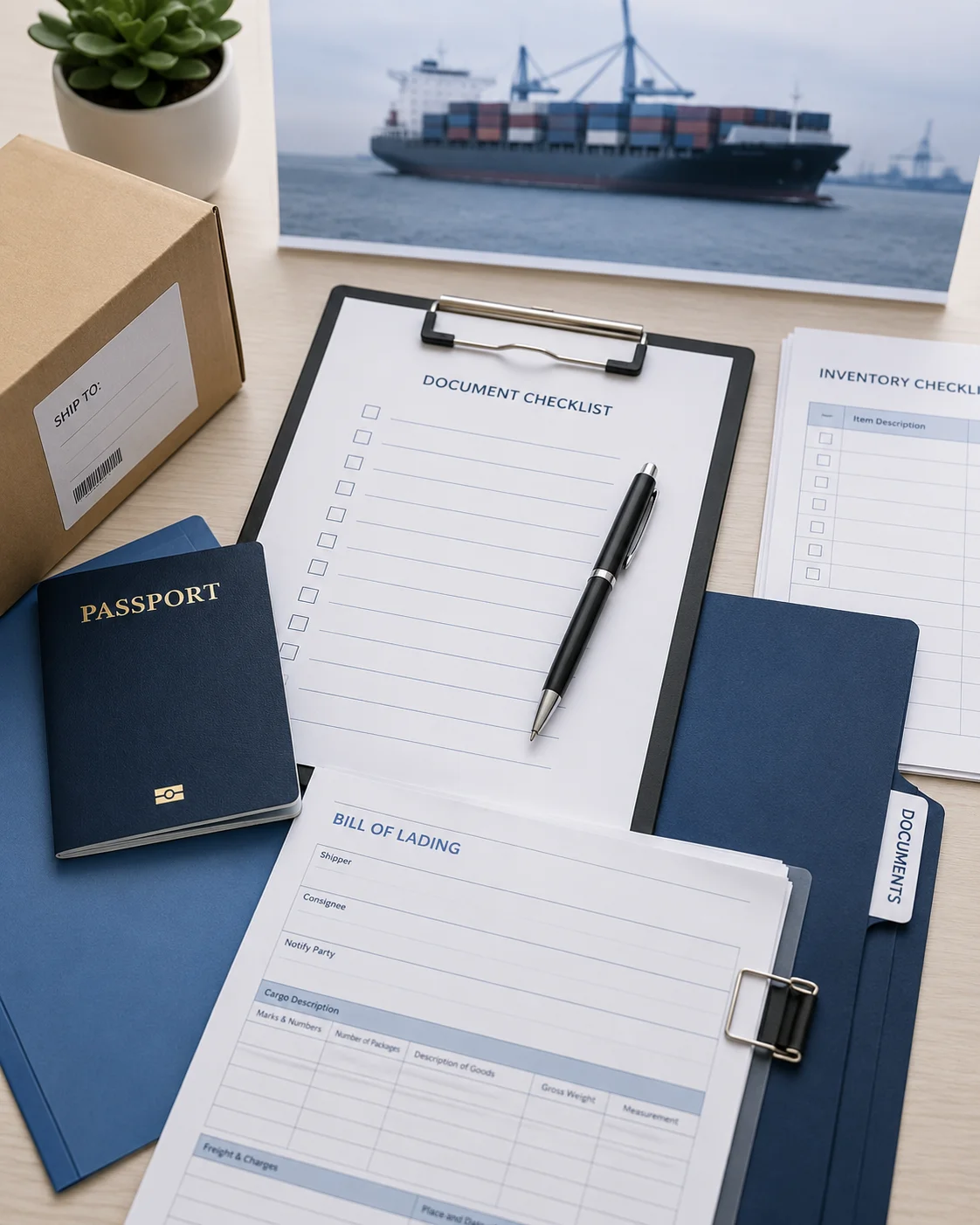
- Passport (copy including photo page and page showing re-entry stamp by Namibian immigration)
- Original Bill of Lading (OBL) / Air Waybill (AWB) / Waybill / Telex Release
- Clear packing list
- Detailed valued inventory in the currency of the origin country
- Completed NA304 form (3 copies, compulsory)
- Completed P1.160 form (3 copies, compulsory)
- Copy of carrier's manifest or Bill of Lading (compulsory)
- Residence permit / work permit
- Letter of exemption on duties and VAT, applied for through the Namibia Revenue Agency (NamRA). The application requires: copy of foreign passport (photo page and re-entry stamp page), original completed NA304, original completed P1.160, copy of the valued inventory packing list, and copies of the work contract (sensitive data may be redacted)
- Diplomatic clearance / Certificate A, issued by the Embassy and stamped by the Ministry of Foreign Affairs (diplomats only)
Specific Information
Returning residents must have lived abroad for at least 6 consecutive months to qualify for duty-free importation of household goods and personal effects.
Work permit holders currently residing in Namibia on a working visa must pay 20% duties and 16.5% VAT on the used goods value of their shipment. However, if a work permit valid for more than 6 months has already been stamped in the passport, the importer may apply for exemption. This application must be made as soon as possible at the Windhoek Customs Information Centre (tel: +264 61 209 2047) before the shipment arrives.
Diplomatic shipments may be imported duty-free provided the Certificate A has been issued by the relevant Embassy and stamped by the Ministry of Foreign Affairs.
The importer's status determines whether duties and VAT apply. Apply for the tax and duties exemption letter as early as possible, as it must be obtained before the shipment arrives.
If the permit has not been stamped in the passport by the time the shipment arrives, or if the exemption is not granted, the shipper may release the cargo by making a provisional payment of 20% duties and 16.5% VAT. This payment is fully refundable once the situation is regularised.
ISPM 15: All wooden packing materials must comply with ISPM 15 phytosanitary standards. Confirm requirements with the destination agent before packing.
Prohibited & Restricted Items
Prohibited Items
The following items are prohibited from import into Namibia:
- Narcotics, drugs, and controlled substances
- Materials that incite violence, hatred, or sedition
- Pornographic books, magazines, and materials
- Walkie-talkie radios
- Feathers, furs, skins, tusks, and other products from animals listed under protected species regulations *(CITES)*
- Endangered species and their derivatives *(CITES)*
- Certain prohibited dog breeds (pit bulls, Rottweilers, and others; confirm current list with MAWLR) *(Permit Required for exceptions)*
Restricted / Dutiable Items
Traveller allowances (hand-carry or accompanying baggage): 400 cigarettes, 50 cigars, or 250 grams of tobacco; 50 ml of perfume and 250 ml of eau de toilette.
Alcohol allowances: Alcohol is allowed with no restrictions for diplomats in possession of a Certificate A. It is recommended to consult the Embassy regarding any potential internal quotas before shipping. For non-diplomatic importers, confirm current alcohol allowances with the destination agent.
Firearms: Import requires a permit. Contact the destination agent for current procedures and permit requirements.
Plants and plant material: Certain plants and plant materials require a phytosanitary certificate and an import licence. Confirm requirements with the destination agent before shipping.
New goods: New items included in a removal shipment are subject to duties and VAT. Duties are 20% and VAT is 16.5%.
Importing a Used Personal Vehicle
Required Documents
- Completed NA304 form
- Import permit (4 copies)
- Registration documents
- Proof of value / purchase invoice
- Original Bill of Lading
- Diplomatic Certificate, completed and signed by the Embassy or Consulate and stamped by the Ministry of Foreign Affairs, with proof of value (diplomats only)
Specific Information
One motor vehicle per family may be imported duty-free, provided the vehicle has been owned and used for at least 1 year prior to shipment. The tax exemption must be applied for at NamRA before the vehicle arrives.
For non-exempt importers, VAT of 16.5% is payable on the assessed vehicle value, and customs duties of 25% apply.
Once imported, a vehicle may not be sold or otherwise disposed of for a period of 2 years.
Diplomats are fully exempt from duties and taxes on vehicle imports.
For temporary residents, the import permit is not required if the vehicle is re-exported within 1 year of importation.
Pets
- ISO-compatible microchip (ISO 11784/11785). The microchip must be implanted before the rabies vaccination.
- Rabies vaccination certificate. Vaccination must have been administered between 30 days and 12 months prior to entry. Annual boosters are required; multi-year vaccinations are accepted only if they remain current within the 12-month window.
- Core vaccinations: dogs must be vaccinated against distemper, hepatitis, leptospirosis, parvovirus, and parainfluenza; cats against feline viral rhinotracheitis, panleukopenia, calicivirus, and feline leukemia.
- International veterinary health certificate, issued within the timeframe required by the country of origin, confirming the pet is healthy, free of parasites, and has current inoculations. The certificate must include the microchip number.
- Import permit from the Directorate of Veterinary Services, Ministry of Agriculture, Water and Land Reform (MAWLR). Permits are valid for a limited period and for one consignment only. Allow at least 3 working days for the permit to be processed; apply well in advance of travel. Contact: Vet.Permits@mawlr.gov.na, tel: +264 61 208 7892.
The microchip must be implanted before the rabies vaccination. If vaccinated before microchipping, the vaccination does not count and the sequence must be restarted.
Pets from South Africa may travel on an inter-territorial movement permit in addition to the documents above; this permit is obtainable through a state veterinarian in South Africa. The same procedure applies in reverse for pets travelling from Namibia to South Africa.
Certain dog breeds including pit bulls and Rottweilers are prohibited from entry due to safety regulations. Confirm the current breed restriction list with MAWLR or the destination agent before shipping.
Wolf hybrids and Savannah and Bengal cats (unless 5th generation or more removed from wild pedigree) cannot be imported under standard regulations.
Non-compliance with import requirements may result in refusal of entry, return to the country of origin, quarantine, or in the worst case, euthanasia. All associated costs are the responsibility of the importer.
Other pets (birds, rodents, reptiles, etc.) may be subject to additional or different requirements. Confirm with MAWLR or the destination agent well in advance.
Consignment Instructions
Recommended: Contact the destination agent to ensure all requirements have been met prior to import, especially for differences regarding air / sea / road shipments.
Tax exemption timing: Apply for the duties and VAT exemption letter through NamRA as early as possible. The exemption must be in hand before the shipment arrives. If it is not, a provisional payment of 20% duties and 16.5% VAT is required to release the cargo, which is refundable once the exemption is granted retrospectively.
Forms NA304 and P1.160: These Namibian customs forms are compulsory and must be completed correctly in triplicate (NA304) and quadruplicate (import permit for vehicles). Obtain the correct versions from the destination agent before shipping.
Valued inventory: The inventory must be detailed and valued in the currency of the origin country. Each item must carry a used-goods value.
SACU membership: Namibia is a member of the Southern African Customs Union (SACU), which also includes South Africa, Botswana, Lesotho, and Eswatini. Shipments originating from or transiting through other SACU member states may have different documentation requirements; confirm with the destination agent.
Principal port of entry: Walvis Bay is the primary seaport. Hosea Kutako International Airport (Windhoek) handles air freight. The Windhoek Customs Information Centre is the main contact point for exemption applications and queries (+264 61 209 2047).
Cultural & Other Information
Namibia is a country in southwestern Africa, bordered by South Africa to the south, Botswana to the east, Zambia and Angola to the north, and the Atlantic Ocean to the west. It is one of the least densely populated countries in the world, with a population of approximately 3 million. The capital and largest city is Windhoek. English is the official language; Afrikaans, Oshiwambo, and other indigenous languages are widely spoken. Namibia gained independence from South Africa in 1990 and has maintained a stable democracy since.
The economy is driven by mining (diamonds, uranium, and other minerals), tourism, fishing, and agriculture. Namibia's landscapes include the Namib Desert, one of the oldest deserts in the world, and the Etosha National Park. The country has a well-developed road network by regional standards and Walvis Bay is the principal deepwater port serving much of landlocked southern Africa.
Business is conducted primarily in English. Namibia is a member of SACU and SADC and maintains close economic ties with South Africa.
Reference Links
Useful resources