

Country Guides
Netherlands

Start here
Overview
Explore sections
Guide Details
Household Goods
Documents
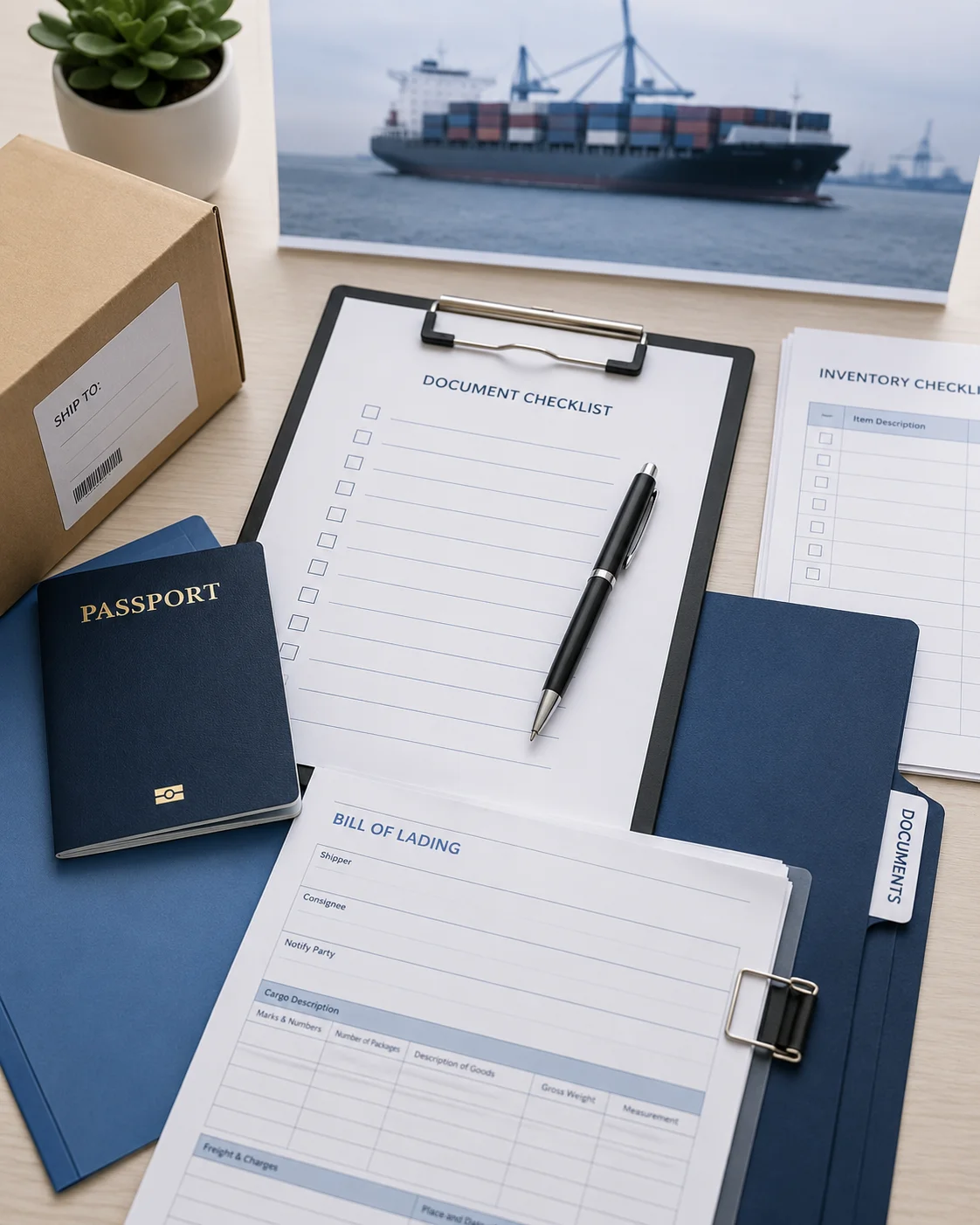
Documents required for importing used household goods, personal effects, and related shipments.
- Clear copy of passport
- Detailed inventory list of all items being imported
- Copy of registration at the town/city hall (gemeente) where the owner will reside. This document must state the country the owner is moving from. If municipal registration has not yet been completed, a proof of deregistration from the country of origin may be submitted instead, together with one of the following: a copy of a work contract or employer declaration confirming the period of employment abroad and the commencement of employment in the Netherlands (with date), or a copy of a rental agreement or purchase contract for the Netherlands residence (not older than 6 months).
- Bewijs van aanmelding (certificate from the population register of the municipality confirming intent to reside in the Netherlands)
- Diplomatic passport
- Aangifte / Douane 39 form (D39)
- Inventory in 2 copies
- Marriage certificate
- Certificate of residence
- Exemption of duties form
- Application for exemption for inheritance
- Copy of passport of applicant
- Registration of residence at town hall
- 2 signed inventory lists
- Notary Statement stating that the goods originate from an inheritance, the date of the testator's death, and the date the goods were acquired by the applicant
- For any motor vehicle included in the inheritance: original licence registration and purchase or ownership document
Specific Information
Fumigated container warning: All containers arriving at the Port of Rotterdam with an excessive concentration of fumigation gas (methyl bromide is the most commonly used toxic gas) will be removed from the logistics chain. Delays can run to several months before the container is released, and high costs are incurred during that period. Ensure containers have not been treated with methyl bromide or other gases above permitted thresholds before routing through Rotterdam. This applies equally to containers entering via Antwerp.
ISPM 15 and phytosanitary compliance: All wooden packing materials must comply with ISPM 15 standards. Plants and wood require a phytosanitary certificate. See Section 4 for details.
Duties & Taxes
Duty-free conditions for removal goods from outside the EU:
To qualify for duty-free importation into the Netherlands, all of the following conditions must be met:
- The owner must have resided outside the European Union for at least 12 months prior to the move.
- The goods must consist of household belongings that have been owned and used for at least 6 months.
- The goods must be imported within 12 months of the owner's date of arrival / registration in the Netherlands.
- The goods will not be sold, lent, rented, pawned, or given away for a period of 12 months after customs clearance.
Owners must apply to Customs for the exemption in the import declaration, supported by the signed inventory and municipal registration certificate. Works of art, antiques, and sports articles require no additional documentation if included as part of the household effects. New furniture and household articles are subject to duties.
Diplomatic shipments are duty-free provided the diplomat does not hold Dutch nationality, is not a permanent resident of the Netherlands, and has not been employed in the Netherlands for more than 10 years (this last condition applies specifically to administrative, technical, and service staff). Alcohol and cigarettes may be imported by diplomats subject to allowances set by the Ministry of Foreign Affairs; confirm with the Embassy before shipping.
Intra-EU moves: Goods moved within the EU are not subject to customs duties or import VAT. Normal EU free movement of goods applies.
Prohibited & Restricted Items
Prohibited Items
The following are prohibited from import into the Netherlands in household goods shipments:
- Narcotics and illegal drugs
- Pornographic materials
- Endangered species and products derived from CITES-listed fauna and flora *(CITES)*
- Weapons (including toy and imitation firearms, replica and alarm pistols, gas pistols, pepper sprays, knives, and stabbing, striking, or thrust weapons without a permit) *(Permit Required)*
- Ammunition without appropriate permit *(Permit Required)*
- Food in removal shipments (not permitted as a rule; exceptions apply for certain processed and branded products -- see Section 4)
- Counterfeit and pirated goods
Restricted / Dutiable Items
Alcohol and tobacco: Subject to excise duties and VAT. Diplomats may import limited quantities per Ministry of Foreign Affairs allowances. Alcohol and tobacco are dutiable, not prohibited, for non-diplomats. Confirm current duty rates with the destination agent.
Firearms and ammunition: Permits issued by Dutch Customs and authorisation from police authorities are required. Hunting and shooting firearms require a permit from Dutch authorities. See also Section 5.
Medicines: No documentation required if included as part of household effects and prescribed by a doctor. Medicines beyond personal use or without a prescription are not permitted. Owners are advised to carry a medical passport from their general practitioner to confirm personal use.
Plants, flowers, fruits, vegetables, and wood: A phytosanitary certificate from the country of origin is required. Without it, Customs will confiscate the items. This applies to all plant material including seeds and cut flowers.
Animal products and food: Food is not permitted in household goods shipments. A health certificate issued by the origin country's authorities is required for animal products including cheese, milk, eggs, meat, meat products, animal skins, and hunting trophies. All animal products are subject to veterinary examination on arrival. An exemption applies to processed products in which the animal ingredient is no longer identifiable (for example, chocolate). Powdered milk, baby food, and special medical foods may be permitted if not requiring refrigeration, packaged and branded, and in unopened, undamaged packaging. Contact the Dutch Embassy in the origin country if in doubt.
New furniture and household articles: Subject to import duties.
Electrical and household appliances: Brand name and production/serial number must be stated on the inventory.
Works of art and antiques: No additional documentation required if part of household effects.
Precious metals, jewellery, coins, carpets, and sports articles: No documentation required if part of household effects.
Strategic goods and environmentally restricted items: The Netherlands enforces EU restrictions on import of strategic goods (weapons, certain technologies) and environmentally restricted items (ozone-depleting substances, certain chemicals). The owner is at all times responsible for the contents of the shipment. Consult Dutch Customs or a licensed customs broker if in any doubt about a specific item.
Importing a Used Personal Vehicle
Required Documents
- Invoice or proof of ownership / property justification
- Registration card (original foreign registration certificate -- RDW will collect this at inspection)
- Certificate of residence
- Copy of foreign insurance certificate or proof of insurance
- Document from Dutch Customs (Belastingdienst) confirming the vehicle qualifies as household goods (for tax-free import)
Specific Information
Tax-free import for relocating residents: If you are moving to the Netherlands and bringing a vehicle you have owned and used for at least 6 months, and you have resided outside the Netherlands (or outside the EU for a non-EU-origin vehicle) for at least 1 year, you are generally entitled to import the vehicle free of BPM (motorrijtuigenbelasting / private vehicle and motorcycle tax). A BPM return must still be filed on paper with the Tax Administration (Belastingdienst); this cannot be done online.
Registration with RDW: All imported vehicles must be inspected and registered with the RDW (Rijksdienst voor het Wegverkeer), the Netherlands Vehicle Authority. An RDW technical inspection (APK) is required before a Dutch registration certificate can be issued. Application for BPM exemption should be requested from Dutch Customs before the RDW inspection. Allow 4 to 6 weeks for the full exemption and registration process.
Vehicles from outside the EU: If relocating from a non-EU country, file an import declaration with Dutch Customs before the RDW inspection to avoid paying BPM, VAT, and/or import duties. The standard EU customs duty on vehicles from non-EU countries is 10% of vehicle value. BPM is calculated based on CO2 emissions and vehicle age; lower-emission vehicles pay less. Fully electric vehicles are currently exempt from BPM as of 2025.
Already registered in the Netherlands BRP: Once you are registered in the Dutch Population Register (BRP), you cannot legally drive a foreign-registered vehicle on Dutch roads if it is registered in your name. Before registration, a temporary 2-week driving exemption can be applied for online via the Belastingdienst to drive the vehicle to the RDW inspection.
Vehicles from EU countries: If the vehicle has a valid EU technical inspection certificate, it can be used to drive in the Netherlands with that certificate. BPM is still payable on registration; VAT was paid in the origin country.
Pets
The Netherlands applies EU-wide pet import regulations. Requirements differ depending on whether the pet is travelling from an EU/listed country or a non-listed third country.
Special Categories
From EU Countries, Norway, Liechtenstein, or Switzerland
- EU Pet Passport (issued by an EU/EEA vet), including microchip details and valid rabies vaccination record
- Rabies vaccination must have been administered at least 21 days before travel and must remain valid on arrival
- Microchip (ISO 11784/11785) implanted on or before the date of rabies vaccination
From Non-EU Countries (Third Countries)
From listed low-risk third countries (see EU list):
- ISO-compatible microchip (implanted before or on the same day as rabies vaccination)
- Current rabies vaccination (at least 21 days old, valid on arrival)
- Official veterinary health certificate, issued within 10 days of the Border Inspection Post check at entry, by an official veterinarian in the country of origin and endorsed by the competent authority. Valid for 4 months after the EU entry check for onward movement within the EU.
From unlisted high-risk third countries:
All of the above plus a rabies antibody titre (titer) test (FAVN or equivalent), showing a result of at least 0.5 IU/ml:
- Blood sample drawn at least 30 days after the rabies vaccination
- Test performed at an EU-approved laboratory
- A waiting period of 3 months from the date of a successful test result before travel to the EU
Russia and Belarus have been classified as high-risk countries since 16 September 2024.
From the United Kingdom:
An Animal Health Certificate (AHC) is required in place of the EU Pet Passport.
For dogs from the USA (additional requirement, effective April 2025):
Dog owners must register with RVO (Rijksdienst voor Ondernemend Nederland) and obtain a UBN (livestock holder registration number) before the first Dutch vet visit. Apply at my.rvo.nl. The one-time fee is approximately EUR 23. Within 14 days of the dog's arrival, take the dog to a Dutch vet to complete import registration and obtain a Dutch EU Pet Passport. This requirement applies to dogs; cats held by private owners are not subject to UBN registration.
General
All pets must enter through a designated Border Inspection Post. For air arrivals, this is Amsterdam Schiphol Airport. The microchip is verified, and the health certificate and vaccination records are checked on arrival.
Pets meeting all requirements do not require quarantine. Maximum 5 pets per person in non-commercial movement. Pets must not be intended for sale or transfer of ownership.
The NVWA (Netherlands Food and Consumer Product Safety Authority) is the competent authority for pet import rules; always contact your destination agent in the Netherlands before shipping animals.
Consignment Instructions
Recommended: Contact the destination agent to ensure all requirements have been met prior to import, especially for differences regarding air / sea shipments.
Municipal registration: The Bewijs van aanmelding (municipality registration certificate) is a key document and must reference the country of origin. If the owner has not yet registered, alternative proof (deregistration certificate plus work contract or rental agreement) must be provided. Delays in registration can hold up customs processing.
12-month rule: All goods must arrive within 12 months of the owner's arrival date in the Netherlands, and the owner must have resided outside the EU for at least 12 months before the move. Plan the shipment timeline accordingly.
Fumigation warning: Do not allow containers to be treated with methyl bromide or other prohibited fumigation agents. Containers arriving at Rotterdam or Antwerp with excessive gas concentrations are removed from the logistics chain and can be held for months at significant cost. Notify the origin agent explicitly.
EORI number: Importers may need an EORI (Economic Operators Registration and Identification) number for customs declarations. Confirm with the destination agent whether this applies to the specific shipment.
Inventory standards: The inventory must be detailed and signed by the owner. All electrical and electronic items must list brand name and serial number. Vague descriptions are not acceptable.
Principal port of entry: Rotterdam (primary seaport) and Schiphol (Amsterdam, air freight). Rotterdam is one of the busiest ports in the world; allow for standard port processing times and confirm logistics with the destination agent.
Cultural & Other Information
The Netherlands is a parliamentary constitutional monarchy in northwestern Europe, bordered by Germany to the east and Belgium to the south, with a North Sea coastline to the north and west. Amsterdam is the capital; The Hague (Den Haag) is the seat of government. The Netherlands is a founding member of the EU, NATO, and the Eurozone. The currency is the Euro. Dutch (Nederlands) is the official language; English is very widely spoken. The population is approximately 18 million.
The Netherlands has one of the most open economies in the world, a highly developed logistics infrastructure, and one of the world's busiest container ports at Rotterdam. It is home to the headquarters of many multinational corporations and international organisations. Business culture is direct, consensus-oriented, and punctual.
Goods entering from outside the EU pass through EU customs at the Netherlands' border. The Netherlands applies all EU customs regulations and free movement of goods rules apply to intra-EU shipments. The Dutch tax authority (Belastingdienst) handles BPM, VAT, and customs declarations jointly with Dutch Customs (Douane).
Reference Links
Useful resources