

Country Guides
New Caledonia

TERRITORY NOTE: New Caledonia is a French special collectivity (collectivité sui generis) in the South Pacific. It is not part of the EU customs territory and operates its own separate customs regime administered by the Direction des Douanes de Nouvelle-Calédonie. French customs rules applicable to metropolitan France do not apply here. The local currency is the CFP franc (XPF), which is pegged to the euro.
Start here
Overview
Explore sections
Guide Details
Household Goods
Documents
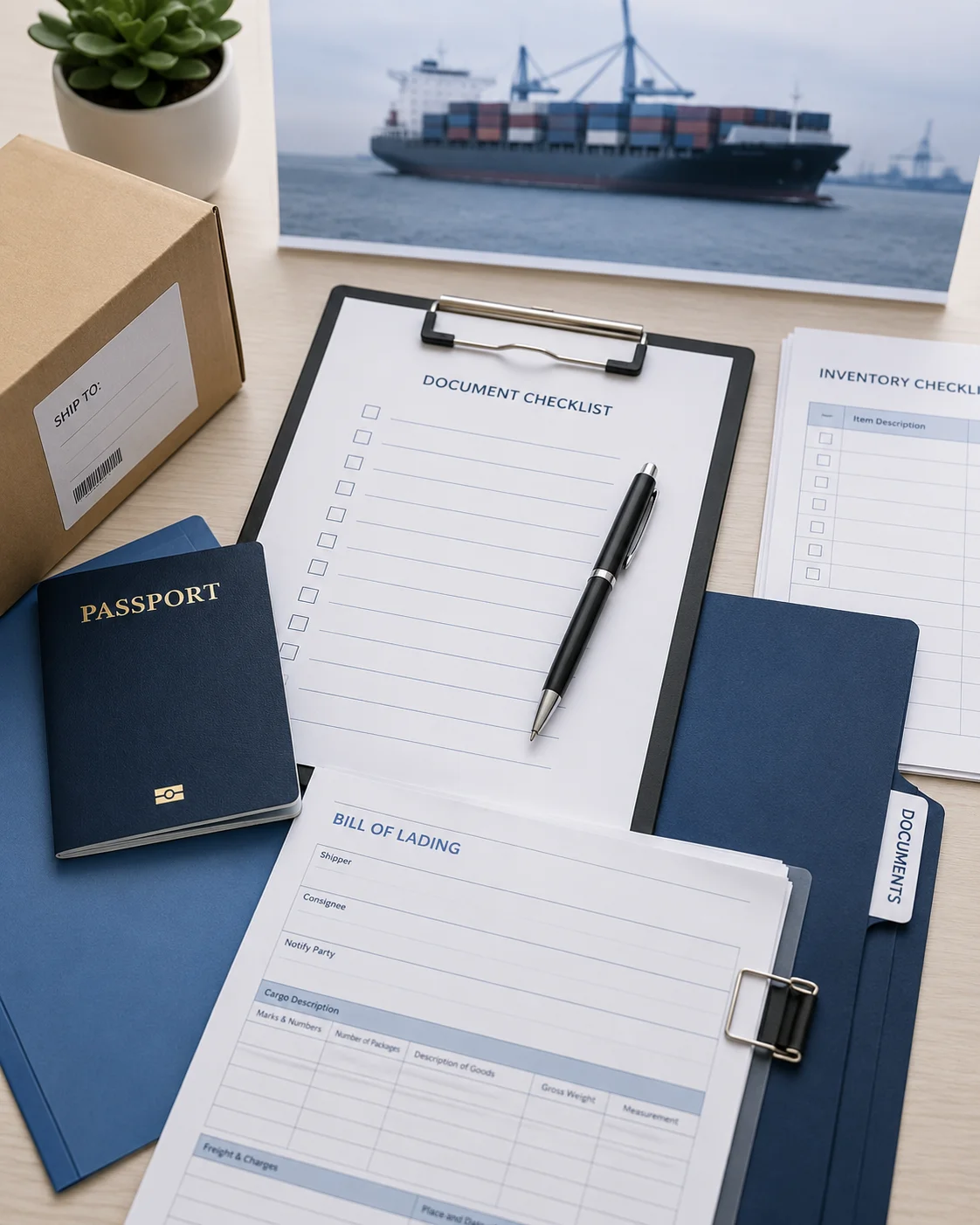
Documents required for importing used household goods, personal effects, and related shipments.
- Information form with arrival contact details and date of arrival in New Caledonia
- Detailed, valued, dated, and signed inventory for used effects, in French, in euros, with destination address
- Declaration of prohibited articles, dated and signed (returned to the agent)
- Copy of invoices for all electrical items over 3 months old; if invoices are unavailable, complete, date, and sign the "Attestation concernant l'acquisition des appareils usagés" form stating month and year of purchase
- Change of residence certificate (for privately employed individuals), reflecting the period spent in the country of origin and the departure date from France; must be submitted prior to shipment
- Copy of transfer order (for civil servants and military); if unavailable, a change of residence certificate must be submitted to the removal company prior to shipment
- Colour scanned copy of passport or ID (both sides) if European
- Non-cession declaration, completed, dated, and signed
- Noumea information note, dated and signed
A separate inventory, dated and signed, stating the exact value of each new item as listed on the accompanying invoice, plus all original invoices reflecting the shipper's name and destination address, plus a completed tax refund application form.
Specific Information
Resale restriction. In the five years following the final importation date, local customs must be informed if personal effects are lent, lent against surety, rented out, or transferred to another person.
All-new shipments. If a shipment consists exclusively of new effects, customs clearance in New Caledonia will be conducted by a freight forwarder whose costs are for the importer's account.
Language. All inventories must be in French and valued in euros.
ISPM 15. All wood packaging materials must comply with ISPM 15 and bear the appropriate treatment mark.
Duties & Taxes
New items. Personal effects less than 3 months old, or less than 18 months old if originating from outside the EU, are subject to local taxes. To avoid this, new effects must have remained in the shipper's possession for at least 3 months before the transfer of residence (18 months for customers from outside the EEC). New items must be listed on a separate inventory with all invoices submitted to the local agent.
Prohibited & Restricted Items
Prohibited Items
- Narcotics and controlled substances
- Firearms and weapons without prior authorisation
- Prohibited dog breeds (see Section 3)
- Pets from non-approved countries of origin (see Section 3)
- Species protected under CITES without valid permits
- Pornographic materials involving minors
- Goods subject to French or international sanctions
- Soil and growing medium (strict biosecurity controls)
- Uncertified wood packaging (non-ISPM 15 compliant)
Restricted / Dutiable Items
New Caledonia operates an independent customs regime with its own tariff schedules. All imports are subject to local customs duties and taxes unless specifically exempted. Items of particular note:
- Alcohol and tobacco: subject to local excise duties; limited personal quantities may be admitted duty-free; confirm thresholds with the destination agent
- New goods and electrical items: dutiable; invoices required; separate inventory required if included in a household goods shipment
- Firearms and weapons: require prior authorisation from the appropriate New Caledonian authority
- Medications: quantities beyond personal use require documentation; controlled substances require additional authorisation
- Plant material and foodstuffs: subject to phytosanitary inspection; some items restricted or prohibited under biosecurity rules
- Currency: amounts above XPF 1,000,000 (approximately EUR 8,400) must be declared
Contact the destination agent or the Direction des Douanes de Nouvelle-Calédonie (douane.gouv.nc) for current tariff rates by commodity.
Importing a Used Personal Vehicle
Required Documents
- Descriptive inventory of the vehicle, in French, in euros, dated and signed **Used cars and motorbikes:**
- Original vehicle registration documents **Used cars and motorbikes:**
- Two valid original non-lien certificates (certificats de non-gage) **Used cars and motorbikes:**
- Colour scanned copy of passport or ID (both sides) if European **Used cars and motorbikes:**
- Copy of purchase invoice **Used cars and motorbikes:**
- Manufacturer's certificate of origin **Used cars and motorbikes:**
- Certificate of value from Argus NC (argus.nc) -- metropolitan Argus valuations are not accepted **Used cars and motorbikes:**
- If vehicle value exceeds EUR 10,000 and vehicle is of EU origin: REX (Registered Exporter) declaration is mandatory **Used cars and motorbikes:**
- Copy of invoice and certificate of origin from the car dealer **Used cars and motorbikes:**
- Descriptive inventory in French, in euros, stating brand and engine size, dated and signed **Registered scooters (49.9cc, purchased from 1 July 2004):**
- Original vehicle registration documents **Registered scooters (49.9cc, purchased from 1 July 2004):**
- Two valid original non-lien certificates **Registered scooters (49.9cc, purchased from 1 July 2004):**
- Invoice and certificate of origin from the car dealer **Registered scooters (49.9cc, purchased from 1 July 2004):**
- Descriptive inventory in French **Inflatable watercraft with outboard engine:**
- Invoice for the craft and its engine **Inflatable watercraft with outboard engine:**
- For registered craft: "carte de circulation" **Inflatable watercraft with outboard engine:**
- Cleaning and disinfection certificate issued by a professional car washing company, attached to the phytosanitary declaration **All vehicles (mandatory biosecurity requirement):**
Specific Information
Duty-free conditions -- land vehicles. To avoid taxes, the importer must have owned the vehicle for more than 18 months prior to the date of transfer of residence (date of departure), and the vehicle must be less than 2 years old on the date of the export customs declaration. Both conditions must be met simultaneously.
Duty-free conditions -- sea and air vehicles. Boats, planes, jet skis, and similar craft are duty-free if the owner has owned the vehicle for more than 18 months prior to the date of shipment and residence transfer.
Taxable imports. If the duty-free conditions are not met, import taxes apply based on the Argus NC valuation. The Argus NC certificate must be obtained by the client (argus.nc); costs for this are for the importer's account.
Mandatory cleaning certificate. When importing any vehicle -- including two-wheelers, boats, planes, jet skis, tractors, and trailers -- a cleaning and disinfection certificate issued by a professional car washing company is mandatory and must accompany the phytosanitary declaration. Certificates issued by any other entity, including the client, are automatically rejected. Non-compliance incurs a fine. In the absence of the certificate, the vehicle is placed on hold by SIVAP (the veterinary, food, and phytosanitary inspection service). In extreme cases the vehicle may be returned at the importer's expense or destroyed after a maximum hold of 30 days.
Hire-purchase vehicles. Vehicles subject to a finance agreement require export authorisation from the credit company in addition to all other documents.
Resale restriction. In the five years following importation, customs must be informed if the vehicle is lent, lent against surety, rented out, or transferred.
Scooters. All 49.9cc scooters purchased from 1 July 2004 must be registered. Contact the destination agent for the current list of documents required.
Pets
- Import permit from DAVAR (Direction des Affaires Vétérinaires, Alimentaires et Rurales), obtained prior to travel; quarantine application must accompany the permit
- ISO 11784/11785-compliant 15-digit microchip (implanted before rabies vaccination)
- Rabies vaccination administered no less than 6 months and no more than 12 months before entry (not required from French Polynesia, Wallis and Futuna, Vanuatu, Australia, or New Zealand)
- Rabies titer test (FAVN recommended) administered more than 30 days after rabies vaccination and between 3 months and 12 months before entry; original results must accompany the import permit application (not required from French Polynesia, Wallis and Futuna, Vanuatu, Australia, or New Zealand)
- Two parasite treatments (internal and external) at specified intervals before travel
- Health certificate issued by a licensed veterinarian within 4 days of departure, endorsed by a government veterinarian; must be in English or French
- Additional vaccinations for dogs: distemper, hepatitis, parvovirus, and kennel cough (parainfluenza and Bordetella bronchiseptica) -- not less than 14 days and not more than 12 months before entry; must not expire within 30 days of arrival
- Additional vaccinations for cats: coryza (calicivirus and rhinotracheitis), panleukopenia, and chlamydia -- not less than 14 days and not more than 12 months before entry; must not expire within 30 days of arrival
Important: New Caledonia has strict biosecurity rules and permits pet imports only from a limited list of approved countries. Pets from unlisted countries cannot enter New Caledonia directly. All pets are subject to 10 days of mandatory quarantine on arrival, regardless of origin.
Mandatory quarantine. All pets are quarantined for 10 days at the government facility at Paita, regardless of country of origin and regardless of whether all documentation is in order. There is no quarantine waiver.
Port of entry. Pets must enter via La Tontouta International Airport and must travel as cargo in sealed, IATA-compliant crates. Cabin travel is not permitted.
Minimum age. Puppies and kittens under 3 months of age may not enter New Caledonia. Exceptions apply for animals born and raised in French Polynesia, Wallis and Futuna, Vanuatu, Australia, or New Zealand, provided all other conditions are met.
Prohibited breeds. The following breeds and their crosses are not permitted: Pit Bull Terrier, Boerboel/Mastiff, Tosa, American Staffordshire Terrier, and Rottweiler.
Other animals. Birds, reptiles, amphibians, rodents, and rabbits are not subject to rabies requirements but require an import permit and health certificate. CITES-protected species require additional permits.
CITES. Exotic pets, parrots, turtles, and other species may be subject to CITES controls. Verify status before shipping.
Special Categories
Eligible Countries of Origin
Pets may enter New Caledonia directly from: France, Germany, Sweden, Switzerland, Belgium, French Polynesia, Wallis and Futuna, Vanuatu, Australia, and New Zealand.
Pets from all other countries may only enter via one of two pathways: residing in France for 6 months immediately prior to import, or transiting through Australia or New Zealand and spending 10 days in quarantine there first.
Consignment Instructions
Recommended: Contact the destination agent to ensure all requirements have been met prior to import, especially for differences regarding air and sea shipments.
New Caledonia is served by sea through the port of Nouméa and by air via La Tontouta International Airport (NOU), approximately 50km north of Nouméa. The majority of household goods shipments arrive by sea. Air freight is used primarily for urgent or small consignments.
All inventories must be in French and valued in euros. The Noumea information note and non-cession declaration must be completed before shipment; the destination agent should provide these forms in advance.
New items must be listed on a separate inventory from used effects, with all original invoices included. Failure to segregate new and used items will cause delays at customs.
The cleaning and disinfection certificate for vehicles must be obtained from a professional car washing company before shipment. Client-issued certificates are rejected without exception. Confirm the format required with the destination agent before arranging cleaning.
New Caledonia's biosecurity controls (SIVAP) are strict. Any animal or plant material that has not been declared or does not comply with import rules may be seized and destroyed at the importer's expense.
Customs processing times at Nouméa can be unpredictable. Ensure all documentation is complete before the shipment departs origin to avoid storage charges.
Cultural & Other Information
- OpenFactBook -- New Caledonia
- Wikipedia -- New Caledonia
- Government of New Caledonia -- gouv.nc
- Direction des Douanes de Nouvelle-Calédonie -- douane.gouv.nc
- DITTT (Vehicle / Traffic Authority) -- dittt.gouv.nc
- DAVAR (Veterinary / Agricultural Authority) -- davar.gouv.nc
- Argus NC (Vehicle Valuations) -- argus.nc
- PetTravel.com -- New Caledonia Pet Import Requirements
- embassypages.com/newcaledonia *(WAF-protected; accessible in browser)*
New Caledonia is an archipelago in the South Pacific, approximately 1,500km east of Australia. The main island, Grande Terre, contains the capital Nouméa. The population is approximately 270,000, comprising Kanak (indigenous Melanesian), European, and other communities. The territory has been a French possession since 1853 and held three independence referendums between 2018 and 2021, all of which returned majorities for remaining within France. The economy is dominated by nickel mining -- New Caledonia holds some of the world's largest nickel reserves -- and tourism. French is the official language; numerous Kanak languages are also spoken. The CFP franc (XPF) is the currency, pegged at 119.33 XPF to the euro.
Useful resources
Quick Links & Resources
New Caledonia has no independent foreign representation. Consular services are provided through French embassies and consulates worldwide.