

Country Guides
New Zealand

Start here
Overview
Explore sections
Guide Details
Household Goods
Documents
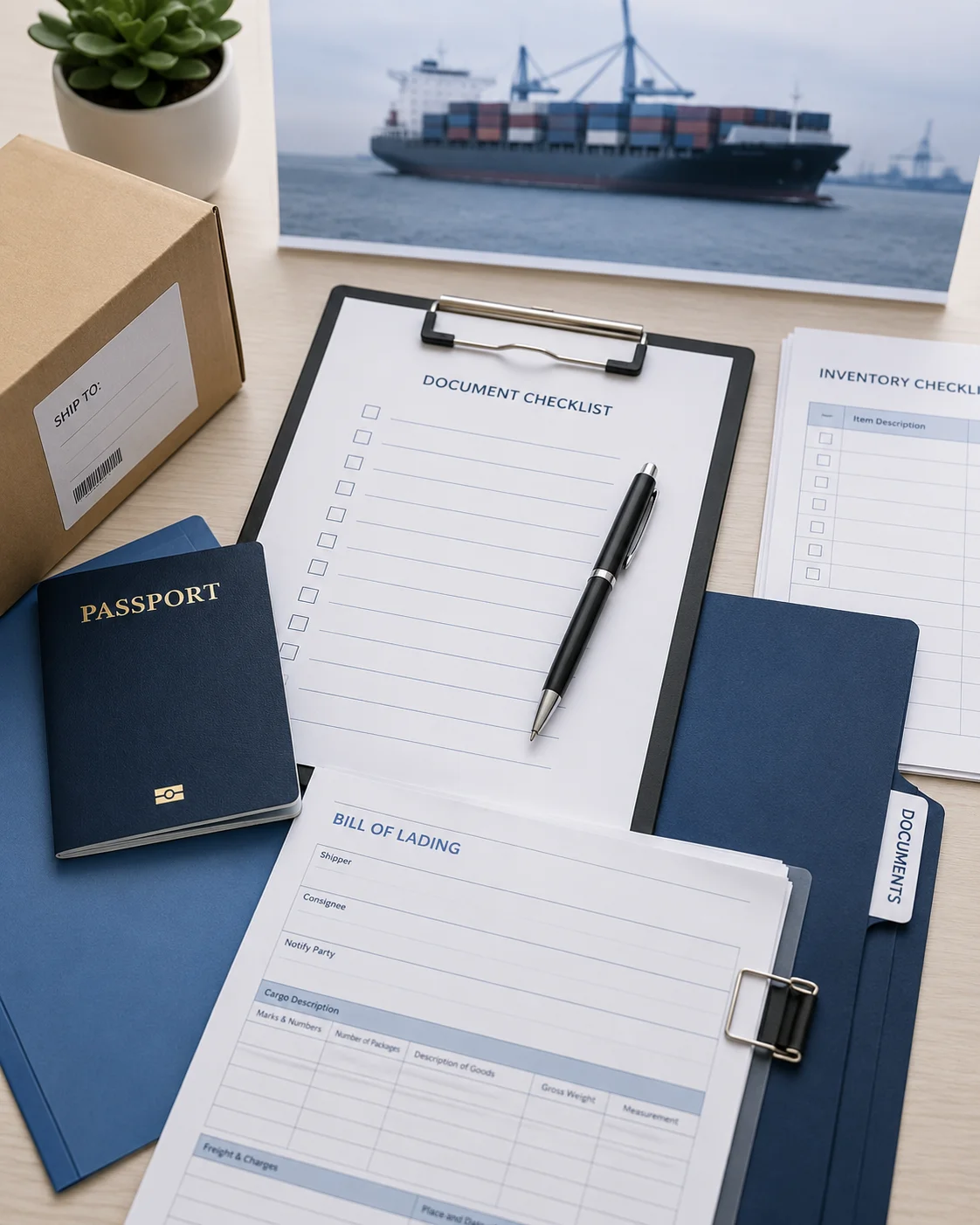
Documents required for importing used household goods, personal effects, and related shipments.
Qualifying documents authorising residence:
- Copy of passport (identification page and entry visa page)
- Original Bill of Lading (OBL) / Air Waybill (AWB)
- Detailed valued inventory in English (no abbreviations such as "Misc." or "PBO")
- MPI Personal Effects Supplementary Declaration form (completed by the importer at origin when the shipment is being packed and forwarded to the destination agent with the rest of the documentation)
- Unaccompanied Personal Baggage Declaration (NZCS218) and Supplementary page (NZCS218A) -- the combined Customs and Quarantine declaration
- Documents authorising residence in New Zealand (see list below)
- Copy of prescriptions for any prescribed drugs included in the shipment
- CITES permit, if applicable (required for items such as pianos with ivory keys)
- Receipts for any new items
- Trade Single Window Client Registration Application (NZCS224), if required (agent will advise)
- List of wine collection with evidence showing the wine has been acquired over a period of time and consists of various types (for wine collections)
- New Zealand or Australian passport
- Current New Zealand residence visa or permit, or returning residence visa or permit
- Current permanent residence visa (including residence return visa) issued by the Government of the Commonwealth of Australia
- Current New Zealand work visa or permit issued for a minimum of 12 months
- Current New Zealand work visa or permit issued under the Work to Residence (Skilled Migrant Category) or Long-Term Business Visa/Permit category
- Current New Zealand visitor's visa or permit issued for a minimum of 3 years
Specific Information
Wedding trousseaux: Treated the same as personal and household effects. Inventory required.
Inheritance: Admitted free of duty provided a copy of the will or executor's letter is produced. The name of the beneficiary and their legacy must be specified.
If the goods are imported more than 5 years after the owner's arrival in New Zealand, concessionary entry requires the specific consent of a Customs Officer.
If the owner does not hold a qualifying residence document at the time the shipment arrives, duty and GST will be payable. Duty applies at 5% on landed value (cost of items plus freight and insurance) for furniture, kitchenware, and some electrical and household goods. GST of 15% is then charged on the landed value including the duty. Duty and GST paid cannot be reclaimed if a qualifying visa is obtained at a later stage.
The owner must be present in New Zealand at the time of shipment arrival for duty-free entry to apply.
Personal jewellery, books, and clothing are not subject to duty or GST regardless of residence status.
Biosecurity -- mandatory inspection: All shipments entering New Zealand must go via an MPI-approved transitional facility for unloading and final clearance, including full container load (FCL) containers. No container is delivered directly from port to residence.
MPI quarantine screening: All packing and inventory lists are screened by MPI (Ministry for Primary Industries). Most consignments of personal effects and household goods require some form of inspection. Items of particular biosecurity concern include: food of any kind; animal products (meat, eggs, dairy, honey, skins, fur, feathers, bone, wool, hair, trophies, fish/shellfish, Chinese traditional medicines, shells, coral, ivory); plants and plant products (fresh or dried fruit, vegetables, plants, flowers, seeds, bulbs, cane, bamboo, basketware, straw, wooden ornaments and carvings); equipment used with animals or plants (veterinary equipment, fishing gear, saddlery, work boots, pet bedding, gardening and forestry equipment); and miscellaneous items (vacuum cleaners, spiked footwear, hiking boots, soiled footwear, water sports equipment, bicycles, boats, camping equipment, barbeques).
ISPM 15: All wood packaging (crates, pallets, dunnage) must comply with ISPM 15 and carry the appropriate mark. Non-compliant wood packaging will be treated, destroyed, or re-exported at MPI's discretion and at the owner's expense, with considerable additional costs and clearance delays.
Brown Marmorated Stink Bug (BMSB): During the BMSB season (September to April), containerised cargo and breakbulk from targeted risk countries must be treated before arriving in New Zealand. Failure to meet the Import Health Standard will result in re-shipment or destruction of the container and contents. Confirm current targeted country list and treatment requirements with the destination agent before loading.
Duties & Taxes
Duty-free entry conditions: Concessionary entry (free of duty and GST) is available to persons who, on the date the effects are imported: hold one of the qualifying residence documents listed above; have resided outside New Zealand for the whole of 21 months before the date of arrival in New Zealand; have owned and used the household goods before the date of departure for New Zealand; and are importing the goods for personal use only (not for sale, gift, disposal, or exchange).
Prohibited & Restricted Items
Prohibited Items
The following items are prohibited from import into New Zealand:
- Controlled drugs (including LSD, heroin, cocaine, cannabis, ecstasy, steroids, human growth hormone, performance-enhancing drugs, and precursor substances) other than prescribed medicines with valid documentation
- Pornographic materials, or materials promoting, inciting, or instructing crime, violence, or drug misuse
- Weapons including flick knives, butterfly knives, swordsticks, knuckle-dusters, disguised weapons, and any weapon designed to resemble another article
- Drug paraphernalia
- Goods designed to facilitate crime
- Tobacco products, tobacco leaf, and tobacco refuse. A permit is required for any import; tobacco products attract high duties and taxes with no duty-free concession. Unpermitted tobacco will be destroyed. *(Permit Required)*
- Mothball products containing naphthalene, camphor, and dichlorobenzene -- banned and must not be included in personal effects
- Meat and meat products, honey, eggs and egg products, dairy products, popcorn
- Most plants and plant products (see Section 5)
- Endangered species and products derived from CITES-listed fauna and flora, unless accompanied by a valid CITES permit *(CITES)*
- Counterfeit and pirated goods
Restricted / Dutiable Items
Firearms: An import permit and a New Zealand Police firearms licence are required before import. Pistols, revolvers, and certain types of rifles are prohibited. Firearms will be seized by NZ Customs pending production of a permit. Contact NZ Police (police.govt.nz) for current requirements.
Prescribed medicines: Duty-free, with a copy of the prescription or doctor's letter.
Wine collections: Admissible as part of household effects if accompanied by a list and evidence showing the wine was collected over time and is of various types.
CITES-restricted items: Ivory in any form, tortoise or sea turtle jewellery or ornaments, animal bone carvings, cat skins or coats, hunting trophies of sea turtles, big cats, rare reptiles, cranes, pheasants, bears, antelope, and deer. Live species including eagles, hawks, owls, parrots, many cacti, orchids, cycads, and carnivorous plants. A CITES permit is required for import; contact the Department of Conservation (doc.govt.nz) for details.
New furniture and household items: Subject to duty and GST if recently purchased. Purchase invoices and receipts required.
Dutiable item tariff rates (for new goods, approximate): Baby strollers, bags, bed linens and blankets, chinaware and cookware, cosmetics, curtains, cutlery, jewellery, lamps, perfume, pots and pans, saddles, sleeping bags, and toys attract approximately 5% tariff duty. Footwear attracts approximately 10%.
Plants and plant material: Most plants, fresh or dried fruit and vegetables, plant cuttings, seeds, bulbs, and roots are prohibited without specific authorisation. Regulations are very strict. Do not despatch without confirming with MPI whether the item is permitted.
Importing a Used Personal Vehicle
Required Documents
- Copy of passport
- Original registration / ownership certificate and/or original deregistration certificate
- Purchase invoice
- Original compliance certificate issued by the manufacturer (if applicable)
- Documents authorising residence in New Zealand (same list as household goods)
- Car condition report
- Owner of Goods Code form
- Supplier Code form
- Deed of Undertaking (required if importing duty-free -- confirms vehicle is for personal use and will not be sold for 2 years)
Specific Information
Duty-free (concessionary) entry conditions: A vehicle may be imported free of duty and GST if the owner holds a qualifying residence document on the date of import, has resided outside New Zealand for the full 21 months before arrival in New Zealand, and has personally owned and used the vehicle for at least 12 months before the date of departure to New Zealand or the date on which the vehicle was surrendered for shipping, whichever is earlier. The owner must also sign a Deed of Undertaking not to sell the vehicle within 24 months of importation.
If the 5-year rule applies (goods imported more than 5 years after the owner's arrival), Customs Officer consent is required.
For all other importers, there is no duty on vehicles imported into New Zealand, but GST of 15% applies on the vehicle's CIF value (purchase price, freight, and marine insurance). Note: duty is applicable on motor homes for non-qualifying migrants.
Compliance and registration: All imported vehicles must undergo a structural inspection and then be tested for certification to New Zealand Safety and Compliance Standards before they can be registered. Owners are strongly advised to check compliance requirements before shipping, as a non-compliant vehicle can be costly or impossible to register. Contact the New Zealand Transport Agency (Waka Kotahi NZTA) for current requirements.
Clean Car Standard: From April 2022, New Zealand introduced a Clean Car Standard for newly registered vehicles. Costs are based on CO2 emissions at the time of first registration. Check the NZTA website for current charges.
Left-hand drive vehicles: LHD vehicles require special assessment. The owner should confirm before shipping whether the vehicle belongs to a permitted category or can be converted to right-hand drive. Confirm with NZTA.
Biosecurity: Vehicles must be thoroughly steam-cleaned and vacuumed before shipment to reduce the risk of a biosecurity hold on arrival. This does not guarantee MPI will not order further treatment, but it significantly reduces the risk. Pay particular attention to BMSB risk during September to April.
Boats and caravans: Boats follow the same import conditions as motor vehicles (excluding compliance certification). Caravans and trailers are treated as household effects. Contact NZ Customs for detailed boat import requirements.
Pets
- Import permit from MPI (required for all countries except Australia). Apply at least 6 weeks before travel; MPI requires at least 20 working days to process applications. Submit completed applications to animalimports@mpi.govt.nz. Include booking confirmation from an approved quarantine facility with the application.
- Health certificate(s) as specified by the applicable Import Health Standard
- Proof of microchip (ISO-compatible)
- Rabies vaccination records (for applicable countries)
- Rabies antibody titre test results (for animals from higher-risk countries) performed at an approved laboratory, result of at least 0.5 IU/ml, blood sample drawn at least 30 days after vaccination
- Proof of Brucella canis testing for dogs (USA-origin dogs: approved tests are RSAT, TAT, CPAg-AGID, and IFAT; the 2ME-RSAT test is no longer accepted as stand-alone)
- NZCS231 form, copy of photo ID, proof of ownership, and Air Waybill (for customs clearance)
Regulatory update (effective 1 July 2026): A new Import Health Standard (IHS) for cats and dogs comes into force on 1 July 2026. There is a transition period of 9 months during which both the 2021 and 2026 IHS requirements are acceptable. From 1 April 2027, all cats and dogs must meet the new IHS requirements, which include an official ID check at least 6 months prior to export. Owners planning to move pets to New Zealand should consult the MPI website and their destination agent immediately to confirm which standard applies to their timeline.
New Zealand classifies source countries into categories based on rabies risk. Requirements vary by category. The UK, USA, Canada, EU member states, and South Africa are in the category requiring an import permit, a minimum 10-day quarantine, and rabies titre testing. Australia has a simplified process with no quarantine and no import permit required, though MPI inspection on arrival applies. Pets from non-approved countries cannot be imported directly; they must first be moved to an approved country, complete a residency requirement there (typically 6 months), and then be imported from that country -- a process that can take close to a year.
All cats and dogs except those arriving from Australia must complete a minimum of 10 days at an MPI-approved quarantine facility. Quarantine space must be pre-booked, and the booking confirmation is part of the permit application. MPI-approved quarantine facilities are privately operated but MPI-supervised.
Pets not meeting import requirements will be returned to the country of origin or euthanised. All costs are the importer's responsibility.
Prohibited breeds: The following dog breeds are banned from import into New Zealand under the Dog Control Act 1996: American Pit Bull Terrier (any type), Brazilian Fila, Dogo Argentino, Japanese Tosa, and Perro de Presa Canario. Hybrid species of any type are also prohibited. Exceptions apply to registered dogs that are certified as guide, hearing, or companion/assistance dogs.
Cats that are hybrid species are prohibited unless the animal is a Bengal cat with documentation proving five or more generations of domestic ancestry.
Cats and dogs must not be more than 42 days pregnant on the date of shipment.
Notify the relevant MPI quarantine facility at least 72 hours before arrival (or at least 5 working days in advance for cats and dogs from Australia).
Special Categories
4. Antiques, Artworks, and Carpets
Antiques are defined as items over 100 years old and may be imported duty and GST-free if not for re-sale and with proof of ownership for more than 12 months. If purchased less than 12 months before import, duty of approximately 7% plus 15% GST on landed value applies. However, if the item is certified as over 100 years old (with a letter or proof of antiquity), the duty is waived and only GST of 15% applies.
Pianos with ivory keys require a Pre-Convention CITES permit. The original validated permit (not a photocopy) must accompany the goods and be surrendered to border officials on import. The permit must also be validated by border officials before exit from the country of export.
Carpets and works of art require no additional documentation if included as part of household effects.
A BADA (British Antique Dealers' Association) certificate of authenticity may be required for items certified as antiques by approved dealers.
Consignment Instructions
Recommended: Contact the destination agent to ensure all requirements have been met prior to import, especially for differences regarding air / sea shipments.
Transitional facility -- mandatory: No shipment (FCL or LCL) is delivered direct from port to residence. Every container must be unloaded and inspected at an MPI-approved transitional facility. Build this into delivery timelines.
21-month rule: The owner must have resided outside New Zealand for the full 21 months prior to arrival in New Zealand to qualify for duty-free entry. This is a critical distinction for qualifying clients. Confirm the client's departure history carefully before advising on duty-free eligibility.
Owner must be in New Zealand: The owner must be present in the country at the time of shipment arrival for concessionary entry to apply. Duty paid at entry cannot be reclaimed retrospectively.
MPI Supplementary Declaration: Must be completed by the importer at origin at the time of packing and forwarded to the destination agent with all other documentation for each shipment.
Inventory standards: All inventories must be in English, detailed, and valued. Abbreviations such as "Misc." or "PBO" are not acceptable.
Biosecurity cleaning: Items that have come into contact with soil, grass, leaves, vegetation, water, seeds, animals, or insects should be thoroughly cleaned before packing. Garden tools, outdoor furniture, sports equipment, footwear, and bicycles in particular should be cleaned and inspected.
BMSB season (September to April): During this period, cargo from targeted countries must be treated before arrival. Confirm the current targeted country list with the destination agent each shipping season.
Principal ports of entry: Auckland (Ports of Auckland, and Auckland Airport for air freight), Tauranga (Port of Tauranga), Lyttelton (Port of Lyttelton, Christchurch), and Wellington.
Cultural & Other Information
New Zealand (Aotearoa in Maori) is an island country in the southwestern Pacific Ocean, comprising two main islands (the North Island and South Island) and numerous smaller islands. Wellington is the capital; Auckland is the largest city. English and Maori (te reo Maori) are both official languages, along with New Zealand Sign Language. The population is approximately 5 million. New Zealand is a parliamentary constitutional monarchy with King Charles III as head of state, represented by the Governor-General.
New Zealand maintains one of the world's strictest biosecurity regimes, reflecting the vulnerability of its unique ecosystems and agricultural sector. This directly affects household goods import -- biosecurity compliance is not optional and delays caused by non-compliant shipments can be lengthy and expensive.
The economy is strong and diversified, with significant sectors in agriculture, tourism, technology, and services. New Zealand uses the New Zealand Dollar (NZD). Business is conducted in English and culture is relatively informal by Western standards.
Reference Links
Useful resources