

Country Guides
Pakistan

Explore sections
Guide Details
Household Goods
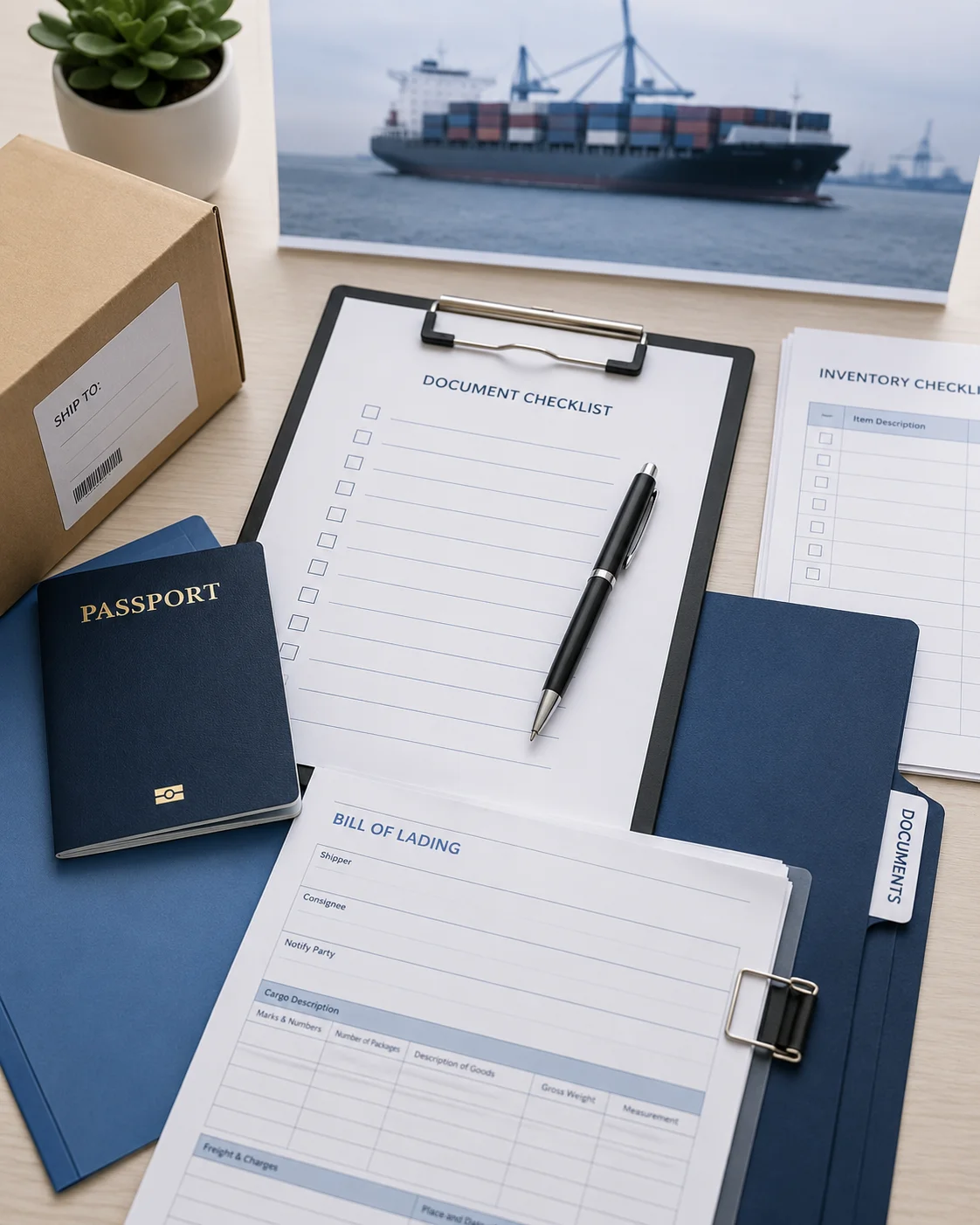
Documents
Documents required for importing used household goods, personal effects, and related shipments.
- Original passport showing full travel history (all pages)
- Original or Express Bill of Lading / Sea Waybill (duly endorsed by consignee), or Air Waybill for air shipments
- Fully detailed packing list, with electrical items listed individually including make, model, and other identifying details
- Signatures on customs, shipping line, or airline authority letters by the consignee
- National Identity Card copy (Pakistani nationals); NICOP (National Identity Card for Overseas Pakistanis) for dual nationals
- Transfer of Residence (TR) form (provided by the destination agent; consignee signs at destination)
- Valid visa copy (foreign nationals only)
- Employment letter confirming posting of 2 or more years (foreign nationals only)
- Duty/Tax Exemption Certificate issued by the Ministry of Foreign Affairs, Islamabad
- Original or Express B/L or AWB
- Detailed inventory / packing list
- Authority letter from the Mission for Customs, shipping line, or airline
- Copy of passport with valid Pakistan visa and arrival stamp
Specific Information
Transfer of Residence (TR) facility: Pakistani nationals are eligible for TR if they have resided abroad for 2 or more years and their cumulative short visits to Pakistan during that period did not exceed 60 days. (The Additional Collector of Customs has discretion to condone stays up to 120 days if reasons are satisfactory.) Foreign nationals are eligible for TR if arriving for a posting of 2 or more years, evidenced by an employment letter.
Shipment must be booked at origin within 15 days of the consignee's arrival in Pakistan. The consignee's personal presence is required at Customs clearance.
For residents not eligible for TR: A gift allowance of up to USD 500 in goods is permitted duty-free on the first entry in a calendar year. Items of personal use (clothing, accessories, toilet articles, one electric iron, one hair dryer, one vacuum cleaner, one wall clock, one table lamp, decoration pieces in use) are also admitted free on first entry. All major electrical appliances are subject to full duty and taxes.
Approximate customs clearance time: 7-10 working days.
Under TR, the following household goods are duty-free: old and used furniture, fixtures, crockery, cutlery, kitchen utensils, rugs, household linen, bedding, and general household goods in use. The following major electrical appliances are admitted at 50% of full duty and taxes under TR: one television set, one deep freezer, one refrigerator, one microwave oven, one cooking range, one washing machine, and one air conditioner. Professional tools and equipment valued up to USD 5,000 are also included, as are used medical or electro-medical equipment for registered Pakistani medical practitioners (subject to an internationally recognized inspection certificate).
All customs duties are assessed on CIF (cost, insurance, and freight) value, determined by customs officials. Duty payments must be made in Pakistani Rupees from the consignee's account to a designated bank.
Do not include insurance documents or invoices showing the value of household goods with the shipment; this can trigger higher assessed duties.
Goods arriving by sea have 10 penalty-free days after vessel arrival before late-filing penalties apply under Section 82. After that, penalties of PKR 5,000 per day apply for the first 5 days, and PKR 10,000 per day thereafter, up to a maximum of PKR 100,000.
Port free storage: 6 days for diplomatic shipments. Demurrage on containerized and LCL shipments begins after 7 days from vessel arrival for standard shipments.
Prohibited & Restricted Items
Prohibited Items
- Alcohol in any quantity (prohibited for all non-diplomatic shipments; even trace quantities trigger penalties and potential refusal)
- Narcotics and controlled drugs
- Weapons of any kind (firearms, ammunition, and similar)
- Pornographic or erotic literature, DVDs, magazines, and artwork (including any depiction of nudity)
- Any publication, book, magazine, CD, or DVD containing material against Islam or Pakistan
- Translations of the Holy Quran without the accompanying Arabic text
- Goods of Israeli origin
- Ivory and animal hides [CITES]
- Toxic and radioactive materials
- 3D printers
- Gambling equipment
- Stolen goods and factory rejects, job-lot, or sub-standard goods
- CFC gas-based refrigerators, deep freezers, and refrigerating/cooling equipment
- Caffeine citrate
- Firearms and similar devices (including toy guns and similar items)
Restricted / Dutiable Items
All electrical and mechanical goods are dutiable even under Transfer of Residence. Major appliances (television, refrigerator, deep freezer, microwave, cooking range, washing machine, air conditioner) are admitted at 50% duty under TR; full duty applies for those not eligible for TR. Any other electrical or mechanical gadget is similarly subject to full duty for non-TR importers.
Personal allowances on first entry in a calendar year (TR and non-TR alike): Clothing and accessories in personal use, personal adornments, toilet requisites, electric shaver, one electric iron, one hair dryer, one vacuum cleaner, one wall clock, one table lamp, decoration pieces in use, one mobile phone, one still camera, one video camera, child's toys, medals and trophies, and professional tools up to USD 500. These items must be clearly personal and in use.
Tobacco and alcohol: 200 cigarettes, 50 cigars, or 0.5 kg of manufactured tobacco are admitted free. Alcohol is prohibited (see Section 5).
Antiquities: Permitted with a notarized purchase invoice and certificate of origin; otherwise prohibited.
Gift allowance: USD 500 in additional goods duty-free on first entry in a calendar year (applies to TR holders in addition to the TR allowance, and to non-TR holders separately).
TR allowances are not applicable if goods are in commercial quantity, goods are not shipped from the country where the consignee resided prior to arrival, goods do not reach Pakistan within 60 days of the consignee's arrival, or the consignee is crew of a conveyance.
Importing a Used Personal Vehicle
Required Documents
- Original Bill of Lading or AWB, duly signed by consignee
- Goods Declaration Form
- Original passport and Certificate of Title
- Invoice of purchase showing engine number, model, and horsepower
- De-registration Certificate (for used vehicles)
- National Identity Card copy (Pakistani nationals); NICOP (dual nationals)
- Signatures on customs, shipping line, or airline authority letters
Specific Information
Vehicles imported under the Transfer of Residence scheme require transfer of foreign currency equivalent to the assessed customs duty and taxes through the banking channel into Pakistan, with proof of transfer.
Age restrictions: Sedan and coupe cars cannot be more than 36 months old. SUVs and motorbikes cannot be more than 60 months (5 years) old.
Duty rates by engine size (approximate):
Up to 800 cc: approximately 107%; 801-1000 cc: approximately 114%; 1001-1500 cc: approximately 126%; 1501-1800 cc: approximately 153%. Hybrid vehicles follow the same brackets. These rates are subject to change; confirm with the destination agent prior to shipping.
Diplomats are exempt from duty and taxes and from vehicle age restrictions, on the basis of a Tax Exemption Certificate from the Ministry of Foreign Affairs (obtained by the embassy). Expatriates and privileged persons may similarly be exempt via a Tax Exemption Certificate from the Ministry of Economic Affairs Division (EAD), obtained by the employer, NGO, or project. Note that GST, sales tax, and excise duty remain payable even for exempt importers.
Pets
- Health and vaccination certificates issued by the relevant authority in the country of origin
- Quarantine certificate / veterinary health certificate issued by the Government of Pakistan
- Pet passport
- Original passport of the owner
- Air Waybill (for cargo shipments)
- Authority letter from the passenger/owner in favour of the clearing agent
- Copy of CNIC (Pakistani nationals); NICOP (dual nationals)
Pets may be transported as accompanied baggage, as unaccompanied baggage, or as air cargo. For air cargo, prior release for immediate clearance must be arranged at least 48 hours before the flight arrives, by submitting the AWB, health and quarantine certificates, and copies of passports to the Animal Quarantine Department.
Pet clearance takes 1-2 days when all documents are in order. Import is subject to quarantine requirements of the Animal Quarantine Department, Ministry of National Food Security and Research.
Consignment Instructions
Recommended: Contact the destination agent to ensure all requirements have been met prior to import, especially for differences regarding air, sea, and road shipments.
The shipment must be booked at origin within 15 days of the consignee's arrival in Pakistan. The consignee must be physically present at Customs clearance. Late filing of the goods declaration (beyond 10 days from vessel arrival) incurs escalating penalties under Section 82; coordinate arrival and document submission carefully with the destination agent.
Do not send insurance policies, valuation certificates, or documents showing the insured or purchase value of goods with the shipment. Customs officials assess CIF value independently; accompanying valuations can trigger higher assessments.
Packing lists must be fully detailed, particularly for electrical items (make, model, serial number where possible). Vague descriptions will cause delays.
For diplomatic shipments, the MOFA Tax Exemption Certificate takes 2-4 weeks to issue. Coordinate with the local partner before the shipment is loaded to avoid port demurrage and penalty exposure under Section 82.
Customs duty payments are made in Pakistani Rupees through the banking channel from the consignee's designated bank account. Foreign currency equivalents for vehicle TR imports must also be transferred through official banking channels with supporting documentation.
Cultural & Other Information
Pakistan (officially the Islamic Republic of Pakistan) is a federal parliamentary republic in South Asia, bordered by India, Afghanistan, Iran, China, and the Arabian Sea. The capital is Islamabad; the largest city and main seaport is Karachi. Urdu and English are official languages; Punjabi, Sindhi, Pashto, and Balochi are among the regional languages widely spoken. The currency is the Pakistani Rupee (PKR).
Islam is the state religion and shapes law, social norms, and daily life. Business hours typically run Monday through Friday, with Friday prayer observed midday. During Ramadan, business hours are reduced and customs clearance times lengthen. Alcohol is prohibited under Pakistani law and is not available to the general public.
Pakistan is the world's fifth most populous country and has a large expatriate community particularly in the Gulf states, the UK, and North America. The Transfer of Residence facility is a significant mechanism for returning nationals and long-term incoming expats; understanding its eligibility conditions and timing requirements is essential for any international move.
Key Resources:
Useful resources