


Explore sections
Guide Details
Household Goods
Documents
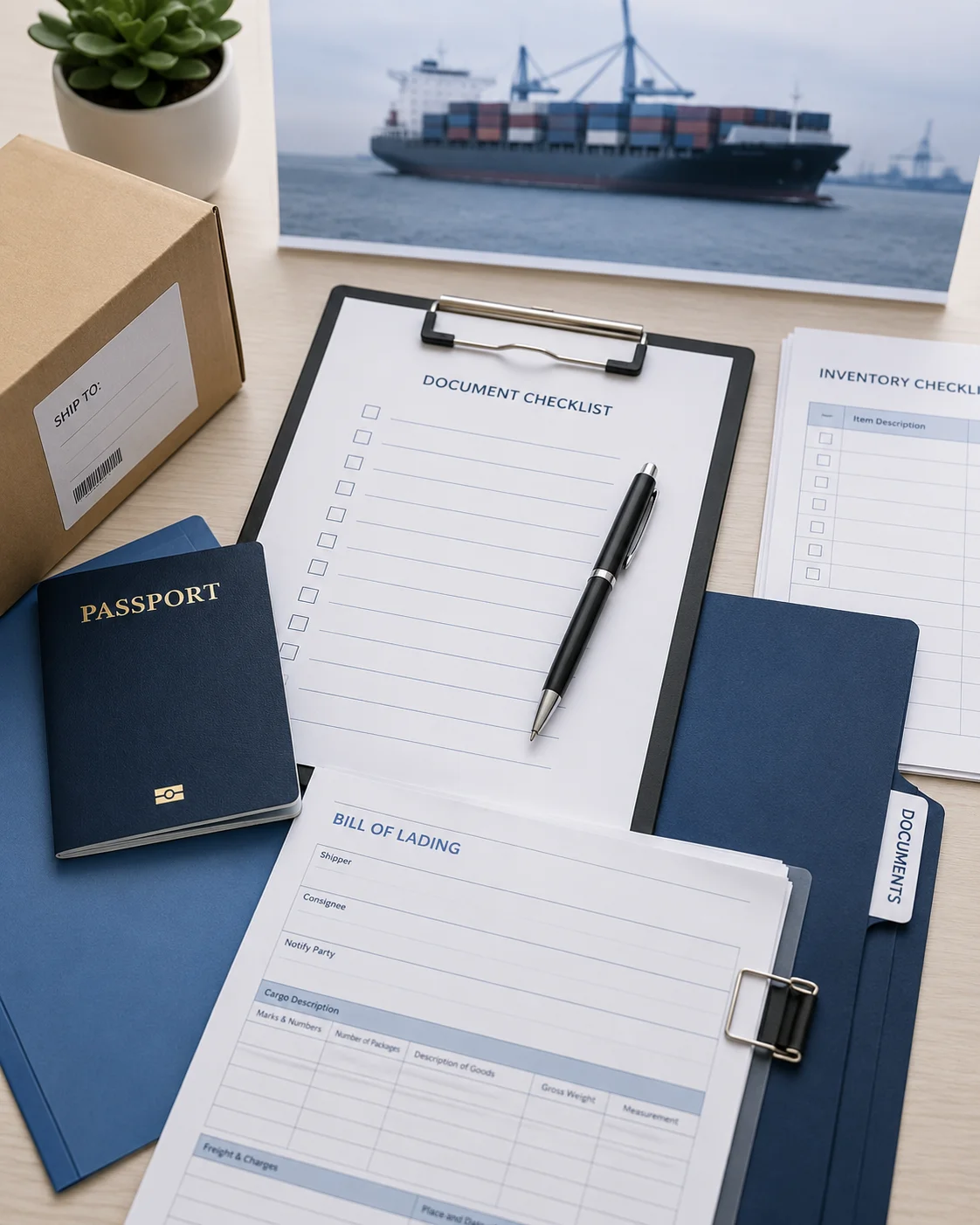
Documents required for importing used household goods, personal effects, and related shipments.
- Consignee's original passport (must show all entries/departures; see eligibility conditions below)
- Detailed and legible packing list, signed by the consignee and by the packing crew leader at origin (avoid PBO entries; all items must be individually described with brand name and serial numbers for electrical items)
- 2 original OBLs or AWBs, showing the exact net and gross weight, exact number of items matching the packing list, and freight rated (cost shown)
- Notarized Power of Attorney letter addressed to Peruvian Customs
- Photocopies of the passport of all family members (ID page and last Peru entry stamp only)
- Marriage certificate (if family members do not share the same last name)
- Children's birth certificates (if family members do not share the same last name)
- Cohabitation affidavit (if the consignee is not married but has a partner included in the shipment)
Applies to Peruvians who have lived abroad for at least 3 years.
- Original Returned Migrant Card (obtained at the Peruvian Consulate in the origin country, or at the Ministry of Foreign Affairs in Peru on arrival)
- Copy of valid national identity document (DNI)
- Original Migratory Certificate proving residence abroad
- Valued list (format provided by SUNAT/Customs)
- Sworn Declarations (formats provided by SUNAT/Customs)
- Original Free Entry Permit issued by the Peruvian Ministry of Foreign Affairs
- Detailed packing list (avoid PBO)
- 2 original OBLs or AWBs, freight rated
- Consignee's original passport
Specific Information
Returned Migrants Law (Law No. 30525): Qualifying returning Peruvians may import duty-free: household goods up to USD 50,000; one new or used vehicle (subject to current vehicle regulations, value not exceeding USD 50,000); and equipment, machinery, and instruments for a business or professional activity up to USD 350,000. This benefit is valid for 4 months after obtaining the Returned Migrant Card and may only be used once per person in their lifetime. Professional goods (machinery, musical or lab equipment) must be on a separate packing list from household goods.
To be eligible for duty-free import under the standard household goods scheme, the consignee must prove they have been living outside Peru for at least 13 consecutive months before their last entry to Peru. This period is not considered interrupted if the consignee made entries to Peru not exceeding 30 consecutive or alternated calendar days during the last year.
The consignee must be present in Peru to initiate and complete the customs process.
Shipments may arrive in Peru no earlier than 1 month before the consignee's first entry into Peru, and no later than 6 months after the consignee's arrival. The OBL or AWB must describe the cargo as "Used household goods and personal effects."
If used household goods and a vehicle are shipped together in the same container, the OBL must clearly describe both, with the weight of each itemized separately.
All household goods shipments are subject to duties and taxes of approximately 12-30%, assessed by the Customs official at physical inspection. Customs assesses value at the time of inspection.
Only household goods previously exported from Peru are admitted duty-free; this must be supported by documentation stamped by Peruvian Customs at the time of original export.
The consignee must not have used the duty-free household goods benefit in the 2 years prior to the current Import Declaration date.
All shipments are inspected by Peruvian Customs, with the exception of foreign diplomat shipments. New furniture arriving in original manufacturer's packaging is not permitted; all items must be repacked by the moving company before shipping.
Documents must be notarized in Peru. Avoid shipping with MSC, as additional handling complications with Peru services have been reported.
Clearance time: sea shipments approximately 10-14 days; air shipments approximately 7 days, provided all documents are received before the shipment arrives.
Prohibited & Restricted Items
Prohibited Items
- Narcotics and illegal drugs (prescription medicines in small quantities with documentation are permitted)
- Pornographic materials
- Automatic firearms
- Explosives
- Plants (not considered household goods; do not include)
- Jewellery and valuable precious metal articles (do not include in household goods shipments)
- Damaged vehicles
- Diesel automobiles
- Automobiles older than 2 years (model year) or with more than 32,000 km
Restricted / Dutiable Items
Wine and alcohol: Non-diplomatic shipments may include wine and other liquors as follows: up to 4 boxes of 12 bottles in a 20-foot container; up to 8 boxes of 12 bottles in a 40-foot container. Air shipments: confirm limits with the moving company. Duties of 30% on CIF value apply. Foreign diplomats may not include alcohol in shipments declared as household goods. Peruvian diplomats may include up to 10 boxes.
Food items (tinned and dry goods): Permitted in small quantities as part of a household goods shipment.
Firearms and ammunition: Authorization from the Ministry of Interior is required prior to shipment arrival, along with a current firearm licence and a special Discamec permit obtained by the consignee before goods arrive.
Medicines: Permitted in small quantities; a medical prescription may be requested.
Telecommunications equipment (radios, fax machines, modems, routers, telephones, antennas): Require a special import permit and the original certificate issued by the Ministry of Telecommunications. It is strongly recommended not to include these items in household goods shipments.
Refrigerant gas equipment: See Section 2 for OTO permit requirements. Items detained at customs accrue daily storage fees.
Food items in air shipments: Must not exceed 10% of total net weight.
Importing a Used Personal Vehicle
Required Documents
- Original purchase invoice
- Ownership / title certificate
- 2 original OBLs, freight rated
- Consignee's original passport
- Consignee's RUC number (Registro Unico de Contribuyentes / VAT number) -- not required for diplomatic shipments
- Gas Emission Certificate (no exceptions; must be obtained in Peru before the import process starts)
- Ficha Tecnica (Technical Automobile Form, issued in Peru; extra charge applies)
- Certificate of mileage from origin (non-diplomatic consignees; may be issued by SGS, SSI, or Bureau VERITAS)
- Duty Free Resolution issued by the Peruvian Ministry of Foreign Affairs (diplomatic vehicles only)
Specific Information
Supreme Decree 005-2020-MTC (in effect since February 2, 2020): Only automobiles not older than 2 years (measured by model year) may be imported. Automobiles must not have more than 32,000 km traveled. Diesel vehicles are prohibited.
Only used vehicles and motorcycles less than 5 years old can be imported for non-diplomatic importers.
All vehicles (with no exceptions, including diplomatic) are subject to physical inspection by Customs authorities. The OBL must show the model, year, engine number, and Vehicle Identification Number (VIN). Carbon monoxide emissions must not exceed 9% by volume.
Damaged vehicles may not be imported.
Duty rates (approximate; confirm with destination agent as rates may vary without notice): Used vehicles: 72% of CIF value. New vehicles: 45% of CIF value.
For diplomatic importers: Vehicles are duty-free provided the value does not exceed the amount authorized by the Peruvian Ministry of Foreign Affairs and the engine does not exceed 2,000 cc. The vehicle must be at least 1 year old. Peruvian diplomats returning after completing missions abroad are entitled to import one vehicle duty-free. The diplomatic franchise must be obtained before the shipment arrives; this takes approximately 3 weeks.
Refrigerant gas equipment (restricted): Before importing refrigerators, air conditioners, freezers, or any appliance containing refrigerant gas, the destination agent must obtain an OTO (Ozone Technical Office) certificate in Peru. To do so, provide any of the following: a photo of the appliance plate/sticker showing product, brand, model, gas type, and serial number; the technical specification sheet; or the user's manual with the same information. The OTO certificate costs USD 100 per article and takes approximately 1 week. Without this permit before shipment arrival, equipment will be retained at customs for 30-90 days with daily storage fees accruing, and the consignee will receive a fine of 1% of the UIT (Unidad Impositiva Tributaria). This applies to refrigerators, air conditioners, and freezers without exception.
Pets
- Health certificate
- Vaccination certificate
- Air Waybill (for air shipments)
- SENASA Certificate (obtained in Peru by the destination agent)
It is strongly recommended to bring pets into Peru as accompanied baggage rather than as unaccompanied cargo; otherwise, import duties are assessed. One pet is exempt from taxes and duties when imported as part of a household goods move. Additional pets are subject to 30% taxes on CIF value.
There is no quarantine period for dogs or cats entering Peru, provided documents are in order.
The SENASA (Servicio Nacional de Sanidad Agraria) certificate is obtained in Peru by the local agent after arrival. Confirm current requirements and any breed restrictions with the destination agent and SENASA before shipping.
Consignment Instructions
Recommended: Contact the destination agent to ensure all requirements have been met prior to import, especially for differences regarding air, sea, and road shipments. Do not send the shipment without a green light from the destination removal agent, particularly for diplomatic shipments awaiting franchise approval.
The OBL must be freight rated (show the cost), must state the exact net and gross weight, and must describe the cargo as "Used household goods and personal effects." If a vehicle is co-loaded, its weight must be listed separately. Provide the consignee's full name (as in passport), passport number, Lima address, and the moving company's name, RUC number, and contact details on the OBL.
All documents must be notarized in Peru after arrival. The Power of Attorney letter to Peruvian Customs must be notarized locally; the origin agent cannot complete this step.
Packing lists must not use "PBO" (packed by owner) descriptions. All electrical items require brand name and serial number. New items must be repacked by the moving company; original manufacturer's packaging is not permitted.
ISPM 15 (NIMF 15) compliance is mandatory for all wood packing. Non-compliant materials will be denied entry; materials showing live plague evidence may be destroyed. Phytosanitary inspection is conducted at the port or airport of entry.
The OTO permit for refrigerant gas appliances must be secured before the shipment arrives. The SENASA certificate for pets and the Gas Emission Certificate for vehicles are both obtained in Peru after arrival; coordinate timing with the destination agent.
Cultural & Other Information
Peru is a republic on the western coast of South America, bordered by Ecuador, Colombia, Brazil, Bolivia, and Chile. The capital and largest city is Lima, which is also the main port city (via Callao). Spanish is the primary official language; Quechua and Aymara are co-official in the regions where they are spoken. The currency is the Peruvian Sol (PEN).
Peru is one of South America's largest economies, driven by mining (copper, gold, silver), agriculture, fishing, and a growing services sector. The country has a large returning migrant community, and the Returned Migrants Law (Law No. 30525) reflects the government's effort to facilitate repatriation. Lima is a major regional hub for multinational business and receives significant expatriate populations in the finance, mining, and NGO sectors.
SUNAT (Superintendencia Nacional de Aduanas y de Administracion Tributaria) is the combined customs and tax authority. All customs clearances pass through SUNAT's systems. The OTO (Ozone Technical Office) restriction on refrigerant appliances and the telecommunications permit requirement are Peru-specific procedural requirements that frequently cause delays for unprepared shipments.
Key Resources:
Useful resources