

Country Guides
Portugal

Start here
Overview
Explore sections
Guide Details
Household Goods
Documents
Documents required for importing used household goods, personal effects, and related shipments.
- **Baggage Certificate (Certificado de Bagagem):** Obtained from the Portuguese Embassy or Consulate in the country of departure. This is the key document for the duty-free exemption. It must state that the owner has been residing in the origin country for more than 12 months, that all listed items are used and have been in the owner's possession, and must include the date of transfer of main residence to Portugal. Do not list values. Do not describe the move as being to a secondary residence.
- **Residence Certificate (Atestado de Residência):** Obtained from the Junta de Freguesia (Parish Council) nearest to the owner's new address in Portugal. Must state the date of arrival in Portugal -- no more than 6 months before the date of the certificate. The address must match the address on the fiscal number registration.
- **Portuguese Fiscal Number (NIF -- Número de Identificação Fiscal):** Obtained from a Serviço de Finanças. The NIF must not be associated with a legal representative (i.e., the consignee must hold it personally, not through a representative), and the registered address must match the Residence Certificate address.
- **European Citizen Registry Certificate:** Issued by the Town Hall. Additional information is available from the immigration authority (AIMA).
- **Passport**
- **Visa Permit / Work Permit:** Required for non-Portuguese and non-EU citizens. A temporary visa is not sufficient -- final residence approval from AIMA is required.
- Declarations to be supplied by the destination agent and signed at the agent's office
Note: Secondary residence imports are not entitled to the duty-free TNR exemption. Duties and taxes of 23% VAT plus applicable import duties will apply based on declared value and transport costs.
- Copy of Portuguese Fiscal Number (NIF)
- Copy of passport
- Declarations to be supplied by the destination agent and signed at the agent's office
The owner must be in Portugal at least one week prior to the shipment's arrival, whether for diplomatic or non-diplomatic shipments. Without this, customs clearance cannot be performed and the shipment will be held under customs supervision with heavy storage charges accruing. Diplomatic moves from EU countries require only an inventory list of goods.
Note: Alcohol is prohibited in all shipments, including diplomatic removals (see Section 5).
- Diplomatic franchise obtained by the Embassy through the Portuguese Ministry of Foreign Affairs, with a minimum of 15 days before the shipment arrives
- Inventory list of goods
- Passport photocopy stamped by the Embassy or Diplomatic Unit
Inheritances are entitled to duty-free entry. The consignee must be present in Portugal at the time of the goods' arrival.
- Luggage Certificate (Certificado de Bagagem) issued by the nearest Portuguese Consulate, stating that the listed items belong to the testator and were inherited by the consignee
- Testament with authenticated translation into Portuguese
- Declaration confirming death of testator
- Passport of the consignee
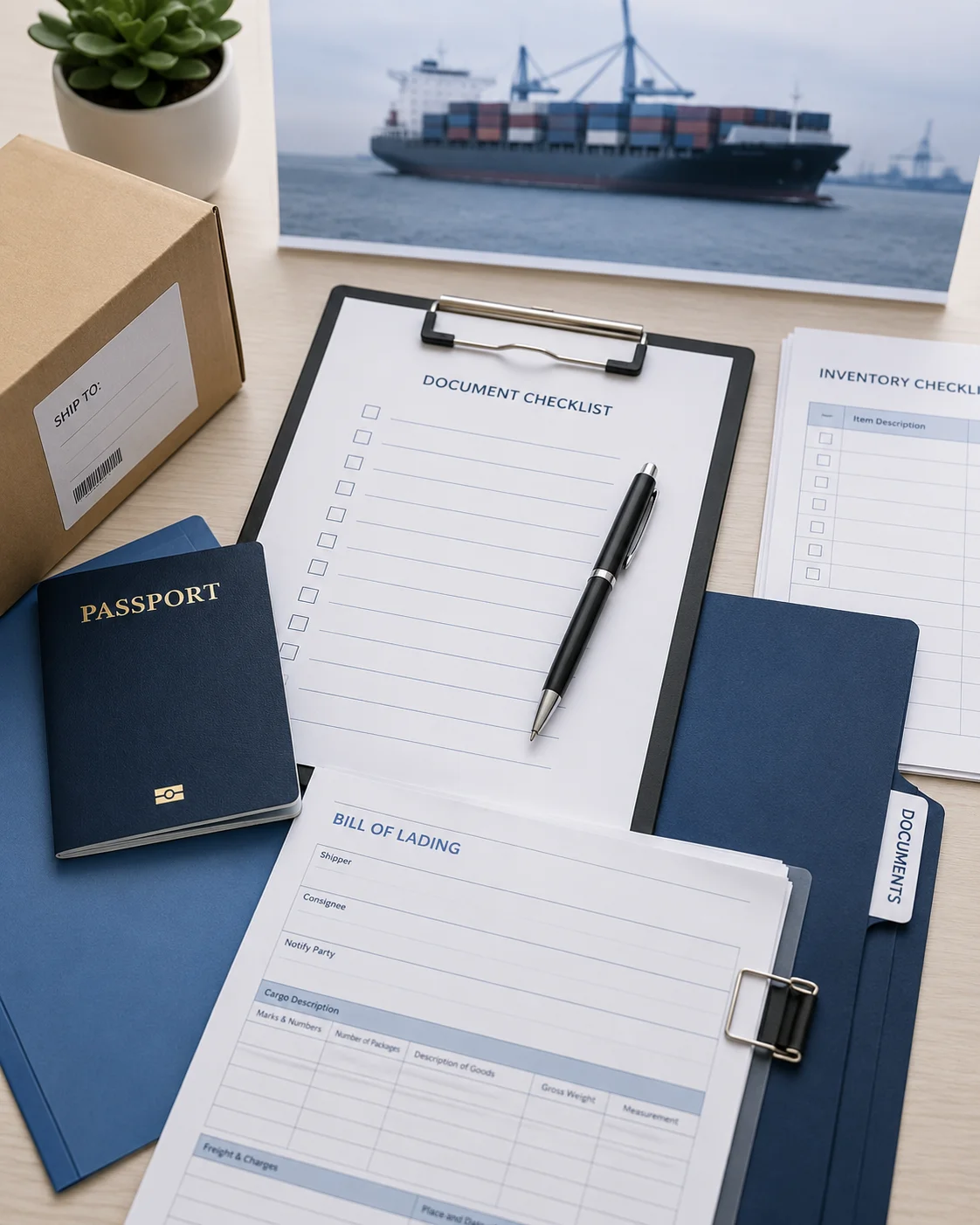
Specific Information
Normally, household removals should be imported in a single shipment from one place of origin. In special circumstances, and with prior submission of proof and explanation to the Customs Main Office before the removal, permission may be obtained to import in two or more shipments. A full inventory must accompany the first consignment, clearly indicating which goods are in the first shipment and which are to follow.
All documents must be with the agent before the goods arrive. If documents are not available on arrival, it will be impossible to organise customs clearance in time.
Note on SEF replacement: The Serviço de Estrangeiros e Fronteiras (SEF) was replaced in October 2023 by AIMA -- the Agência para a Integração, Migrações e Asilo (Agency for Integration, Migration and Asylum). All residence permit applications for non-EU nationals are now processed through AIMA. As of April 2025, AIMA only accepts fully complete applications; no exceptions are made for missing documents at the time of submission.
Goods qualify for duty-free TNR entry if: the owner has been habitually resident outside the EU for at least 12 months prior to transfer of residence; goods are used and have been in the owner's possession for at least 6 months; goods arrive within 6 months of the owner's own arrival in Portugal; and goods are not for sale after release.
Although duty-free entry applies to qualifying shipments, customs broker fees are always required. These are calculated on an ad valorem basis. Port handling charges and warehouse fees may be included and can be expensive -- estimates should be requested from the agent before the shipment departs.
If all required documents are not available at the time of customs clearance, duties and taxes will be assessed on the declared value.
Transferees must be present for customs clearance and must provide the exact date of their arrival in Portugal.
Antiques imported as part of a removal shipment are duty-free and require no additional documentation, but it is strongly recommended to declare them to customs at the time of entry to avoid complications on future export.
ISPM 15: Portugal enforces EU-wide requirements for heat-treated wood packaging materials (pallets, crates, dunnage) on shipments from non-EU countries. All wooden packing materials must carry the ISPM 15 mark.
Duties & Taxes
Portugal is an EU member state. Shipments originating within the EU move under EU free movement principles and are not subject to customs duties or formal clearance. Shipments from outside the EU are subject to Portuguese customs controls administered by the Autoridade Tributária e Aduaneira (AT -- Tax and Customs Authority). The primary duty-free route is the Transfer of Normal Residence (TNR) exemption under EU Regulation 1186/2009.
Prohibited & Restricted Items
Prohibited Items
The following items are prohibited from import into Portugal:
- Alcoholic beverages (prohibited in all shipments, including diplomatic removals)
- Narcotics and illegal drugs
- Pornographic materials and objects
- Foodstuff (beyond the restricted personal-use allowances described in Section 4)
- Meat, milk, and any by-products thereof from non-EU countries, with limited exceptions for specified quantities from Andorra, Croatia, the Faroe Islands, Greenland, and Iceland -- check with the agent for current allowances
- Protected species and products thereof under the Washington Convention (CITES), including ivory, tortoiseshell, coral, reptile skins, and wood from Amazonian forests
- Firearms, cut-and-thrust weapons, and any instrument without specific civilian application (without the required authorisation -- see Section 4)
- Counterfeit goods and goods infringing intellectual property rights
Restricted / Dutiable Items
Intra-EU Imports
Shipments arriving from other EU member states are not subject to customs duties. There are no formal quantity limits on goods for personal use moving within the EU.
Non-EU Imports
The following categories are restricted or dutiable:
Wine is restricted and is subject to duty. Tobacco products are restricted. New items still in original factory packaging are dutiable and are not eligible for the duty-free TNR exemption.
Firearms (hunting and civilian weapons only): a property title is required, and the weapon must be listed on the Portuguese Consulate certificate. Cut-and-thrust weapons and instruments with no specific civilian application are prohibited.
Furs, leather goods, and coats made from protected animal species require special authorisation.
Fish for personal consumption must not be disembowelled and cannot exceed 20 kg.
Powdered milk for babies, food for children, and special medical foods (including some pet food) may be permitted if they do not require refrigeration and have an original, unbroken seal -- unless already in use. Quantities must not exceed 10 kg if originating from Croatia, the Faroe Islands, Greenland, or Iceland, and 2 kg from all other non-EU countries.
Medicines and foodstuffs that may be harmful to national health are restricted.
Antiques imported separately (not as part of a removal shipment) require an import licence and invoice, and are subject to duties. Only commercial companies may apply for import licences for separately imported antiques.
Fine arts and exhibition goods imported temporarily may be covered by an ATA Carnet (no duties, taxes, or deposit required). Without an ATA Carnet, customs duties must be guaranteed by a deposit or bank guarantee. A special temporary import licence application to the Customs Main Office is required, valid for up to 6 months.
The following are also restricted or controlled: essences for counterfeiting regional wines; systems for copying Portuguese mail-stamping systems; roulette machines and other games of hazard; gold in bars; and live apes and monkeys.
Importing a Used Personal Vehicle
Required Documents
- Full vehicle registration certificate and title of property
- International driving licence
- Insurance documents
- Declaration from the Portuguese Embassy confirming the owner lived abroad for more than 12 months
- Purchase invoice
Specific Information
A vehicle may be temporarily imported duty-free for a period of 12 months, during which definitive legalisation (registration and payment of duties/taxes) must be completed. If definitive importation is not completed within this period, the vehicle must leave Portugal.
The vehicle must have been owned by the transferee for at least 12 months prior to the owner's arrival in Portugal.
Costs of duties and taxes for definitive importation depend on the vehicle's assessed value in Portugal. The consignee should obtain a Portuguese licence plate number; payment of duties and taxes is dealt with directly by the client with a customs broker or with the ACP (Automóvel Clube de Portugal). Provide vehicle details (brand, model, VIN, engine specifications) to the destination agent in advance.
Only one vehicle per person qualifies for the duty-free temporary import provision. Additional vehicles are subject to full duties.
Caravans are subject to the same duty regime as motorcars and require an invoice, registration certificate, and title of property.
Boats for definitive import are subject to duties and require a registration certificate and import licence. Definitive importation of boats is very difficult and is usually only permitted in special circumstances. Boats may be temporarily imported duty-free with only a registration certificate; special permission from the Customs Main Office is required for exhibition or racing purposes.
Bicycles are duty-free as long as they are listed on the inventory.
Pets
- EU Pet Passport, issued by an authorised veterinarian, containing valid microchip and rabies vaccination records From EU Member States
- Microchip documentation (ISO 11784/11785 standard) From Non-EU Countries
- Official health certificate issued by a government veterinarian From Non-EU Countries
- Vaccination certificate, including current rabies vaccination From Non-EU Countries
- Owner's passport From Non-EU Countries
Portugal is an EU member state and follows EU pet travel regulations for cats, dogs, and ferrets.
All pets must be identifiable by ISO-standard microchip or, for animals microchipped before 3 July 2011, a clearly visible tattoo. The rabies vaccination must have been administered after microchipping and at least 21 days before travel, and must remain valid on arrival.
All pets must undergo a medical examination before being cleared through customs.
Horses require a certificate of foal registration, a veterinary certificate, and an import licence. No horses should be sent without prior customs approval.
For other animals, requirements vary by species and country of origin; consult the destination agent before shipping. CITES-listed species cannot be imported without valid CITES permits.
Consignment Instructions
Contact the destination agent to ensure all requirements have been met prior to import, especially regarding differences between air and sea shipments.
All documents must arrive with the agent before the goods. Without documents in place at the time of arrival, customs clearance cannot be organised and storage charges will accrue rapidly.
The Baggage Certificate (Certificado de Bagagem) is the single most important document for the duty-free exemption. It must be obtained from the Portuguese Embassy or Consulate in the country of departure before the shipment leaves. It must not reference a secondary residence or list any item values.
The transferee must be present in Portugal for customs clearance and must provide an exact date of arrival.
Alcohol must not be packed in any shipment under any circumstances, including diplomatic removals. Alcohol found in a shipment will be refused at customs.
New or unopened items are not eligible for the duty-free exemption and will be assessed for duties and taxes. Ensure all items on the inventory are clearly described as used.
Antiques and items requiring special documentation should be clearly identified on the inventory and stowed for easy access during inspection.
Unpredictable additional expenses may arise, including customs broker fees (calculated ad valorem), port handling charges, warehouse fees, and inspection costs. Request detailed pre-arrival cost estimates from the destination agent.
Special territories: The Azores and Madeira are autonomous regions of Portugal with their own excise frameworks for tobacco and alcohol. Customs treatment for goods destined for these islands may differ from mainland Portugal; confirm requirements with the destination agent before shipping to these territories.
Cultural & Other Information
Portugal is a Western European country with a population of approximately 10.19 million and a GDP of around $308.7 billion. The capital is Lisbon; other major cities include Porto, Braga, and Coimbra. Portuguese is the official language. The currency is the Euro (EUR). Portugal is a founding member of NATO and has been an EU member since 1986. The country includes two autonomous island regions: the Azores (mid-Atlantic) and Madeira (off the coast of northwest Africa), both of which have distinct administrative and excise frameworks.
The Autoridade Tributária e Aduaneira (AT) administers both customs and tax collection. Vehicle registration and roadworthiness are managed through the IMT (Instituto da Mobilidade e dos Transportes). Animal and veterinary import controls are administered by DGAV (Direção-Geral de Alimentação e Veterinária). Residence permits for non-EU nationals are processed by AIMA (Agência para a Integração, Migrações e Asilo), which replaced SEF in October 2023.
Key Resources:
- OpenFactBook -- Portugal
- Wikipedia -- Portugal
- Autoridade Tributária e Aduaneira -- AT (Tax and Customs Authority)
- IMT -- Instituto da Mobilidade e dos Transportes (Vehicle Authority)
- DGAV -- Direção-Geral de Alimentação e Veterinária (Animal and Veterinary Authority)
- AIMA -- Agência para a Integração, Migrações e Asilo (Residence Permits / Immigration) *(may require browser access)*
- Portal das Comunidades -- Portugal's Embassies Abroad *(may require browser access)*
- EU Pet Travel -- Dogs, Cats and Ferrets (European Commission)
Useful resources