

Country Guides
Singapore

Key regulatory update: Singapore's GST rate increased from 7% to 9% in two stages -- 7% to 8% on 1 January 2023, and 8% to 9% on 1 January 2024. All GST figures in this guide reflect the current 9% rate. The former Agri-Food and Veterinary Authority (AVA) has been restructured; pet import licensing is now administered by the Animal and Veterinary Service (AVS) under the National Parks Board (NParks).
Explore sections
Guide Details
Household Goods
Documents
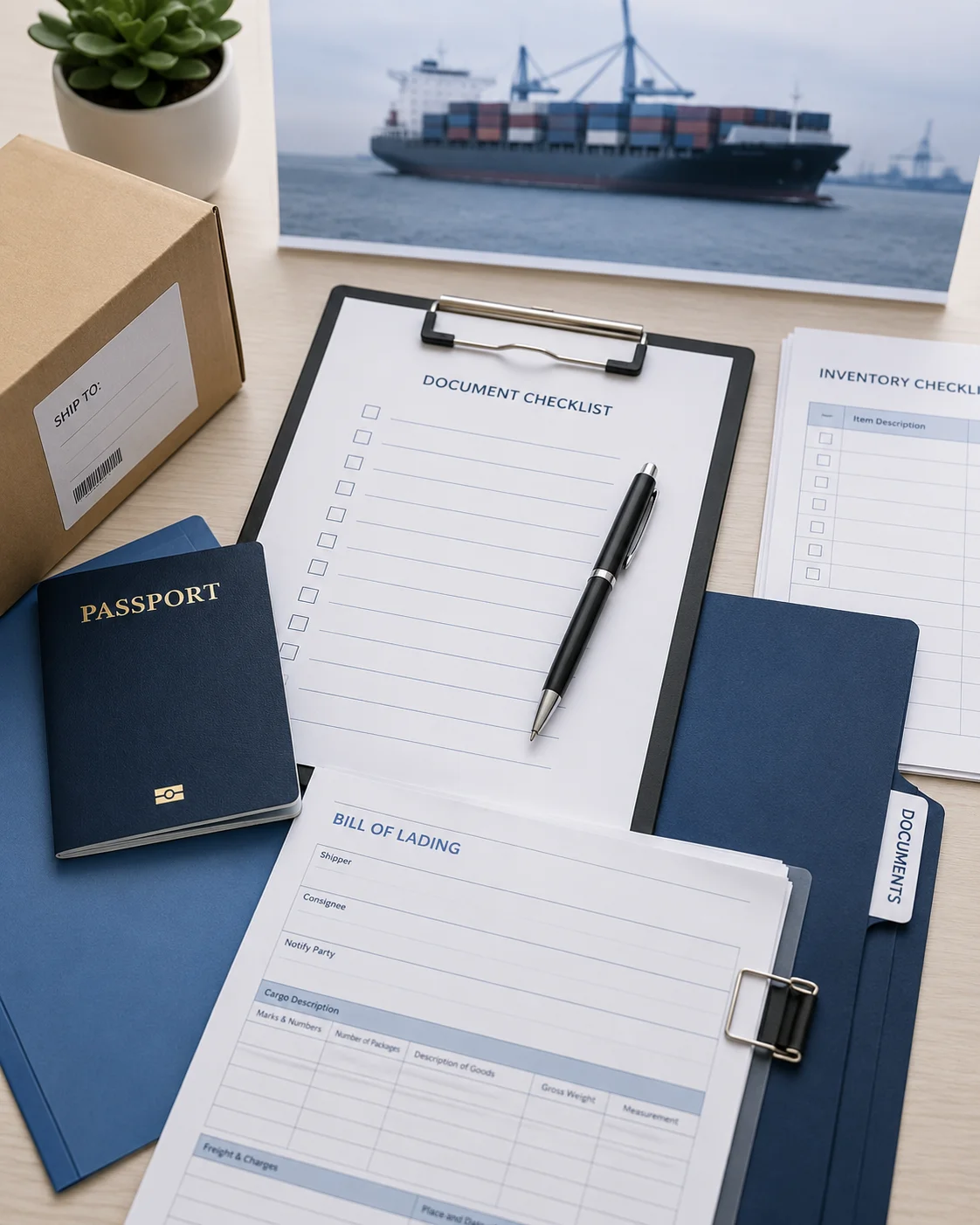
Documents required for importing used household goods, personal effects, and related shipments.
- Copy of passport (photograph and personal information pages)
- Declaration of Facts (DOF) form -- submitted online to Singapore Customs
- Original bill of lading (OBL) or air waybill (AWB)
- Copy of the owner's employment pass, dependent pass, or student pass (both sides); or In-Principle Approval (IPA) letter from the Ministry of Manpower (MOM); or for returning Singaporeans/PRs, proof of overseas residence
- GST relief application (In-Non-Payment permit) -- applied for via TradeNet through the appointed customs agent
- Supplementary Customs declaration form (where applicable)
- Wine and liquor declaration form (if applicable)
- Exemption permit (diplomats only -- must be registered with Singapore Customs)
Specific Information
GST relief is not automatic. The customs agent must submit an online Declaration of Facts through Singapore Customs, and the application is assessed by customs officers. Only after approval is a GST In-Non-Payment permit issued.
Goods not eligible for GST relief even when moving to Singapore include: intoxicating liquors, tobacco products, motor vehicles, petroleum products, and certain other controlled or dutiable items. These categories are always dutiable and/or GST-payable regardless of the relocation circumstances.
All imports into Singapore are subject to GST at 9% (since 1 January 2024), calculated on the CIF value. GST relief may be granted for qualifying importers transferring residence to Singapore, subject to the following conditions:
- The articles and personal effects must have been in the owner's possession and use for at least 3 months.
- The shipment must be imported within 6 months of the owner's first arrival into Singapore.
- The owner must give an undertaking not to dispose of the articles and personal effects within 3 months from the date of importation.
Qualifying importers are: Singaporeans and Permanent Residents (PRs) residing overseas and returning to resume residence in Singapore; and foreigners transferring residence or migrating to Singapore. For returning Singaporeans/PRs to qualify, they must have been residing overseas for more than 6 months.
If the shipment arrives more than 6 months after the owner's first arrival (as evidenced by the employment pass issue date), the shipment is subject to 9% GST on the full CIF value and a Customs In-Payment (GST) permit must be obtained instead.
Diplomatic missions, high commissions, consulates, and accredited trade organizations accorded diplomatic privileges by the Singapore Government are eligible for duty exemption and GST relief on goods for personal or official use. The organization and its authorized claimants must first be registered with Singapore Customs, and an exemption permit is required for each shipment.
A failure to declare all items or pay taxes due may result in prosecution, fines, and/or imprisonment. Singapore Customs enforces this strictly.
All solid wood packing materials must comply with ISPM 15 phytosanitary standards.
Prohibited & Restricted Items
Prohibited Items
The following items are prohibited from import into Singapore:
- Chewing gum (except dental or medicated gum approved by the Health Sciences Authority)
- Chewing tobacco and imitation tobacco products
- E-cigarettes, vaporizers, and electronic nicotine delivery systems (ENDS)
- Shisha and water pipe tobacco
- Smokeless cigars, cigarillos, or cigarettes
- Dissolvable tobacco or nicotine products
- Nasal snuff and oral snuff (prohibited since 1 August 2016)
- Gutkha, khaini, and zarda (prohibited since 1 August 2016)
- Any nicotine or tobacco product for topical, implant, or injection use
- Any solution or substance containing tobacco or nicotine intended for use in electronic delivery systems
- Cigarette lighters shaped as pistols or revolvers
- Liquors or cigarettes marked "SINGAPORE DUTY NOT PAID" on labels, cartons, or packets
- Narcotics, controlled drugs, and psychotropic substances
- Weapons, firearms, and ammunition (without authorization) [PERMIT REQUIRED]
- Weapons including kris, spears, and swords
- Bullet-proof clothing (without authorization) [PERMIT REQUIRED]
- Firecrackers, pyrotechnics, and explosives
- Obscene articles and pornographic materials (including publications, videotapes, discs, and software)
- Reproductions of copyright publications, video tapes, CDs, laser discs, and cassettes
- Seditious and treasonable materials
- Animals, birds, and their by-products (without authorization -- see Pets section for dogs and cats)
- Endangered species of wildlife and their by-products [CITES]
- Plants (without authorization and phytosanitary certification) [PERMIT REQUIRED]
- Counterfeit currency and goods
- Telecommunications and radio communication equipment (without authorization) [PERMIT REQUIRED]
- Films, videotapes, discs, laser discs, CD-ROMs, and video games (subject to classification/censorship prior to import)
- Medicines and pharmaceuticals (without authorization from the Health Sciences Authority) [PERMIT REQUIRED]
- Prerecorded cartridges and cassettes (subject to content classification)
Restricted / Dutiable Items
The following items are always subject to duty and/or GST regardless of qualifying for household goods GST relief:
- Intoxicating liquors: Subject to excise duty and GST. Duty is calculated based on alcoholic strength and quantity. Wine and liquor declaration form required in shipment.
- Tobacco products: Subject to excise duty and GST. No duty-free allowance in unaccompanied household goods shipments.
- Motor vehicles: See Motor Vehicles section.
- Petroleum products: Dutiable.
Traveller duty-free allowances (accompanied baggage only, not unaccompanied shipments):
Alcohol: up to 1 litre each of spirits, wine, and beer, for persons 18 and over who have spent 48+ hours outside Singapore and are not arriving from Malaysia. Tobacco: no duty-free concession for cigarettes -- all tobacco products are fully dutiable on arrival.
Importing a Used Personal Vehicle
Required Documents
- Certificate of Compliance (exhaust emission standard)
- Original commercial invoice
- Insurance papers
- Vehicle registration certificate (from country of origin)
- Owner's passport
- Inward declaration permit
- Customs In-Payment permit (duty and GST)
- Customs duty payment receipt
- Temporary Certificate of Entitlement (from LTA)
- Manufacturer's letter confirming the date of manufacture
Specific Information
Importing a motor vehicle into Singapore is extremely costly and is strongly discouraged for most transferees. The vehicle cost structure involves multiple layers of charges:
- Excise duty: 20% of the vehicle's Open Market Value (OMV)
- GST: 9% calculated on the total import cost (CIF + excise duty)
- Certificate of Entitlement (COE): A Singapore-specific quota system that grants the right to own and use a vehicle for 10 years. COE premiums are set by competitive bidding and can reach SGD 100,000 or more for popular categories. This is separate from and in addition to import duties.
- Additional Registration Fee (ARF): 100% or more of the OMV, depending on the vehicle's value
The total cost of registering an imported vehicle in Singapore (excise duty + GST + COE + ARF + other fees) routinely exceeds the purchase price of the vehicle itself. Transferees are strongly advised to contact the destination agent and the Land Transport Authority (LTA) before making any decision on vehicle import.
Left-hand drive vehicles are prohibited -- Singapore drives on the left.
Vehicles more than 3 years old generally cannot be imported (with exceptions for classic and vintage vehicles -- confirm with LTA).
A Certificate of Compliance confirming the vehicle meets Singapore's exhaust emission standards is required for all new and used vehicles.
All personal items must be removed from the vehicle before shipment.
Dismantled vehicles are not permitted for import.
Boats may be imported duty-free for the owner's personal use and not for resale.
Important: Do not load a motor vehicle into a container shipment before confirming eligibility, duty liability, and LTA registration requirements with the destination agent. The LTA website (onemotoring.lta.gov.sg) has full current details on vehicle import procedures and costs.
Pets
- ISO-compliant microchip (ISO 11784/11785) -- must be implanted before vaccination; mandatory for all dogs and cats
- Import licence from the Animal and Veterinary Service (AVS/NParks) -- apply in advance via NParks e-services
- Rabies vaccination certificate (required for all countries except Schedule I; vaccination administered between 30 days and 12 months before export; must be an inactivated vaccine; microchip number must appear on the certificate)
- Rabies Neutralising Antibody Titre Test (RNATT) result -- required for Schedule II, III, and IV countries; blood drawn at least 30 days after vaccination; titre must be at least 0.5 IU/ml; test must be processed by an EU- or OIE-approved laboratory; for Schedule III countries, the test must be completed at least 3 months before travel
- Veterinary health certificate issued by a licensed veterinarian and endorsed by the government veterinary authority of the originating country
- Dog licence (for dogs) -- must be obtained before applying for the import licence
- Additional vaccinations: dogs must be vaccinated against distemper, hepatitis, and parvovirus; cats against feline calicivirus, feline viral rhinotracheitis, and feline panleukopenia -- all at least 2 weeks before export
- Quarantine reservation at an AVS-approved quarantine centre (AQC) -- must be booked before travel
Pet imports are now administered by the Animal and Veterinary Service (AVS) under NParks. The Singapore Customs website also provides guidance on importing pets as part of a household move.
Singapore classifies all exporting countries into schedules (I through IV) based on rabies risk. Requirements escalate significantly for Schedule III and IV countries (high-rabies-risk). Most countries outside of Australia, New Zealand, the UK, Japan, and a handful of others will be Schedule II or III. Members must check the current schedule classification for the specific origin country via AVS/NParks before advising clients.
Quarantine: Pets from Schedule I (rabies-free) countries with compliant documentation may enter without quarantine. Pets from Schedule II countries are subject to 10 days quarantine if the first rabies vaccination was administered more than 4 months before import, or 30 days quarantine if it was administered more than 3 months before. Pets from Schedule III countries face a mandatory minimum 30-day quarantine at an AVS-approved quarantine centre. Quarantine space must be reserved in advance.
Prohibited breeds (dogs): Pit Bull types (American Pit Bull Terrier, Bull Terrier, Staffordshire Bull Terrier, American Staffordshire Terrier, and crosses with any of these), Akita, Boerboel, Dogo Argentino, Fila Brasileiro, Neapolitan Mastiff, Tosa, Presa Canario, and their crosses. Confirm the current full list with AVS/NParks.
Prohibited breeds (cats): Bengal, Savannah, Chausie, and other wild hybrid cat breeds are prohibited.
Only dogs and cats are permitted under standard import procedures. Rabbits, hamsters, birds, reptiles, and other animals require special permissions from AVS/NParks and are subject to additional or different requirements.
An inspection appointment must be booked via NParks e-services at least 5 days before the pet's arrival at Changi Airport. Arriving without an appointment incurs a fee of SGD 133 per hour.
Singapore's pet import process typically takes 4 to 6 months from start to finish for Schedule II/III origin countries. Members should advise clients to begin the process as early as possible.
Consignment Instructions
Recommended: Contact the destination agent to ensure all requirements have been met prior to import, especially for differences regarding air and sea shipments.
The Declaration of Facts must be submitted online to Singapore Customs by the appointed agent before the shipment arrives. Ensure all supporting documents are provided promptly. The six-month window from the owner's first arrival in Singapore is strictly enforced -- shipments arriving after this window lose GST relief eligibility.
Singapore operates TradeNet, an electronic customs filing system. All permits and declarations are processed through TradeNet. Only licensed customs agents may submit declarations; all shipments must be handled by an appointed licensed agent.
Dutiable goods (liquors, tobacco) must be identified and declared separately. The wine and liquor declaration form should accompany any shipment containing alcohol.
Singapore has strict controls on prohibited items. Attempting to import prohibited goods is a serious offence. Ensure clients thoroughly review the prohibited items list before packing.
For sea freight, the main port is PSA Singapore (formerly the Port of Singapore Authority) at Tanjong Pagar and Pasir Panjang terminals. For air freight, goods are handled at the air freight centre at Changi Airport.
Cultural & Other Information
Singapore is a sovereign island city-state at the southern tip of the Malay Peninsula in Southeast Asia. It is one of the world's most prosperous countries and a leading global financial, trade, and logistics hub. Singapore has four official languages: English, Mandarin Chinese, Malay, and Tamil. English is the language of government, business, and education. The currency is the Singapore dollar (SGD).
Singapore maintains one of the world's most efficient and highly regarded customs and regulatory regimes. It consistently ranks at or near the top of global ease-of-doing-business and trade facilitation indices. Customs regulations are enforced rigorously and predictably. Singapore has zero tolerance for drug trafficking -- offences involving controlled drugs above threshold quantities carry mandatory death or life imprisonment.
Reference links:
Useful resources