


Key regulatory updates: South Africa's VAT rate remains at 15% (a proposed increase to 16% in 2025 was reversed by the Ministry of Finance in April 2025). The South African Bureau of Standards (SABS) has been restructured -- the vehicle Letter of Authority (LOA) is now issued by the National Regulator for Compulsory Specifications (NRCS). SARS continues to modernize through digital systems, and tariff amendments were issued as recently as June 2026.
Explore sections
Guide Details
Household Goods
Documents
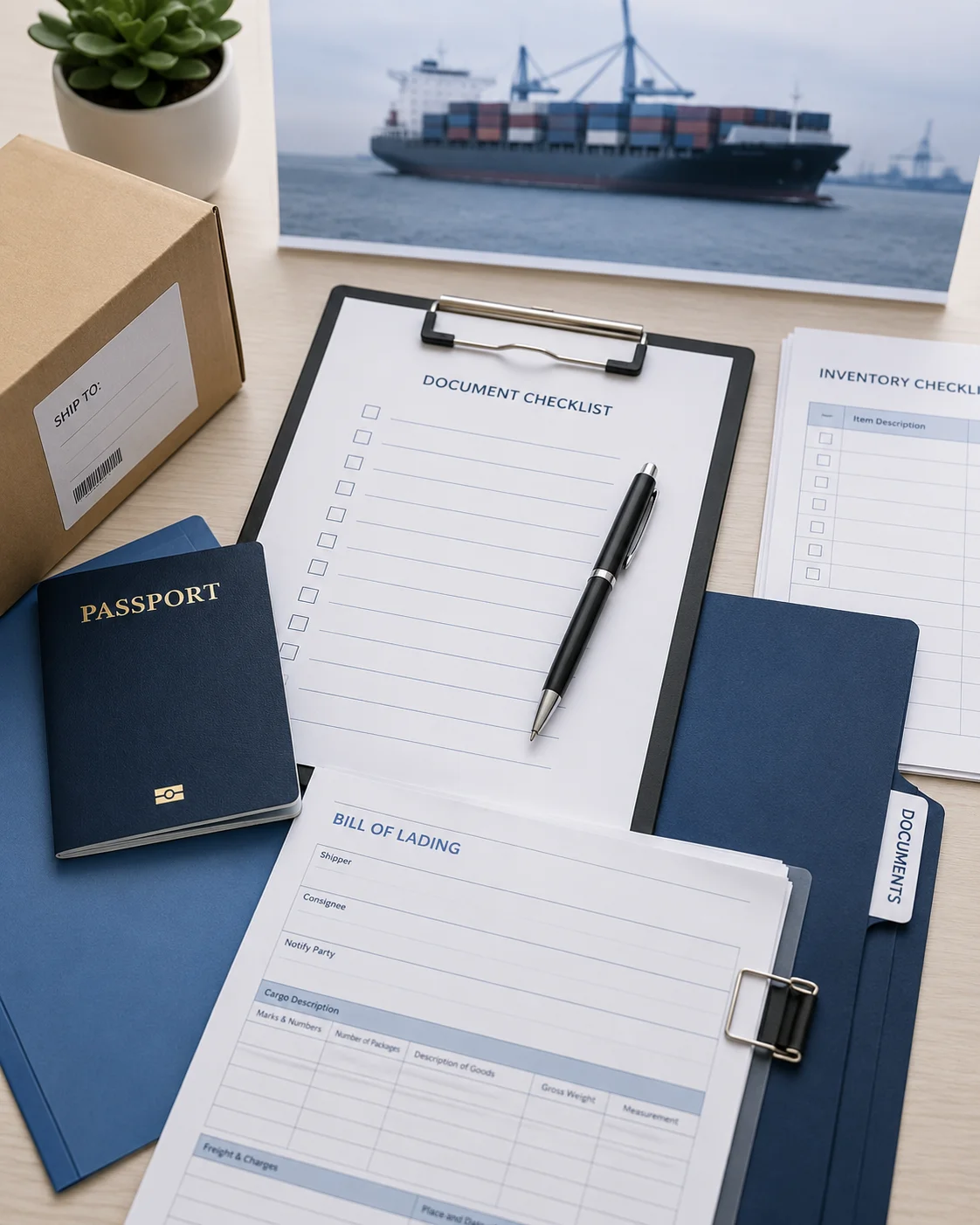
Documents required for importing used household goods, personal effects, and related shipments.
- Original passport (including the page with entry stamp)
- Original bill of lading (OBL), express or telex release, or copy of air waybill (AWB)
- Detailed inventory
- Customs form DA 304 (declaration for household furniture and personal effects -- for returning residents and immigrants)
- Customs form P.1.160 (where applicable)
- Affidavit stating the reason for return to South Africa
- Permanent residence documents or visa
- Valid temporary residence permit or work permit
- Diplomatic clearance documentation
- Certificate from the embassy signed by the South African Department of International Relations and Cooperation (DIRCO)
Specific Information
The owner of the goods must provide all required documents to the destination agent before the shipment is cleared. The owner must be present for customs clearance.
Used household goods and personal effects may be imported duty-free under rebate item 407.04 (immigrants) or 407.06 (returning residents) if all of the following conditions are met:
- The articles have been in the owner's use and possession for more than 12 months.
- The articles are not for sale or other disposal.
- Returning South African residents must have been abroad for a period of at least 6 consecutive months for purposes other than touring, and must have established temporary residence in unfurnished or semi-furnished accommodation abroad.
New household goods and furniture are treated as commercial imports and are subject to full customs duties and 15% VAT. Works of art forming part of a bona fide household shipment, or works over 100 years old (antiques), may be imported duty-free as part of an otherwise qualifying shipment.
The goods should arrive in South Africa after the owner if possible. If the shipment arrives before the owner, goods are placed in storage at the owner's expense pending clearance.
Returning residents must register personal items of value (jewelry, watches, cameras, laptops, etc.) with SARS before leaving South Africa to avoid paying duty upon re-importation. Failure to do so may result in a duty deposit being required at the time of re-entry.
Non-compliance with requirements may result in destruction of the goods by customs, or return of the entire consignment to the port of origin at the owner's expense.
All solid wood packing materials must comply with ISPM 15 phytosanitary treatment standards.
Prohibited & Restricted Items
Prohibited Items
The following items are prohibited from import into South Africa:
- Narcotics and illegal drugs
- Pornographic books, magazines, and material
- Plants and vegetable products (subject to strict phytosanitary controls; all plants and plant products require phytosanitary certificates and inspection) [PERMIT REQUIRED for authorized imports]
- Animals and animal by-products, birds, poultry, dairy products, butter, and eggs without authorization [PERMIT REQUIRED]
- Animal products including certain feathers, furs, skins, tusks, and products from protected species [CITES]
- Radio communication equipment and walkie-talkies (may include other prohibited communication devices -- confirm with destination agent) [PERMIT REQUIRED]
- Counterfeit goods
- Left-hand drive vehicles (if registered on or after 1 January 2000)
- Rabbits and ferrets
- Goods subject to South African sanctions
Restricted / Dutiable Items
Traveller duty-free allowances (accompanied baggage, per person):
New or used goods: R5,000 (or R25,000 if arriving from Botswana, Lesotho, Namibia, or Swaziland/Eswatini); valid once per person per 30-day period after an absence of at least 48 hours. Goods between R5,000 and R20,000 may be assessed at a flat customs duty rate of 20% (less full duty) with VAT exempt; goods over R20,000 pay standard duty plus 15% VAT. Tobacco: 200 cigarettes and 20 cigars and 250 g of tobacco per person. Alcohol: 2 litres of wine and 1 litre of spirits or other alcoholic beverages per person (persons under 18 may not claim alcohol or tobacco allowances). Perfume: 50 ml; eau de toilette: 250 ml.
Currency: South African bank notes in excess of R25,000, gold coins, coin and stamp collections, and unprocessed gold must be declared. Foreign currency may be imported freely but amounts exceeding the exchange control regulations must be declared and may require SARB authorization.
Wine and liquor in household goods shipments: Require an import permit and, for quantities of 15 litres or more, a liquor removal certificate. For quantities under 15 litres, the liquor removal certificate is not required but duties and taxes remain payable. A wine list must be prepared and the wine/liquor must be packed last in the shipment (to be accessible for customs examination). Documentation requirements must be met before the shipment arrives.
Firearms: Require an import permit and a South African Police Service (SAPS) Firearm Registrar Certificate (SAP 312). Firearms must be hand-carried by the owner -- they cannot be included in sea or air freight shipments and the shipment cannot be cleared if firearms are included. [PERMIT REQUIRED]
Medicines: Personal-use medicines may be imported for one month's supply without permit. For larger quantities, a letter or prescription from a registered physician is required.
Endangered species (CITES): Require a CITES permit. [CITES]
Inheritances: Documents required: death certificate; will or certified extract or court probate order (with English translation); inventory with lawyer's declaration; declaration from the beneficiary confirming permanent South African residency and right to the estate. Items of inheritance may be imported duty-free if the beneficiary is permanently resident in South Africa. Duty is payable on inherited motor vehicles. Goods should not be shipped until customs has authorized duty-free entry.
Wedding trousseaux: Require an invoice and, if customs requests, an import permit for second-hand goods. Subject to payment of duties.
Importing a Used Personal Vehicle
Required Documents
- Customs form DA 304/A (required for automobiles and motorcycles)
- Vehicle registration certificate
- Original bill of lading (OBL), express or telex release, or copy of AWB
- Document proving the vehicle has been in the owner's use and possession abroad for more than 12 months (original purchase invoice, insurance certificate, or equivalent)
- Valuation certificate (3 copies)
- Import permit (for permanent residents -- not required for temporary residents)
- Letter of Authority (LOA) issued by the National Regulator for Compulsory Specifications (NRCS) in Pretoria -- must be submitted at the time of customs clearance
Specific Information
All motorized vehicles -- motor cars, motorcycles, scooters, and any other motorized vehicle -- are subject to customs examination. The owner must be present for pickup at the designated customs warehouse (Elliottwarehouse in Johannesburg).
Critical timing requirements: The owner must be in South Africa at least 10 business days before the arrival of an ocean vessel carrying the vehicle. For air shipments, the owner must arrive before the shipment. The origin agent cannot dispatch the vehicle shipment until the destination agent confirms a "green light." Shipment sent before receiving this confirmation will incur customs clearance charges.
The LOA from NRCS (formerly SABS) is required before the vehicle arrives. The application must be submitted to NRCS with proof of payment of the applicable fee. A faxed or scanned copy of the LOA and import permit must be received by the destination agent before clearance. Originals are required after clearance. Motorized vehicles should not be shipped until the owner has proven possession of all required documents to customs and has received written permission for import.
No left-hand drive vehicles may be imported if registered on or after 1 January 2000. South Africa drives on the left; right-hand drive vehicles only.
Vehicles more than 12 years old generally cannot be registered for use on public roads; confirm current age restrictions with the destination agent.
Import restrictions by residency status:
- Permanent residents: require import permit; pay full duties and taxes on return; vehicles may not be sold for at least 2 years after importation.
- Temporary residents: no import permit required; must pay in cash; must provide a customs bond covering full duties and taxes (refundable on re-export -- contact agent for details); vehicle must be re-exported when the temporary residence permit expires.
- Diplomats: no duties or taxes, subject to conditions of the diplomatic clearance certificate and proof of value.
VAT at 15% is assessed on the import value of the vehicle, in addition to any applicable excise or customs duties.
Pets
- ISO-compliant microchip (ISO 11784/11785, 15-digit non-encrypted) -- must be implanted before vaccination; microchip number must appear on all documentation
- Current rabies vaccination certificate (administered between 30 days and 12 months before entry)
- International veterinary health certificate issued by a licensed veterinarian and endorsed by the government veterinary authority of the originating country, within 10 days of entry
- Import permit from the Director of Animal Health, South Africa (required for pets from countries other than Botswana, Lesotho, Malawi, Namibia, Swaziland/Eswatini, and Zimbabwe; apply well in advance -- permit valid for 6 months from issue)
- Blood test results for dogs (required from all countries): tests for Brucellosis, Distemper, Hepatitis, Parvovirus, Babesia canis, and Leishmania (or equivalent) from an approved laboratory within 30 days of entry -- if the originating country is free of a disease and the government attests to this, testing for that specific disease may be waived
- Parasite treatment records for dogs (internal and external parasites, within 30 days of travel)
Dogs: Subject to a minimum 14 days quarantine on arrival from most countries except a short list of approved countries (including Australia, New Zealand, UK, Ireland, and select others). Dogs from approved low-rabies countries with proper documentation may enter without quarantine. All dogs entering via quarantine may only be imported through Johannesburg OR/Tambo International Airport or Cape Town International Airport; other airports and land border posts are not permitted for quarantined dogs.
Cats: Not subject to quarantine if they have a properly completed import permit and veterinary health certificate. Cats are permitted to enter from Mozambique via land border.
Breeds: Mixed breeds cannot be imported unless spayed or neutered. Most pedigree breeds are permitted. Proof of pedigree should be available.
Puppies/kittens: Puppies under 8 months of age may not be imported unless accompanied by their mother. Kittens under 3 months of age may only be imported if the mother had been vaccinated for rabies more than 30 days and less than 12 months before the kitten's birth; kittens must be vaccinated in South Africa at 3 months of age.
Other animals: Rabbits and ferrets are not permitted to enter South Africa. Birds, reptiles, rodents, and other non-standard pets require a health certificate and import permit, and may have additional requirements. Contact the destination agent and the DIRCO / Department of Agriculture for current requirements.
Pets must travel as air cargo (IATA-compliant crate) unless the animal is a certified service animal accompanying a disabled passenger.
Consignment Instructions
Recommended: Contact the destination agent to ensure all requirements have been met prior to import, especially for differences regarding air and sea shipments.
South Africa has three major seaports relevant to household goods: Durban (busiest, east coast), Cape Town (west coast), and Port Elizabeth/Gqeberha (east coast). Motor vehicles are processed through a specialist customs warehouse (Elliottwarehouse in Johannesburg). Air freight moves through OR Tambo International Airport (Johannesburg), Cape Town International Airport, and King Shaka International Airport (Durban).
The owner must be present in South Africa for customs clearance of household goods -- clearance cannot be done entirely by the agent in the owner's absence.
For vehicle imports, the 10-day pre-arrival presence requirement is strictly enforced. The LOA from NRCS takes time to obtain and should be applied for well before the vehicle shipment departs origin.
Wine and liquor must be packed separately and last in the shipment for easy customs access. Declare all wine and liquor quantities accurately -- under-declaration is treated as a serious customs offence.
New goods within a household goods shipment are treated as commercial imports and will be assessed for full duties and 15% VAT. Members should advise clients to separate new items from used goods documentation, or to declare them accurately.
Non-compliance -- including failure to declare goods, under-declaration of values, or inclusion of prohibited items -- can result in destruction of the entire consignment or its return to origin at the owner's expense.
Cultural & Other Information
South Africa is the southernmost country in Africa and one of the continent's most economically developed nations. It has three capital cities: Pretoria (executive), Cape Town (legislative), and Bloemfontein (judicial). The largest city is Johannesburg. South Africa has 11 official languages; English is the language of government, business, and education. The currency is the South African rand (ZAR).
South Africa has a highly developed financial, legal, and logistics infrastructure, and is a member of the African Union, SADC, BRICS, and the Commonwealth. It hosts the continent's largest stock exchange (JSE). The country is known for extraordinary natural and cultural diversity, from the Drakensberg mountains and the Kruger National Park to Cape Town's Table Mountain and world-renowned winelands.
Reference links:
Useful resources