


Key regulatory update: The pet section requires particular attention when planning a move. South Korea's pet import regime is administered by the Animal and Plant Quarantine Agency (APQA), with microchip-before-vaccination sequencing, mandatory rabies titer testing, and no mandatory post-titer waiting period for same-day release. The duty-free personal effects threshold for returning travelers has been updated to USD 800 (from USD 400). South Korea's official name is the Republic of Korea (ROK).
Explore sections
Guide Details
Household Goods
Documents
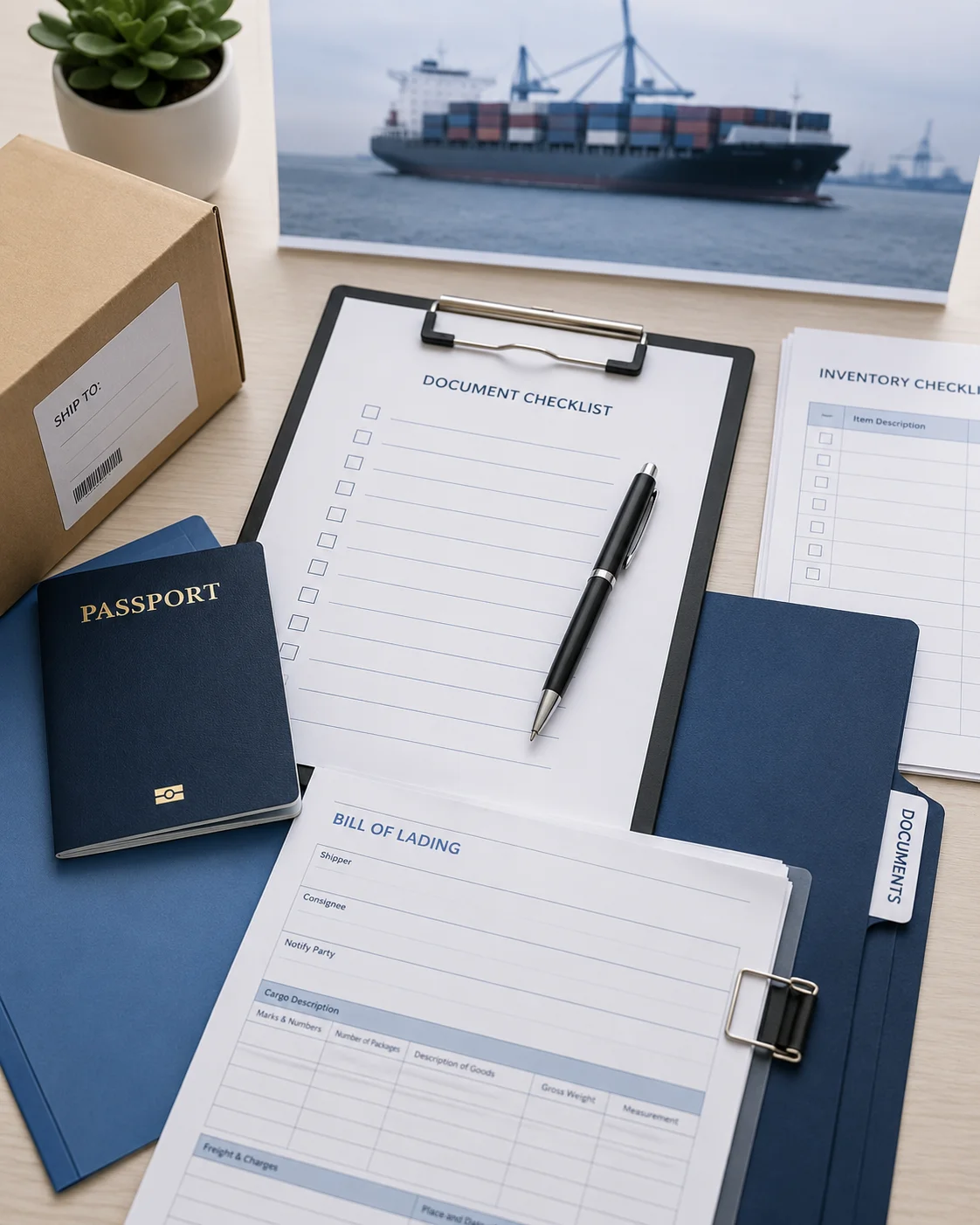
Documents required for importing used household goods, personal effects, and related shipments.
- Copy of passport (photo page, entry stamp page, and long-term visa pages)
- Detailed inventory / packing list in English
- Copy of bill of lading (OBL) or sea waybill, or air waybill (AWB)
- Alien Registration Card (ARC) from the Korean Immigration Office -- must be valid for at least 12 months
- Power of attorney (for the destination customs agent)
- Customs declaration form
- All documents listed above (ARC not applicable for returning citizens; substitute Korean national ID)
- Certificate of entry and exit (issued by Korean Immigration Service confirming 12+ months abroad)
- Evidence in passport of at least 12 months spent abroad
- All standard documents
- Application for duty exemption issued by the Ministry of Foreign Affairs of Korea
Specific Information
Eligibility for duty exemption on household goods:
Key operational requirements:
A person moving to Korea -- whether a foreigner intending to reside for at least one year (or 6 months if accompanied by family members), or a returning overseas Korean -- may import moving goods duty-free, provided the goods meet the following conditions:
- Goods must have been used overseas for more than 3 months.
- Goods must be registered in the name of the moving person or an accompanying family member for more than 3 months before entry.
For returning Korean citizens and those who have restored citizenship, goods used for more than 3 months abroad generally qualify for the duty exemption. Short-term residents (staying less than 1 year) may still qualify for duty-free treatment on goods used more than 3 months that are generally recognized as personal effects given the nature and duration of the stay.
- Goods must arrive at the Korean port or airport of entry within 6 months of the owner's arrival in Korea.
- Personal effects cannot be customs-cleared prior to the owner's arrival in Korea.
- All incoming shipments (except diplomatic) are subject to open inspection by the Korea Customs Service (KCS). Even diplomatic shipments must be de-vanned and trans-loaded to a mover's van within Seoul's four main gates area -- though diplomatic containers are not inspected.
- Clearance takes place at a Customs bonded warehouse (except for diplomats).
All solid wood packing materials must comply with ISPM 15 phytosanitary treatment standards.
Prohibited & Restricted Items
Prohibited Items
The following items are prohibited from import into South Korea:
- Illegal drugs and narcotics
- Pornographic materials (sexually inappropriate materials)
- Counterfeit goods and materials (forged currency, bonds, securities)
- Subversive and treasonous materials
- Weapons and firearms without authorization [PERMIT REQUIRED]
- Products from endangered species protected under CITES [CITES]
Restricted / Dutiable Items
Traveller duty-free allowances (accompanied baggage, persons 19 and over):
Personal goods, gifts, and new items: USD 800 total value (updated from USD 400 in an older baseline source). Separately: alcohol (1 litre total); tobacco (200 cigarettes, or 50 cigars, or 20 ml of e-cigarettes/liquid nicotine, or 250 g of other tobacco products); perfume (100 ml / 60 ml in some references -- confirm with KCS). Alcohol and tobacco allowances do not apply to persons under 19. Persons voluntarily declaring goods in excess of their allowance receive a 30% reduction in standard customs duty; failure to declare and subsequent detection results in an additional 40% penalty tax.
Food items in household goods shipments:
Food items are allowed in sea shipments only. All food items must be sealed and labeled. Small amounts may qualify for duty-free treatment. Shipments containing excessive quantities of food may be assessed at 20% duty on the food value. Confirm food quantity limits with the destination agent.
Plants and plant by-products: Subject to quarantine inspection and approval by APQA. Denial of entry is possible. A phytosanitary certificate from the originating country's plant protection authority is required.
Arriving from countries with avian influenza or other livestock disease outbreaks: Birds, chicken meat, and all animal products (ham, sausages, etc.) from affected countries are restricted. Contact the destination agent for current restrictions.
Firearms and ammunition: Require authorization from Korean authorities. [PERMIT REQUIRED]
Narcotic and psychotropic drugs: Require authorization. [PERMIT REQUIRED]
Currency: Amounts of USD 10,000 or more in foreign currency or Korean won must be declared on arrival and departure.
Importing a Used Personal Vehicle
Required Documents
- Original title **For All Importers**
- Original registration certificate (from country of origin) **For All Importers**
- Copy of purchase receipt or invoice **For All Importers**
- Insurance policy documents **For All Importers**
- Vehicle must be listed on the inventory with full technical specifications: make, model, chassis/VIN number, plate number, engine number, engine type, displacement (cc), and power (kW) **For All Importers**
- Detailed inventory listing the vehicle **For Diplomats, Additionally**
- Customs duty exemption document showing frame number, chassis number, engine number, model, and type **For Diplomats, Additionally**
Specific Information
In order to register and drive a vehicle in South Korea, all imported vehicles must pass three mandatory government tests: (1) exhaust emission test; (2) noise and vibration test; (3) type and model approval. Vehicles not meeting Korean standards require modification and approval before they can be registered. This process can be costly; confirm with the destination agent before shipping.
Korean automobile insurance must be obtained prior to removing the vehicle from the Customs bonded warehouse. The insurance should be arranged in advance so it is ready at clearance.
For vehicles qualifying for duty-free treatment (part of a qualifying household goods move), the vehicle must have been used abroad for more than 3 months and registered in the owner's name for more than 3 months before entry.
Vehicles previously exported from Korea (registration plates typically beginning with "K") qualify for full duty exemption on return. For other vehicles, the dutiable value is calculated based on the new vehicle's value from the Korean Blue Book (price guide), adjusted by a residual value percentage rate, plus freight and insurance costs.
Diplomatic vehicle restrictions: Vehicles imported duty-free by diplomats may not be sold or transferred to a non-diplomatic individual for 3 years. Transfer between diplomats is permitted. If a diplomat sells or transfers a vehicle to a non-diplomatic individual, full duties and taxes are assessed by Korean Customs.
Pets
- ISO-compliant microchip (ISO 11784/11785, 15-digit non-encrypted) -- must be implanted **before** the first rabies vaccination; microchip number must match all documentation exactly **For all dogs and cats:**
- Government-issued health certificate from the competent authority of the exporting country, issued at the port of export, confirming the microchip number, birth date, and (where applicable) rabies titer result **For all dogs and cats:**
- Rabies vaccination record (for dogs and cats aged 90 days or older from non-rabies-free countries) **For all dogs and cats:**
- Rabies Neutralizing Antibody Titer Test (RNATT / FAVN) result of at least 0.5 IU/mL, conducted at an OIE/WOAH-approved laboratory; blood must be drawn within 24 months before arrival in Korea; the microchip must be implanted before the blood draw **Additional requirement for dogs and cats aged 90 days or older from countries NOT on the APQA rabies-free list:**
Pet imports are administered by the Animal and Plant Quarantine Agency (APQA) of Korea. The APQA publishes detailed English-language guidance at qia.go.kr.
Same-day release: Quarantine-free same-day release is possible for fully compliant pets. A pet with a confirmed ISO microchip, valid titer (where required), and a properly completed government health certificate can be released on arrival after a clinical inspection. Quarantine is imposed only when documentation is incomplete or non-compliant, and is at the owner's expense.
Sequence matters: Microchip must be implanted before vaccination; vaccination must precede the titer test; the titer blood draw must be at least 30 days after the most recent rabies vaccination. The titer result must be at least 0.5 IU/mL. Unlike the EU, South Korea does NOT require a post-titer waiting period before travel -- the animal can travel as soon as the titer result is confirmed. This makes South Korea one of the faster destinations in Asia for pet imports that require titer testing.
Dogs and cats from recognized rabies-free countries (including Australia, New Zealand, Japan, UK, Iceland, and others on the APQA list) do not require the titer test but still require a microchip and health certificate confirming the microchip number and birth date.
Animals under 90 days of age are exempt from the rabies vaccination requirement but still require a microchip and government health certificate.
Persons bringing 10 or more cats and/or dogs to Korea must submit an advance notification form to APQA and obtain prior approval for quarantine facility use.
All incoming pets are subject to a clinical health inspection at the port of entry. Animals with missing or mismatched microchips, failed titer tests, or incomplete documentation face extended quarantine at the owner's expense. If no health certificate is presented, the pet must be returned to the country of origin at the owner's cost.
Birds, rabbits, and other non-dog/non-cat pets have separate import requirements. Contact the destination agent and APQA for current requirements.
Consignment Instructions
Recommended: Contact the destination agent to ensure all requirements have been met prior to import, especially for differences regarding air and sea shipments.
Personal effects cannot be cleared until the owner has arrived in Korea. The shipment must arrive within 6 months of the owner's arrival. Members should ensure clients understand this timeline constraint when planning their move.
All shipments (except diplomatic) are subject to open inspection by Korean Customs. This should be factored into delivery timelines. Diplomatic shipments are de-vanned and trans-loaded within Seoul's restricted inner-city area without inspection, but this still adds transit time.
The Alien Registration Card (ARC) is critical for foreign nationals. It must be valid for at least 12 months and must be presented for customs clearance. Clients should ensure they have ARC registration arrangements in place well before the shipment is dispatched from origin.
South Korea's main ports of entry for sea freight are Busan (primary), Incheon, and Gwangyang. Incheon International Airport handles air cargo. The Korea Customs Service uses an electronic clearance system (UNI-PASS); the destination agent handles all customs filings electronically.
Cultural & Other Information
The Republic of Korea (South Korea) is an East Asian nation on the southern portion of the Korean Peninsula. The capital and largest city is Seoul. Korean is the official language. The currency is the South Korean won (KRW). South Korea is a highly developed OECD member economy, a leading manufacturer in semiconductors, automobiles, shipbuilding, and electronics, and home to globally recognized brands such as Samsung, Hyundai, Kia, and LG.
South Korea has a vibrant and distinctive culture with global influence through Korean popular music (K-pop), film, drama (K-dramas), and cuisine. Korea is also notable for its mandatory military service requirement for male citizens. The country maintains a state of armistice (not formal peace) with North Korea; the Demilitarized Zone (DMZ) separates the two countries.
Reference links:
Useful resources