

Country Guides
Switzerland

Note on Swiss Customs rebranding: The Swiss Federal Customs Administration (EZV) was renamed the Federal Office for Customs and Border Security (FOCBS / German: BAZG) in January 2022. The website has migrated to bazg.admin.ch. Old ezv.admin.ch URLs redirect to the new domain.
Start here
Overview
Explore sections
Guide Details
Household Goods
Documents
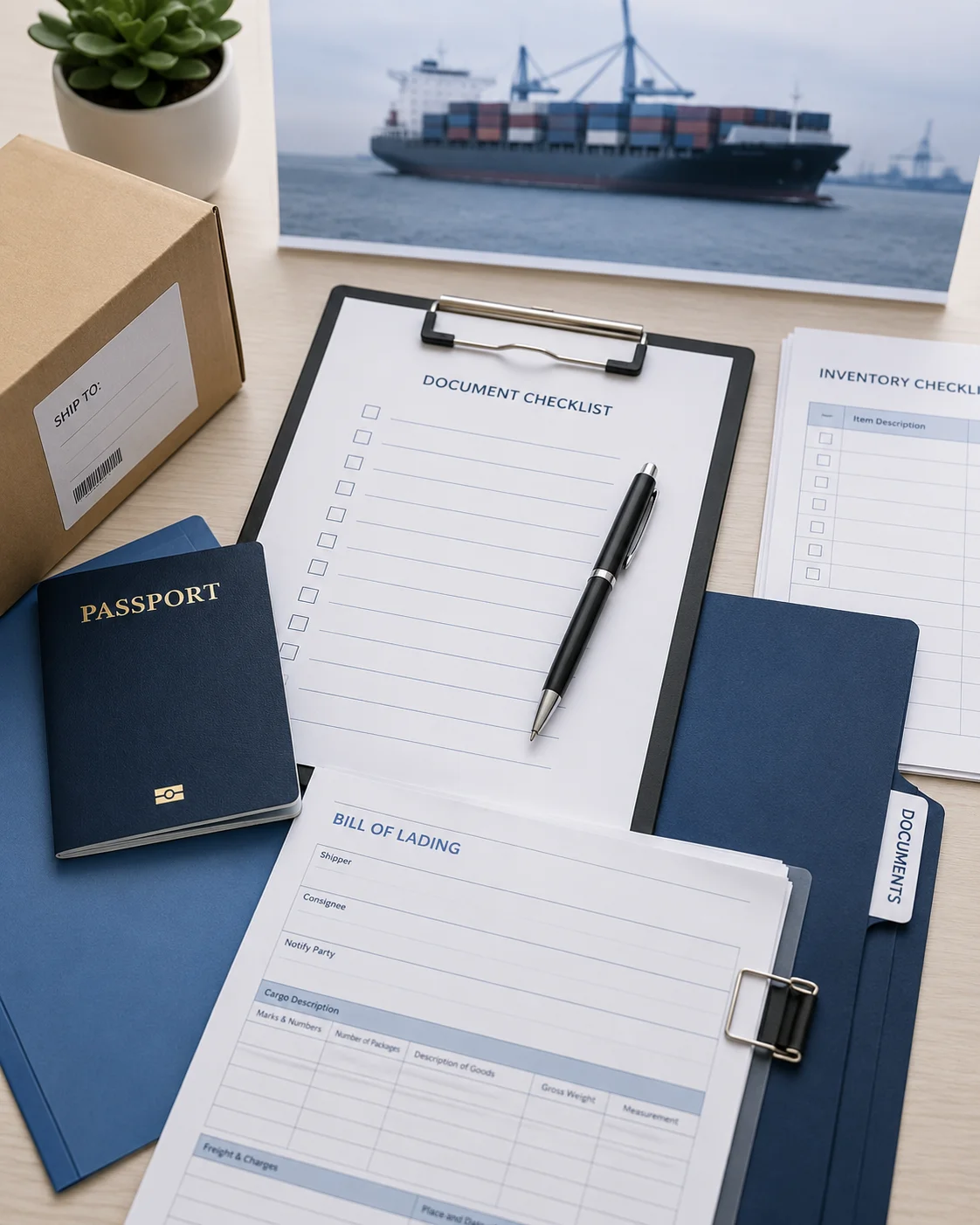
Documents required for importing used household goods, personal effects, and related shipments.
All importers:
- Original signed Customs Form 18.44 (application for duty- and tax-free clearance of removal goods) — original signature mandatory; copies and PDFs are not accepted. The destination agent provides this form.
- Copy of passports for all co-immigrating persons (photo/identification pages)
- Inventory of goods in one of the official languages (French, German, Italian) or in English
- Copy of lease agreement or property title for the Swiss apartment or house (countersigned)
- Copy of registration certificate from the local Swiss town hall (Gemeinde)
- Proof of residence in the country of origin (employer letter, rental contract, utility bills, etc.) confirming the shipper lived outside Switzerland for at least 12 months
- Copy of residence permit or approval letter from the local immigration department ("Zusicherung der Aufenthaltsbewilligung" / "Ermächtigung zur Visumerteilung") or employment contract (countersigned)
- Employment contract (countersigned)
- Copy of residence permit or approval letter from the local immigration department ("Zusicherung der Aufenthaltsbewilligung" / "Ermächtigung zur Visumerteilung")
- Application for free entry on Customs Form 14.60, completed by the Embassy or diplomatic representation and submitted to the nearest customs office (Geneva La Praille or Bern)
- Copy of Legitimation Card ("Carte de Légitimation") — allow approximately 2 months to obtain
Specific Information
Works of art: Duty-free when part of a removal. If imported as commercial goods for resale, subject to duties and VAT. For items that are antiques (over 100 years old), an invoice confirming this is required; antiques are duty-free but subject to VAT.
ISPM 15: As of October 2010, Switzerland adopted ISPM 15 standards for wood packaging material. All wood packing from outside Europe (and from Portugal) must carry the ISPM heat-treatment seal. Samples are examined at the Swiss customs border in Basel.
Inheritance: Requires Customs Form 18.46 (original signature; provided by destination agent), inventory with supporting legal declaration or will, death certificate, and passport copy of the inheritor. Duty-free provided the inheritor has Swiss residence at both the time of death and the time of import, and only used household goods and effects are being imported.
Used household goods may be imported duty- and tax-free when the following conditions are all met: the goods have been in the possession and use of the owner for at least 6 months prior to shipment; they correspond to the normal requirements of an intended Swiss resident; they are for the continued use of the owner after importation; they are not in excess of the owner's household needs; and the import takes place within 24 months of the change of residence.
Returning Swiss citizens qualify for duty-free entry when their employment abroad exceeded 12 months.
Customs authorities are permitted to request additional documentation not listed above during the clearance process (e.g., employment contract, de-registration at origin, cost of the removal). All goods should be imported in a single consignment wherever possible.
If one or more documents is missing — most commonly the residence permit — clearance may be arranged on a temporary basis, but a cash deposit or bank guarantee will be required. This amount is refunded once all missing documents are provided, within a maximum of 6 months from the date of temporary clearance.
Second or additional shipments must be announced at the time of the main import declaration and must also take place within 24 months of the change of residence. If the owner can prove they are unable to proceed with a second shipment, Customs may extend the delay up to 24 months from the date of first clearance.
All goods intended for duty-free import must not be sold, lent, or otherwise disposed of for a period of 1 year from the date shown on the residence permit.
Goods to be imported duty-free must not be for commercial use or for the use of other persons.
Clients officially changing residence to Switzerland from abroad may import all their personal effects duty-free. Clients who are not officially changing residence will be required to pay duties and taxes.
Unaccompanied hand baggage consisting only of used personal effects and/or books may be imported duty-free, accompanied by an inventory and subject to Customs inspection.
If a secondary home is bought or rented, removal goods may be imported free of duties and taxes, but importation must occur close to the date of the purchase or lease contract. Vehicles do not fall under this rule.
For new furniture and household goods: VAT at 7.7% applies, plus customs duty charged by weight. A EUR 1 certificate of origin may allow duty-free entry from EEA/EFTA countries or reduced rates from certain other countries.
Duties & Taxes
Wedding trousseaux: Requires Customs Form 18.45 (original signature), inventory, marriage certificate, and residence permit for both partners if non-Swiss. Duty-free if the shipment takes place within 6 months of the civil marriage and items will be used for at least 12 months.
Prohibited & Restricted Items
Prohibited Items
- Narcotics and illegal drugs
- Weapons other than sporting and hunting firearms `PERMIT REQUIRED` for licensed firearms
- Ammunition (without proper permits)
- Anti-radar equipment
- Counterfeit items (e.g., fake watches, branded goods)
- Products made from protected or endangered animal species (ivory, reptile skins, etc.) `CITES`
- Material that violates Swiss or EU trade sanctions
- Explosives and related materials (without authorization)
Restricted / Dutiable Items
Alcohol (up to 25% alcohol by volume): Duty-free as part of a removal in a reasonable quantity proportional to the size of the shipment, up to a maximum of 200 litres of wine. Must be declared on a separate inventory and loaded to allow easy access for inspection. If purchased specifically for export and not in the owner's possession prior to the move, it is dutiable and may be subject to import quotas.
Spirits (over 25% alcohol by volume): Duty-free up to 12 litres. For quantities above this, very heavy duty and taxes apply (over CHF 50 per bottle).
Firearms: Must be described exactly on the inventory (make, model, calibre, etc.) and loaded near the container door for easy inspection. Some types require an import permit from the Federal Authorities in Bern; others do not — the type determines the requirement. Confirm with the destination agent before shipping.
Hunting rifles: Admitted duty- and tax-free when imported as part of household goods.
Plants: Duty-free in reasonable quantities as part of a removal; a plant health certificate is helpful. For large quantities or shipments not accompanying removal goods, a phytosanitary health certificate is required.
Food products: Dutiable; may be subject to additional import controls.
Tobacco: Dutiable.
New articles and consumer goods: If not corresponding to normal household requirements, dutiable; purchase invoice required.
Works of art and antiques for resale: Subject to duties and VAT; if imported for resale, customs clearance for antiques can only be arranged in coordination with the appropriate customs office. If part of household goods and not for resale, duty-free; antiques over 100 years old are VAT-exempt on duties but still carry VAT.
Importing a Used Personal Vehicle
Required Documents
- Documents as listed under removal goods (Section 1), plus:
- Purchase contract/receipt
- Original title or registration card
- Third-party liability insurance is mandatory for registration and use on Swiss roads
Specific Information
Vehicles may be imported duty- and tax-free when the vehicle has been in the possession and use of the owner for at least 6 months prior to shipping. All removal goods eligibility conditions apply.
The vehicle cannot be driven in Switzerland without a number plate — either foreign plates or Swiss plates. A vehicle may not be sold, lent, pledged, rented, or given away within 1 year of the duty-free exemption being granted. If the owner wishes to transfer the vehicle during that period, Swiss Customs must be notified and customs duty, VAT, and other applicable taxes will be assessed.
Swiss Customs may request proof of first registration or official first use of the vehicle.
After clearance, the vehicle must be registered with the cantonal road traffic authority (Strassenverkehrsamt) and must meet Swiss technical and emissions standards. Non-compliant vehicles require homologation before registration. Third-party liability insurance is mandatory.
Pets
- ISO 11784/11785-compliant 15-digit microchip (implanted before or simultaneously with rabies vaccination) **From EU Member States, Part 1 or Part 2 Listed Countries (including USA, Canada, Australia, Japan):**
- Rabies vaccination: effective 21 days after vaccination, until the end of the vaccine's validity period as stated by the manufacturer **From EU Member States, Part 1 or Part 2 Listed Countries (including USA, Canada, Australia, Japan):**
- EU Pet Passport (for resident EU pets) or EU Health Certificate (non-EU-resident pets) or government-issued pet passport from a listed country **From EU Member States, Part 1 or Part 2 Listed Countries (including USA, Canada, Australia, Japan):**
- Official veterinary health certificate **From EU Member States, Part 1 or Part 2 Listed Countries (including USA, Canada, Australia, Japan):**
- ISO-compliant microchip **From the United Kingdom:**
- Current rabies vaccination **From the United Kingdom:**
- Animal Health Certificate (AHC) — UK Pet Passports are not accepted as a substitute **From the United Kingdom:**
- Rabies titer blood test, taken at least 30 days after the most recent rabies vaccination **From countries where urban rabies is known (additional requirements):**
- A minimum of 4 months must elapse between the last rabies vaccination and entry into Switzerland **From countries where urban rabies is known (additional requirements):**
- Import permit (contact the destination agent to arrange) **From countries where urban rabies is known (additional requirements):**
Switzerland is a member of the European Free Trade Association (EFTA) and has adopted most EU regulations for importing dogs, cats, and ferrets. Although not an EU member state, Switzerland applies equivalent rules for pet import.
Note: Switzerland does not recognize any countries as completely rabies-free. Requirements depend on the country classification. A current list of countries where urban rabies is known is maintained by the Federal Food Safety and Veterinary Office (BLV) at the link below.
No quarantine is imposed if all requirements are met. If requirements are not met, the animal will be quarantined (if facilities are available), returned to the country of origin, or euthanized. All associated costs are borne by the importer.
The microchip must be implanted before or at the same time as the rabies vaccination. If vaccinated before microchipping, the vaccination does not count for Swiss purposes.
If relocating with a dog that has a docked tail or ears, Swiss Customs Form 18.44 and the full supporting documents for household goods are required in addition to standard pet documents.
For birds: requirements differ from dogs and cats. Consult the BLV website for current bird import rules.
Consignment Instructions
Contact the destination agent to ensure all requirements have been met prior to import, especially for differences between air, road, and sea shipments.
Customs Form 18.44 must be submitted in original hard copy with original signature — photocopies and PDFs are not accepted. The destination agent provides the current form version. If documents are missing at the time of clearance, Swiss Customs will levy a deposit based on the volume of the removal; this is refunded once all missing documents are provided within 6 months.
All goods should be imported in a single consignment if possible. Additional shipments must be noted on the original customs declaration at the time of the main clearance and must still occur within the 24-month window.
Alcohol and spirits must be declared on a separate inventory and placed where they are easily accessible for inspection. For diplomatic shipments, the full alcohol list must be stamped by the Swiss Ministry of Foreign Affairs alongside the Form 14.60 application.
ISPM 15 compliance is required for all wood packaging material imported from outside Europe. Samples are inspected at Basel.
Cultural & Other Information
Switzerland — officially the Swiss Confederation — is a landlocked country in Central Europe bordered by Germany, Austria, Liechtenstein, Italy, and France. Despite not being a member of the European Union, it is deeply integrated with Europe through bilateral agreements and EFTA membership. The population is approximately 8.8 million. Bern is the federal capital; Zurich, Geneva, and Basel are the major commercial cities.
Switzerland has four official languages: German, French, Italian, and Romansh. The currency is the Swiss Franc (CHF); Switzerland has not adopted the Euro. Switzerland is known for its high cost of living, strong banking sector, pharmaceutical industry, and watch manufacturing. It ranks consistently among the world's highest-income countries.
The country operates as a federal republic with 26 cantons, each with significant autonomy over local governance and regulation. This decentralized structure can affect vehicle registration requirements, local pet regulations, and municipal registration procedures.
- Switzerland — OpenFactBook
- Switzerland — Wikipedia
- Swiss Customs — FOCBS (Federal Office for Customs and Border Security)
- Swiss Federal Food Safety and Veterinary Office — BLV (Pet Import)
- EmbassyPages — Switzerland *(WAF-protected; accessible in browser)*
- PetTravel.com — Switzerland Pet Import Requirements
Useful resources