


Regulatory update (2019/2021): Per Ministry of Commerce (MOC) announcements in 2019 and 2021, private importation of automobiles and motorcycles is prohibited for non-diplomatic importers. Only diplomatic shipments with DP1 documentation may import motor vehicles.
Start here
Overview
Explore sections
Guide Details
Household Goods
Documents
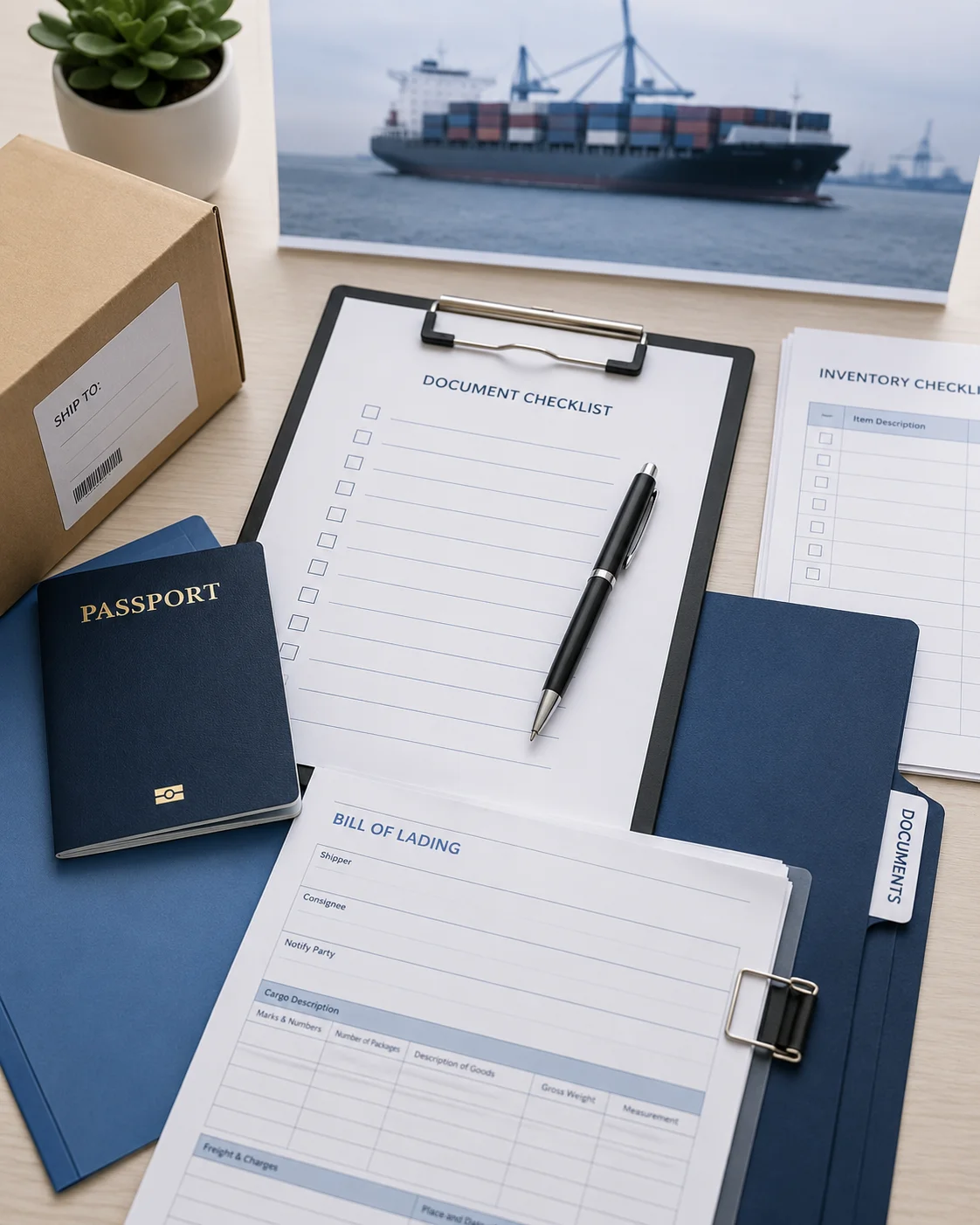
Documents required for importing used household goods, personal effects, and related shipments.
Provided by the shipper:
Provided by the origin agent:
OBL/AWB marking requirements:
- Original passport (with immigration entry/exit stamps — see below)
- Original Thai ID card (Thai nationals)
- Non-Immigrant B (business) visa valid for one year, or Residence Visa valid for one year (foreign nationals)
- Work Permit valid for one year (foreign nationals) — or Smart Visa reference number for Smart Visa holders
- Expired visa from abroad showing duration of overseas residence (returning Thai nationals)
- Legible copy of packing inventory in English
- Original Bill of Lading (if not surrendered/express released) or Airway Bill
- Sea shipments: must be marked "Used Household Goods & Personal Effects"
- Air shipments: must be marked "Used Personal Effects" only — do not describe as "Household Goods" or "Household Effects" on the AWB
- "Marks and Numbers" field on the OBL must show the consignee's name — cannot be left blank or marked "No Marks" (THB 1,500 fine if incomplete)
- All shipments (except diplomatic) must be consigned to the shipper's full name exactly as shown in the passport, with title (Mr./Mrs./Ms./Miss) in front, c/o the removal company's address
Specific Information
Smart Visa holders: Only a full one-year Smart Visa qualifies for the duty exemption, with a maximum weight limit of 3,500 kg. Original passport and original confirmation letter from the Smart Visa Office are required.
Visa types that do NOT qualify for duty-free entry: Visa type O, O-A (Retirement or Guardian), Elite Visa, ED (Education Visa), tourist visa, and all other categories not listed above. Holders of these visa types must pay full duties on all household goods.
Important passport stamping rule: Both foreign nationals and returning Thai nationals must not use the electronic (automated) lane when departing the origin country or when arriving at Suvarnabhumi International Airport. A physical immigration stamp must be obtained. If an electronic lane was used on a previous visit, a full immigration travel record must be obtained from the Central Immigration Department in Bangkok before clearance.
General conditions for duty-free entry (all qualifying importers):
Wedding gifts: Subject to duties per the applicable tariff.
Inheritance: Subject to duties unless Thai citizens can satisfy government residence requirements.
- The shipment must originate from the same country as the shipper's last place of residence or work
- All items must be used (not new)
- Only one of each type of electrical appliance is permitted duty-free; duplicate appliances are charged full duties
- Only one air shipment and one sea shipment per person are permitted duty-free; any additional shipments are fully dutiable
- The shipment must arrive after the shipper's arrival in Thailand but no later than 6 months from the date of first arrival
- The shipper does not need to be physically present at Customs, but the original passport must be presented to Customs during inspection
- Household effects under 6 months old are subject to duties (i.e., the items must have been in the shipper's possession for at least 6 months)
A 7% VAT applies to all service invoices issued in Thailand.
Duties & Taxes
Duty-free eligibility for foreign nationals: The shipper must hold a one-year Non-Immigrant B (business) visa and a valid one-year Work Permit at the time of shipment arrival. Without the one-year work permit, the shipment is dutiable. A bond facility is not available pending work permit issuance.
Duty-free eligibility for returning Thai nationals: The shipper must have lived abroad continuously for more than 12 months, must never have previously imported goods into Thailand, and must have lived in the origin country for at least 12 months continuously. Each stay in Thailand during the overseas period must not exceed 3 months per visit, and Thai Customs must see immigration entry/exit stamps in the passport. Frequent travel back and forth between Thailand and the origin country may cause Customs to deny the exemption.
New furniture and household goods: Subject to duties — for example, wooden furniture attracts 28.40% of CIF value.
Prohibited & Restricted Items
Prohibited Items
- Firearms and ammunition (without specific authorization from the Ministry of Interior) `PERMIT REQUIRED`
- Narcotics and illegal drugs
- Pornographic or obscene material
- Shortwave radios
- Counterfeit currency, bonds, and coins
- Medical equipment (without a licence)
- Gold and silver (above permitted personal quantities)
- Buddha heads and incomplete Buddha figures
- Alcohol (for private non-diplomatic importers without a licensed import permit)
- American Pit Bull Terriers and Staffordshire Bull Terriers (live animals)
- Wildlife products covered by CITES (ivory, skins, etc.) `CITES`
Restricted / Dutiable Items
The following items are dutiable and will not receive duty exemption under any circumstances — including in air shipments where Customs apply stricter scrutiny:
- Toys and baby items
- PC games
- Office items (files, documents, office equipment)
- Bicycles (49.80% of CIF)
- Exercise and sports equipment
- Golf sets
- Musical instruments
- Luxury goods (crystal, porcelain, carpets)
- Fax machines and telecommunications equipment
Wine and alcohol: Subject to duty of 330%+. An import permit from the Excise Department is required and is effectively unavailable to private individuals — it is only granted to licensed importers. Thai Customs regulations on alcohol are extremely strict. Including alcohol in a shipment is not recommended; it will cause significant delays and expense.
Food: Subject to duty of approximately 37%; import permit required.
Tins: Subject to approximately 72% duty; import permit required.
Fine Arts and Buddhist items: Must be pre-registered with the Thai Fine Arts Department before importation. Photos of items and their dimensions are required. Some Asian antiques and religious artifacts require a Fine Arts Dept. permit for both import and re-export. Do not include in air shipments.
Antiques: Must appear on the packing list with photos. Specify on import documentation to facilitate eventual re-export. Do not include in air shipments.
Buddha statues and religious items: Require import permits and Fine Arts Department pre-clearance. Buddha heads or incomplete Buddha figures are prohibited — only full-figure statues may be permitted. This is a sensitive area with Thai Customs; send photos to the destination agent before packing.
Wildlife and protected species: Firearms, wild flora and fauna, animal skins, and trophies require special import licensing and should not be included without prior consultation with the destination agent.
Plants: Prohibited items include certain plants, fruits, and plant products from many countries. Enquire in advance with the Thai Consulate or DLD.
Importing a Used Personal Vehicle
Specific Information
Private importation of automobiles and motorcycles is prohibited for non-diplomatic importers following MOC announcements in 2019 and 2021. Import licenses are no longer granted to private individuals. Non-diplomatic importers should not attempt to ship personal vehicles to Thailand.
Diplomatic importers with DP1 documentation may import vehicles duty-free. Diplomats wishing to import wine and alcohol alongside their shipment must separately obtain permission from their local embassy before the import is permitted.
Bicycles are subject to duty at 49.80% of CIF value. Water vehicles are subject to import tax and duties; consult the destination agent before shipping. Do not include bicycles in air shipments.
Re-registering an imported vehicle in Thailand is the responsibility of the owner.
Pets
- Import permit from the Department of Livestock Development (DLD) — must be applied for 7–10 working days in advance; apply by sending photocopies of all documents to the destination agent before the pet travels
- Rabies vaccination certificate (vaccination must be administered not less than 21 days and not more than 12 months before arrival)
- Government-issued health certificate (export permit) from the country of origin — completed by a government veterinarian; copies must be sent to the agent prior to the pet's arrival at the airport
- Owner's original passport
- Airway Bill
- Colour photo of the pet
- ISO 11784/11785-compliant microchip certificate (strongly recommended)
- All documents must be in English
No quarantine is imposed if all requirements are met. Pets not meeting requirements will be quarantined, returned, or euthanized at the owner's expense.
It is strongly recommended to send pets as excess baggage rather than air cargo — excess baggage pets are generally not subject to Customs clearance and no duty applies. Pets sent as air cargo are subject to full Customs clearance and a 30% import duty based on CIF value assessed by Thai Customs.
If the pet arrives after 4 p.m., special Customs clearance can be arranged, provided the destination agent is given flight details at least 48 hours in advance.
The pet must be at least 4 months old. Only cats and dogs are covered by the standard import procedure described here.
Prohibited breeds: American Pit Bull Terrier and Staffordshire Bull Terrier cannot be imported.
Special Categories
Documents Required (Diplomatic only)
- Passport copy
- DP1 diplomatic documents
- Original Bill of Lading, Sea Waybill, or Express BL
- Vehicle details: make, model, year, color, engine number, chassis number
- Export vehicle documents and export vehicle inspection
Consignment Instructions
Contact the destination agent to ensure all requirements have been met prior to import, especially for differences between FCL sea, LCL sea, and air shipments.
Passport stamping is critical — both at departure from the origin country and on arrival in Thailand. Do not use electronic/automated immigration lanes. Without physical immigration stamps, Customs may deny the duty-free exemption entirely.
All shipments must be consigned correctly (full name with title, c/o removal company) and marked correctly on the OBL or AWB. Incorrect marking results in fines and clearance delays.
Do not include in air shipments: alcohol, food, Buddha items, Fine Art, liquid soap/shampoo, toys, cosmetics, prescription medicines, bicycles, sports gear, carpets, antiques, or large quantities of electronics. Air Customs are significantly stricter than sea Customs and will tax dutiable items at full rates.
For diplomatic shipments, DP1 processing by the embassy takes 1–4 weeks after the shipment arrives. Port storage and demurrage will accrue during this period; plan accordingly.
The destination agent must have the client's actual original passport for clearance of all non-diplomatic shipments.
Cultural & Other Information
Thailand — officially the Kingdom of Thailand — is a country in Southeast Asia bordered by Myanmar, Laos, Cambodia, and Malaysia. It has a population of approximately 72 million. The capital and main port of entry is Bangkok (Suvarnabhumi International Airport and Laem Chabang Port). Thai is the official language. The currency is the Thai Baht (THB).
Thailand is a constitutional monarchy with a deep reverence for the monarchy and Buddhist traditions. It is a major hub for expatriate relocation in Southeast Asia. The economy is export-driven with strong tourism, manufacturing, and agricultural sectors. Buddhism is the dominant religion and its practices, including restrictions on Buddha imagery, are reflected in customs regulations.
Useful resources