

Country Guides
Tunisia

Explore sections
Guide Details
Household Goods
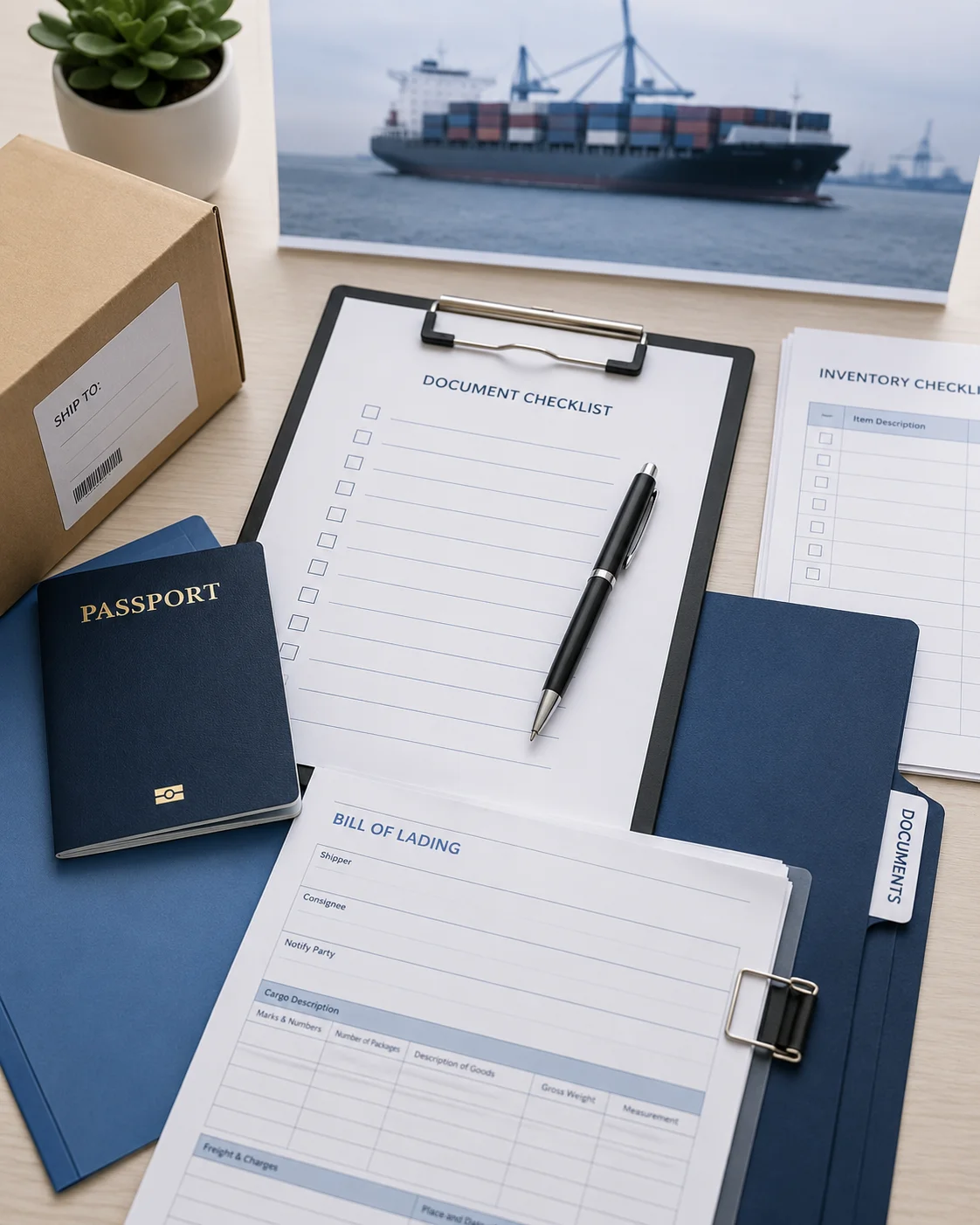
Documents
Documents required for importing used household goods, personal effects, and related shipments.
- Original passport
- Original Bill of Lading, Express Release, or Airway Bill — an advance copy must be sent to the destination agent with the shipper's name matching the passport exactly
- Detailed inventory of all appliances (not valued); appliances must list make, model, and serial number
- Packing list (in French for diplomatic shipments; forwarded to the destination agent in advance with a copy of the OBL to avoid delays)
- Original Residence Permit, duly approved by the Ministry of Interior
- Original Work Permit, duly approved by the Ministry of Employment
- Original ID card (for both spouses if married)
- Packing list in French
- Diplomatic Franchise/Exemption, approved by both the Ministry of Foreign Affairs and the Customs Administration — the diplomat must be present in Tunisia at least 2–3 weeks before the shipment arrives to be accredited; the full approval process takes approximately 1 month
- Authorizations from the Ministry of Tourism permitting the customer to have a secondary residence
- Proof of purchase from the appropriate government office
- Sales contract for the secondary residence
- Title of ownership, Residence Permit
- Residence Permit
- Proof of financial resources through a local Tunisian bank
Specific Information
Tunisian Customs distinguishes between expatriates working for the Export/Offshore market and those working for the local market.
Expatriates working for the Export/Offshore sector: goods cleared duty-free on a temporary franchise basis. All items previously imported must be re-exported upon departure. Valuable articles should be declared on arrival to ensure smooth re-export later.
Expatriates working for the local market: full duties and taxes apply.
All shipments (except diplomatic) are subject to physical inspection at the point of entry. The shipper must be present for Customs clearance. Diplomats are exempt from both inspection and the presence requirement.
If the Work Permit or Residence Permit is not available at the time of clearance, port storage and container demurrage charges will accrue. If the Residence Permit is unavailable, Customs may accept a temporary importation arrangement backed by a bank deposit, valid for 12 months. The deposit is cancelled upon presentation of the final Residence Permit within the allowed period.
Retired persons renting (rather than owning) their residence are subject to duties and taxes; it is advisable to limit shipment volume to no more than one 20-foot container.
Baggage is cleared at the first airport of entry in Tunisia. Passengers in transit at Tunis–Carthage Airport (TUN) holding onward tickets to a destination outside Tunisia are exempt.
Prohibited & Restricted Items
Prohibited Items
- Drones and mini-drones
- Pornographic documents
- Counterfeit items
- Cultural artefacts and objects of cultural importance
- Henna
- Palm trees and any products thereof
- Explosive material
- Illegal drugs and narcotics
- Weapons, ammunition, and explosives (without specific authorization) `PERMIT REQUIRED`
- Boerboel, Pitbull, Rottweiler, and Tosa dog breeds
- Falcons
Restricted / Dutiable Items
- Appliances, electronics, and computers: one of each item is allowed duty-free; make, model, and serial number must be listed on the detailed inventory for every appliance
- New items: dutiable regardless of overall shipment exemption status
- Plants: phytosanitary certificate required
- Perfume: reasonable personal quantity permitted
- Alcohol: 1 litre of spirits (over 25% ABV) or 2 litres of lighter beverages (up to 25% ABV); the same restrictions apply to diplomats, who should verify their personal allowance with their embassy before shipping
- Tobacco: 200 cigarettes or 50 cigars or 100 cigarillos or 500g of tobacco (no age restriction specified)
- Satellite receivers, fax machines, walkie-talkies, and telephones: subject to possible temporary hold by Customs; entry permitted only with authorization from the appropriate authorities
- Medications: restricted; may require authorization
- Live animals: health certificate and complete valid vaccinations required; contact the nearest embassy to obtain permission
- Hunting weapons: permissible with authorization from the Ministry of Interior; contact nearest embassy
- Tunisian Dinar (TND): cash importation permitted only with prior permission from the nearest embassy
- Foreign currency: must be declared on arrival if exceeding TND 5,000 equivalent (foreigners) or TND 25,000 equivalent (residents)
- CITES-protected species: may be imported only with CITES permission `CITES`
Importing a Used Personal Vehicle
Required Documents
- Owner's passport
- Original Bill of Lading
- Original registration and insurance certificates (in the shipper's name)
Specific Information
The shipper must be present for Customs clearance. Vehicles are subject to inspection; the report must include the engine number and vehicle type. Vehicle details must be stamped on the importer's passport.
The owner may temporarily drive the vehicle for up to 3 months while clearance is in progress.
Contact the destination agent to confirm current duty rates applicable to the vehicle before shipping.
Pets
- Official health certificate from the veterinary authorities in the country of origin, stating that no contagious diseases of animals occurred at the place of origin for at least 6 weeks before shipment
- Rabies vaccination certificate (for dogs and cats), issued between 1 and 6 months before arrival in Tunisia
- Vaccination record
No quarantine is imposed for healthy animals meeting requirements. Animals are subject to veterinary examination upon arrival.
The following breeds are prohibited from entry into Tunisia: Boerboel, Pitbull, Rottweiler, and Tosa. Falcons are also prohibited.
The health certificate must specifically confirm that the animal has been free from contagious disease for at least 6 weeks before shipment. Contact the nearest Tunisian embassy to confirm any additional country-specific requirements for the import permit.
Consignment Instructions
Contact the destination agent to ensure all requirements have been met prior to import, especially for differences between air and sea shipments.
An advance copy of the OBL or AWB must be sent to the destination agent before the shipment arrives. The shipper's name must match the passport exactly on all documents.
The shipper must be present for Customs clearance of all non-diplomatic shipments. For diplomatic shipments, the diplomat must be in Tunisia at least 2–3 weeks before the shipment arrives; the full diplomatic franchise approval process takes approximately 1 month.
If work or residence permits are not in hand at the time of clearance, port storage and demurrage will accrue. All valuable articles should be declared upon arrival to ensure they can be re-exported without issue later.
Cultural & Other Information
Tunisia — officially the Republic of Tunisia — is a North African country at the tip of the Maghreb region, bordered by Algeria to the west, Libya to the southeast, and the Mediterranean Sea to the north and east. It has a population of approximately 12 million. The capital is Tunis. Arabic is the official language; French is widely used in business and government. The currency is the Tunisian Dinar (TND).
Tunisia is one of the more economically developed countries in Africa, with a diversified economy based on tourism, manufacturing, agriculture, and hydrocarbons. The country underwent a democratic transition after the 2011 Arab Spring revolution, though political conditions have evolved significantly since 2021.
- Tunisia — OpenFactBook
- Tunisia — Wikipedia
- Tunisian Customs (Direction Générale des Douanes) *(WAF-protected; accessible in browser)*
- Ministry of Foreign Affairs — Tunisia *(WAF-protected; accessible in browser)*
- EmbassyPages — Tunisia *(WAF-protected; accessible in browser)*
- PetTravel.com — Tunisia Pet Import Requirements
Useful resources